7Z53 image
Deposition Date 2022-03-07
Release Date 2022-10-26
Last Version Date 2025-10-01
Entry Detail
PDB ID:
7Z53
Keywords:
Title:
Structure of native leukocyte myeloperoxidase in complex with a truncated version (SPIN truncated) of the Staphyloccal Peroxidase Inhibitor SPIN from Staphylococcus aureus
Biological Source:
Source Organism:
Host Organism:
Method Details:
Experimental Method:
Resolution:
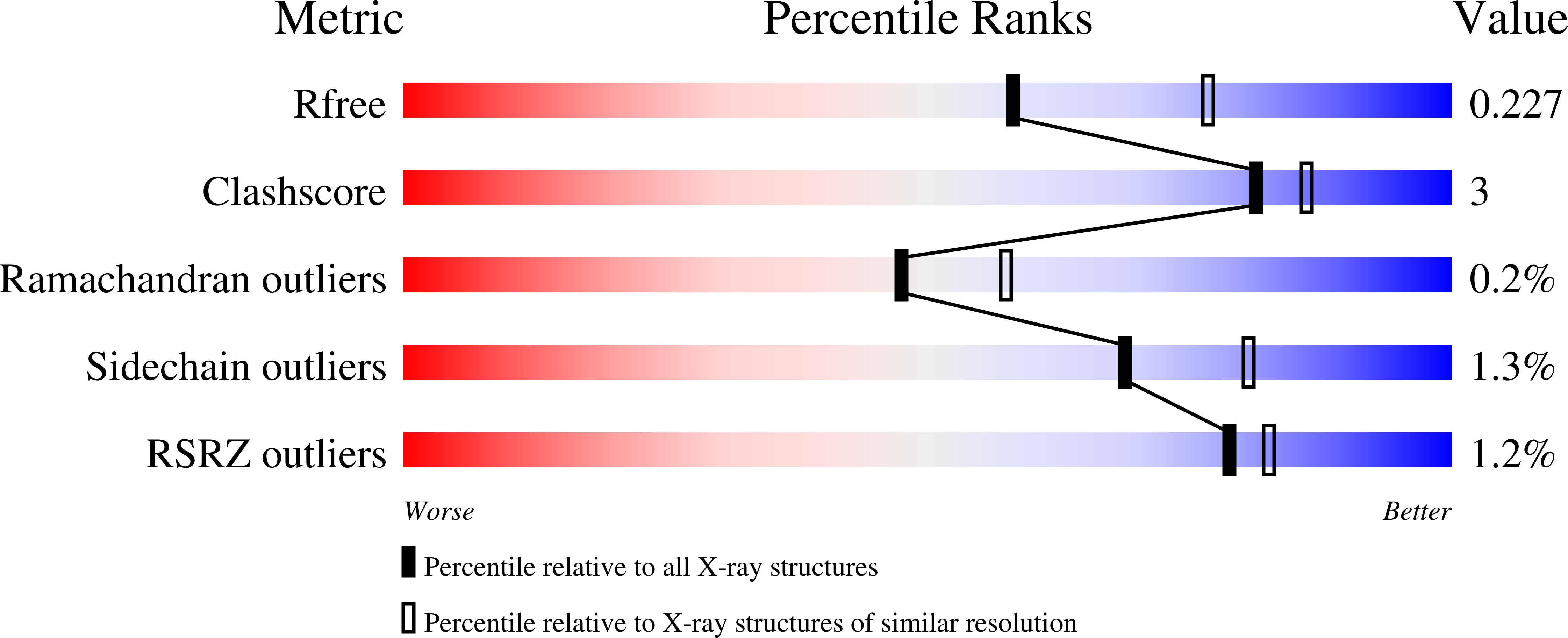
2.28 Å
R-Value Free:
0.22
R-Value Work:
0.17
R-Value Observed:
0.17
Space Group:
P 21 21 2
Macromolecular Entities
Structures with similar UniProt ID
Protein Blast
Polymer Type:polypeptide(L)
Molecule:Myeloperoxidase light chain
Gene (Uniprot):MPO
Chain IDs:A, C, G, I, M, O, S, U
Chain Length:106
Number of Molecules:8
Biological Source:Homo sapiens
Structures with similar UniProt ID
Protein Blast
Polymer Type:polypeptide(L)
Molecule:Myeloperoxidase heavy chain
Gene (Uniprot):MPO
Chain IDs:B, D, H, J, N, P, T, V
Chain Length:466
Number of Molecules:8
Biological Source:Homo sapiens
Structures with similar UniProt ID
Protein Blast
Polymer Type:polypeptide(L)
Molecule:Myeloperoxidase inhibitor SPIN
Chain IDs:E, F, K, L, Q, R, W, X
Chain Length:59
Number of Molecules:8
Biological Source:Staphylococcus aureus
Modified Residue
Compound ID Chain ID Parent Comp ID Details 2D Image
CSO B CYS modified residue
Primary Citation
The staphylococcal inhibitory protein SPIN binds to human myeloperoxidase with picomolar affinity but only dampens halide oxidation.
J.Biol.Chem. 298 102514 102514 (2022)
PMID: 36150500 DOI: 10.1016/j.jbc.2022.102514

Abstact

The heme enzyme myeloperoxidase (MPO) is one of the key players in the neutrophil-mediated killing of invading pathogens as part of the innate immune system. MPO generates antimicrobial oxidants, which indiscriminately and effectively kill phagocytosed pathogens. Staphylococcus aureus, however, is able to escape this fate, in part by secreting a small protein called SPIN (Staphylococcal Peroxidase Inhibitor), which specifically targets and inhibits MPO in a structurally complex manner. Here, we present the first crystal structures of the complex of SPIN-aureus and a truncated version (SPIN-truncated) with mature dimeric leukocyte MPO. We unravel the contributions of the two domains to the kinetics and thermodynamics of SPIN-aureus binding to MPO by using a broad array of complementary biochemical and biophysical methods. The C-terminal "recognition" domain is shown to mediate specific binding to MPO, while interaction of the N-terminal "inhibitory" domain is guided mainly by hydrophobic effects and thus is less sequence dependent. We found that inhibition of MPO is achieved by reducing substrate migration, but SPIN-aureus cannot completely block MPO activity. Its' effectiveness is inversely related to substrate size, with no discernible dependence on other factors. Thus, SPIN-aureus is an extremely high-affinity inhibitor and highly efficient for substrates larger than halogens. As aberrant MPO activity is implicated in a number of chronic inflammatory diseases, SPIN-aureus is the first promising protein inhibitor for specific inhibition of human MPO.

Legend

Protein

Chemical

Disease

Primary Citation of related structures
Feedback Form
Name
Email
Institute
Feedback