7Z3A image
Deposition Date 2022-03-02
Release Date 2022-08-10
Last Version Date 2025-07-02
Entry Detail
PDB ID:
7Z3A
Keywords:
Title:
AMC009 SOSIPv5.2 in complex with Fabs ACS101 and ACS124
Biological Source:
Source Organism:
Host Organism:
Method Details:
Experimental Method:
Resolution:
3.95 Å
Aggregation State:
PARTICLE
Reconstruction Method:
SINGLE PARTICLE
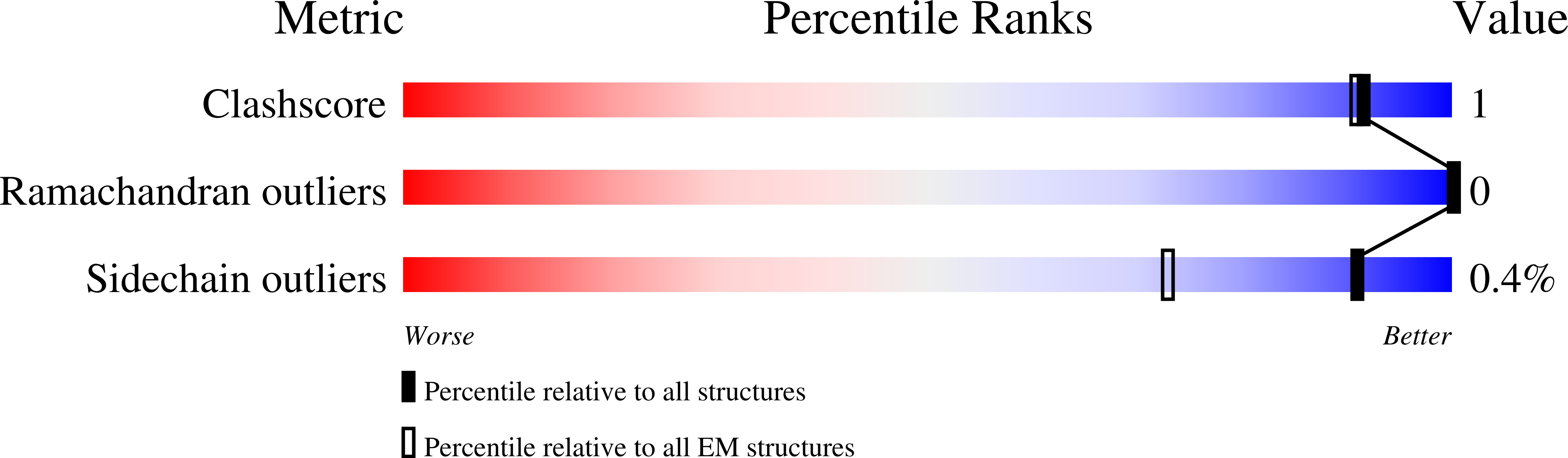
Macromolecular Entities
Polymer Type:polypeptide(L)
Molecule:AMC009 SOSIPv5.2 envelope glycoprotein gp120
Chain IDs:A, C, E (auth: D)
Chain Length:482
Number of Molecules:3
Biological Source:Human immunodeficiency virus 1
Polymer Type:polypeptide(L)
Molecule:AMC009 SOSIP.v5.2 envelope glycoprotein gp41
Chain IDs:B, D (auth: E), F
Chain Length:154
Number of Molecules:3
Biological Source:Human immunodeficiency virus 1
Polymer Type:polypeptide(L)
Molecule:ACS124 heavy chain
Chain IDs:G, K (auth: M)
Chain Length:124
Number of Molecules:2
Biological Source:Homo sapiens
Polymer Type:polypeptide(L)
Molecule:ACS101 heavy chain
Chain IDs:I (auth: H), M (auth: J), O (auth: K)
Chain Length:126
Number of Molecules:3
Biological Source:Homo sapiens
Polymer Type:polypeptide(L)
Molecule:ACS124 light chain
Chain IDs:H (auth: I), L (auth: O)
Chain Length:108
Number of Molecules:2
Biological Source:Homo sapiens
Polymer Type:polypeptide(L)
Molecule:ACS101 light chain
Chain IDs:J (auth: L), N, P
Chain Length:108
Number of Molecules:3
Biological Source:Homo sapiens
Ligand Molecules
Primary Citation

Abstact

A major goal of current HIV-1 vaccine design efforts is to induce broadly neutralizing antibodies (bNAbs). The VH1-2-derived bNAb IOMA directed to the CD4-binding site of the HIV-1 envelope glycoprotein is of interest because, unlike the better-known VH1-2-derived VRC01-class bNAbs, it does not require a rare short light chain complementarity-determining region 3 (CDRL3). Here, we describe three IOMA-class NAbs, ACS101-103, with up to 37% breadth, that share many characteristics with IOMA, including an average-length CDRL3. Cryo-electron microscopy revealed that ACS101 shares interactions with those observed with other VH1-2 and VH1-46-class bNAbs, but exhibits a unique binding mode to residues in loop D. Analysis of longitudinal sequences from the patient suggests that a transmitter/founder-virus lacking the N276 glycan might have initiated the development of these NAbs. Together these data strengthen the rationale for germline-targeting vaccination strategies to induce IOMA-class bNAbs and provide a wealth of sequence and structural information to support such strategies.

Legend

Protein

Chemical

Disease

Primary Citation of related structures
Feedback Form
Name
Email
Institute
Feedback