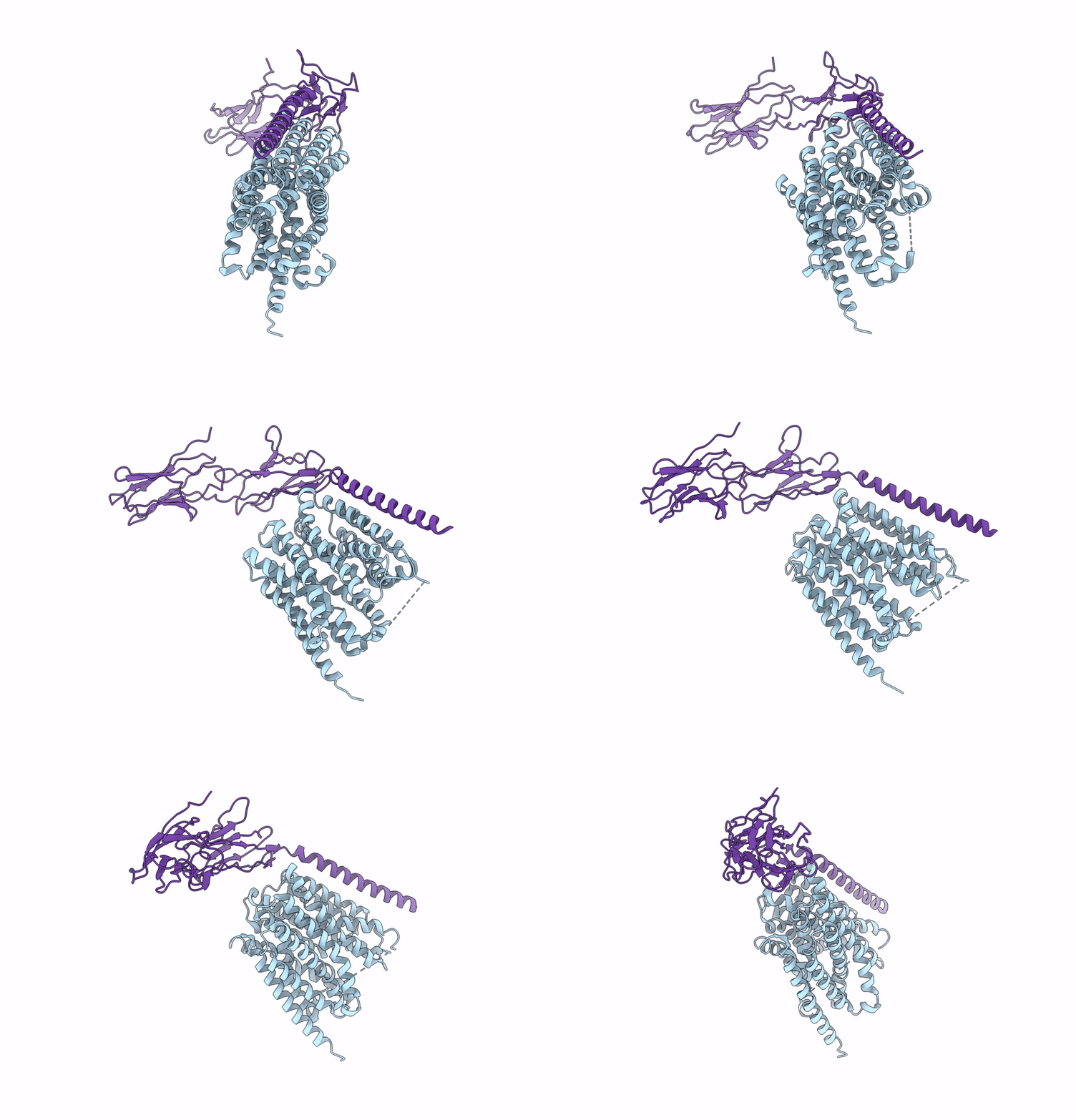
7YR5 image
Deposition Date 2022-08-08
Release Date 2022-09-28
Last Version Date 2024-10-16
Entry Detail
PDB ID:
7YR5
Title:
Embigin facilitates monocarboxylate transporter 1 localization to plasma membrane and transition to a decoupling state
Biological Source:
Source Organism:
Homo sapiens (Taxon ID: 9606)
Method Details:
Experimental Method:
Resolution:
3.63 Å
Aggregation State:
PARTICLE
Reconstruction Method:
SINGLE PARTICLE

Macromolecular Entities
Structures with similar UniProt ID
Protein Blast
Polymer Type:polypeptide(L)
Molecule:Monocarboxylate transporter 1
Gene (Uniprot):SLC16A1
Chain IDs:B (auth: A)
Chain Length:508
Number of Molecules:1
Biological Source:Homo sapiens
Structures with similar UniProt ID
Protein Blast
Polymer Type:polypeptide(L)
Molecule:Embigin
Gene (Uniprot):EMB
Chain IDs:A (auth: B)
Chain Length:327
Number of Molecules:1
Biological Source:Homo sapiens
Ligand Molecules
Primary Citation
Embigin facilitates monocarboxylate transporter 1 localization to the plasma membrane and transition to a decoupling state.
Cell Rep 40 111343 111343 (2022)
PMID: 36103816 DOI: 10.1016/j.celrep.2022.111343

Abstact

Cell-surface ancillary glycoproteins basigin or embigin form heterodimeric complexes with proton-coupled monocarboxylate transporters (MCTs), facilitating the membrane trafficking of MCTs and regulating their transport activities. Here, we determine the cryoelectron microscopy (cryo-EM) structure of the human MCT1-embigin complex and observe that embigin forms extensive interactions with MCT1 to facilitate its localization to the plasma membrane. In addition, the formation of the heterodimer effectively blocks MCT1 from forming a homodimer through a steric hindrance effect, releasing the coupling between two signature motifs and driving a significant conformation change in transmembrane helix 5 (TM5) of MCTs. Consequently, the substrate-binding pocket alternates between states of homodimeric coupling and heterodimeric decoupling states and exhibits differences in substrate-binding affinity, supporting the hypothesis that the substrate-induced motion originating in one subunit of the MCT dimer could be transmitted to the adjacent subunit to alter its substrate-binding affinity.

Legend

Protein

Chemical

Disease

Primary Citation of related structures
Feedback Form
Name
Email
Institute
Feedback