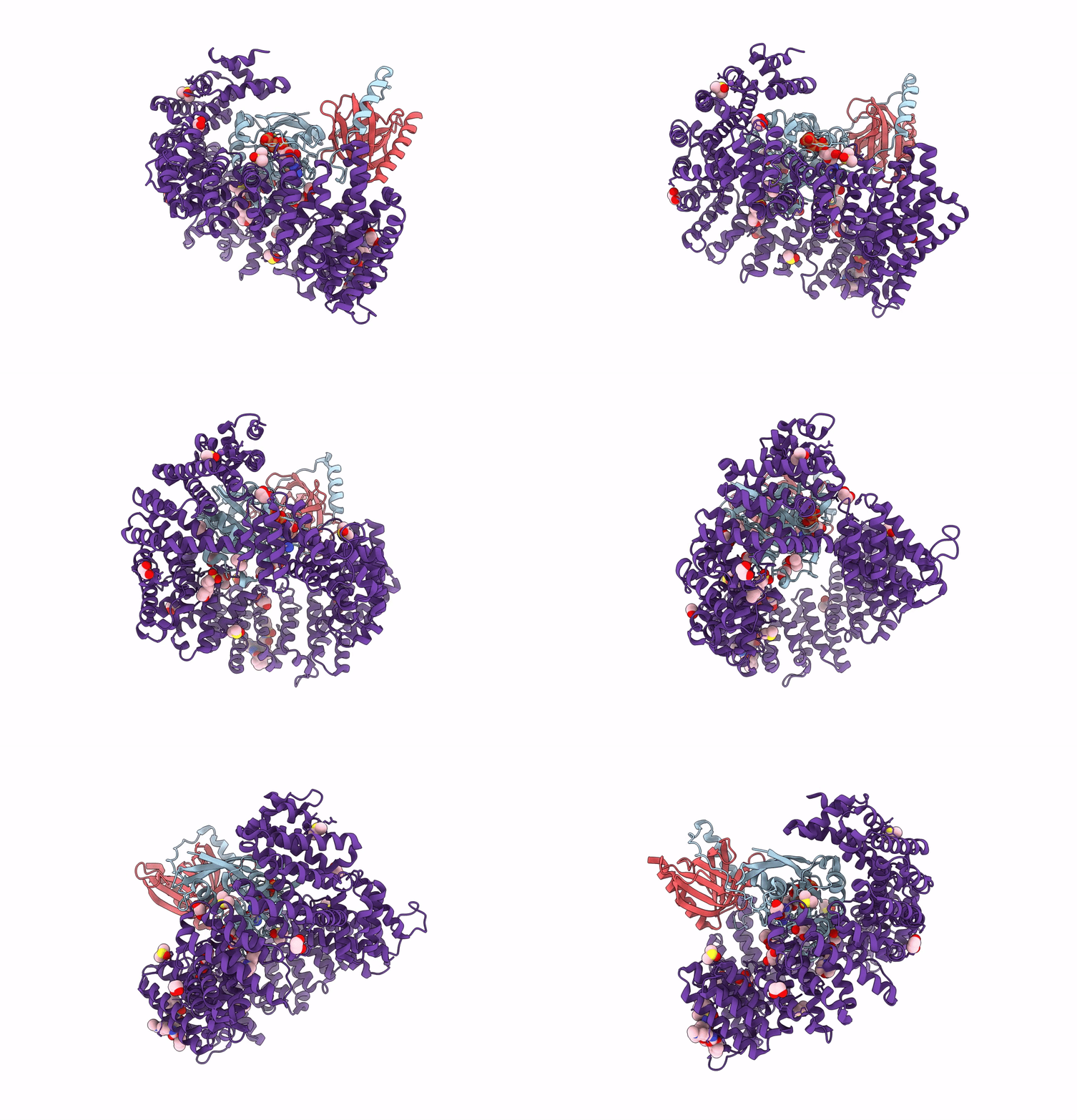
7YPZ image
Deposition Date 2022-08-05
Release Date 2023-08-16
Last Version Date 2024-05-08
Entry Detail
PDB ID:
7YPZ
Title:
Zafirlukast in complex with CRM1-Ran-RanBP1
Biological Source:
Source Organism:
Host Organism:
Method Details:
Experimental Method:
Resolution:
2.15 Å
R-Value Free:
0.21
R-Value Work:
0.18
R-Value Observed:
0.18
Space Group:
P 43 21 2
Macromolecular Entities
Structures with similar UniProt ID
Protein Blast
Polymer Type:polypeptide(L)
Molecule:GTP-binding nuclear protein Ran
Gene (Uniprot):RAN
Mutagens:Q69L, L182A
Chain IDs:A
Chain Length:216
Number of Molecules:1
Biological Source:Homo sapiens
Structures with similar UniProt ID
Protein Blast
Polymer Type:polypeptide(L)
Molecule:YRB1 isoform 1
Chain IDs:B
Chain Length:140
Number of Molecules:1
Biological Source:Saccharomyces cerevisiae
Structures with similar UniProt ID
Protein Blast
Polymer Type:polypeptide(L)
Molecule:CRM1 isoform 1
Mutagens:S27E , Q49E, A51V, del377-413, del441-461, D537G, T539C, V540E, K541Q, S553R, Q561E, A741T, Y1022C
Chain IDs:C
Chain Length:1003
Number of Molecules:1
Biological Source:Saccharomyces cerevisiae
Primary Citation
Searching for Novel Noncovalent Nuclear Export Inhibitors through a Drug Repurposing Approach.
J.Med.Chem. 66 1574 1582 (2023)
PMID: 36622814 DOI: 10.1021/acs.jmedchem.2c01772

Abstact

Chromosomal region maintenance protein 1 (CRM1) is a validated anticancer drug target, and its covalent inhibitor KPT-330 has been approved for marketing. However, the development of CRM1 inhibitors, especially the noncovalent ones, is still very limited. Drug repurposing is an effective strategy to develop drug leads for new targets. In this work, we virtually screened a library of marketed drugs and identified zafirlukast as a new CRM1 inhibitor. Biochemical and structural analysis revealed that zafirlukast was a noncovalent CRM1 inhibitor that bound to four subpockets in the nuclear-export-signal (NES) groove. Methylation of the sulfonamide group rendered zafirlukast completely inactive against CRM1. Zafirlukast inhibited the growth of a variety of cancer cells and worked synergistically with the drug doxorubicin. Taken together, these works laid a solid foundation for reshaping zafirlukast as a valuable lead compound for further design of noncovalent, specific, and potent CRM1 inhibitors toward the treatment of various cancers.

Legend

Protein

Chemical

Disease

Primary Citation of related structures
Feedback Form
Name
Email
Institute
Feedback