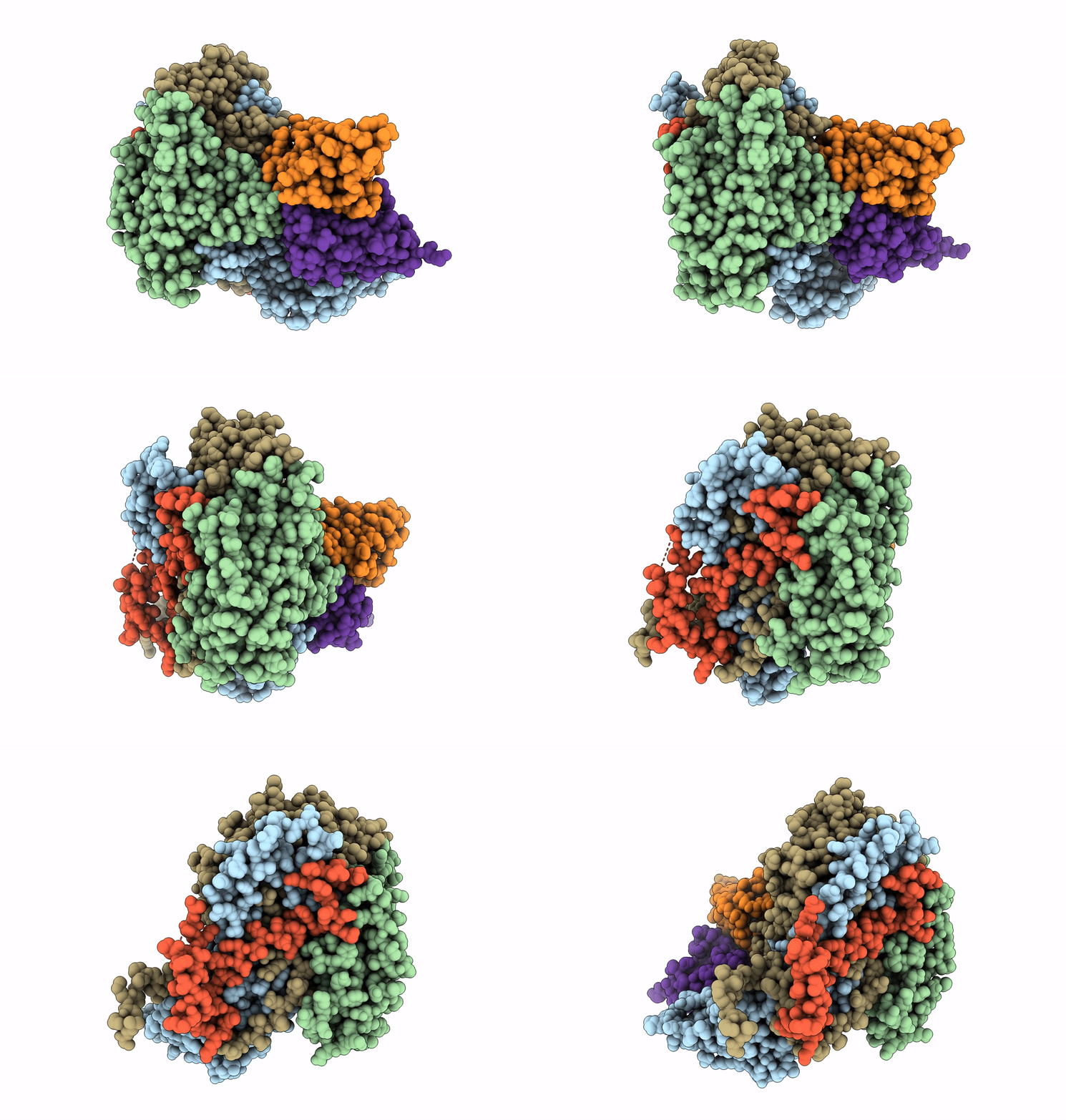
7X2T image
Deposition Date 2022-02-26
Release Date 2022-09-28
Last Version Date 2025-06-25
Entry Detail
PDB ID:
7X2T
Keywords:
Title:
Cryo-EM structure of Coxsackievirus B1 mature virion in complex with nAb 8A10 (CVB1-M:8A10)
Biological Source:
Source Organism:
Mus musculus (Taxon ID: 10090)
Coxsackievirus B1 (Taxon ID: 12071)
Method Details:
Experimental Method:
Resolution:
3.69 Å
Aggregation State:
PARTICLE
Reconstruction Method:
SINGLE PARTICLE

Macromolecular Entities
Structures with similar UniProt ID
Protein Blast
Polymer Type:polypeptide(L)
Molecule:Virion protein 1
Chain IDs:C (auth: A)
Chain Length:278
Number of Molecules:1
Biological Source:Coxsackievirus B1
Structures with similar UniProt ID
Protein Blast
Polymer Type:polypeptide(L)
Molecule:VP2
Chain IDs:D (auth: B)
Chain Length:263
Number of Molecules:1
Biological Source:Coxsackievirus B1
Structures with similar UniProt ID
Protein Blast
Polymer Type:polypeptide(L)
Molecule:VP3
Chain IDs:E (auth: C)
Chain Length:238
Number of Molecules:1
Biological Source:Coxsackievirus B1
Structures with similar UniProt ID
Protein Blast
Polymer Type:polypeptide(L)
Molecule:Capsid protein VP4
Chain IDs:F (auth: D)
Chain Length:69
Number of Molecules:1
Biological Source:Coxsackievirus B1
Polymer Type:polypeptide(L)
Molecule:8A10 heavy chain
Chain IDs:B (auth: H)
Chain Length:118
Number of Molecules:1
Biological Source:Mus musculus
Polymer Type:polypeptide(L)
Molecule:8A10 light chain
Chain IDs:A (auth: L)
Chain Length:108
Number of Molecules:1
Biological Source:Mus musculus
Ligand Molecules
Primary Citation
Structural basis for the synergistic neutralization of coxsackievirus B1 by a triple-antibody cocktail.
Cell Host Microbe 30 1279 ? (2022)
PMID: 36002016 DOI: 10.1016/j.chom.2022.08.001

Abstact

Coxsackievirus B1 (CVB1) is an emerging pathogen associated with severe neonatal diseases including aseptic meningitis, myocarditis, and pancreatitis and also with the development of type 1 diabetes. We characterize the binding and therapeutic efficacies of three CVB1-specific neutralizing antibodies (nAbs) identified for their ability to inhibit host receptor engagement. High-resolution cryo-EM structures showed that these antibodies recognize different epitopes but with an overlapping region in the capsid VP2 protein and specifically the highly variable EF loop. Moreover, they perturb capsid-receptor interactions by binding various viral particle forms. Antibody combinations achieve synergetic neutralization via a stepwise capsid transition and virion disruption, indicating dynamic changes in the virion in response to multiple nAbs targeting the receptor-binding site. Furthermore, this three-antibody cocktail protects against lethal challenge in neonatal mice and limits pancreatitis and viral replication in a non-obese diabetic mouse model. These results illustrate the utility of nAbs for rational design of therapeutics against picornaviruses such as CVB.

Legend

Protein

Chemical

Disease

Primary Citation of related structures
Feedback Form
Name
Email
Institute
Feedback