7WRW image
Deposition Date 2022-01-27
Release Date 2023-02-01
Last Version Date 2023-08-16
Entry Detail
PDB ID:
7WRW
Keywords:
Title:
Structure of Deinococcus radiodurans HerA
Biological Source:
Source Organism:
Host Organism:
Method Details:
Experimental Method:
Resolution:
3.00 Å
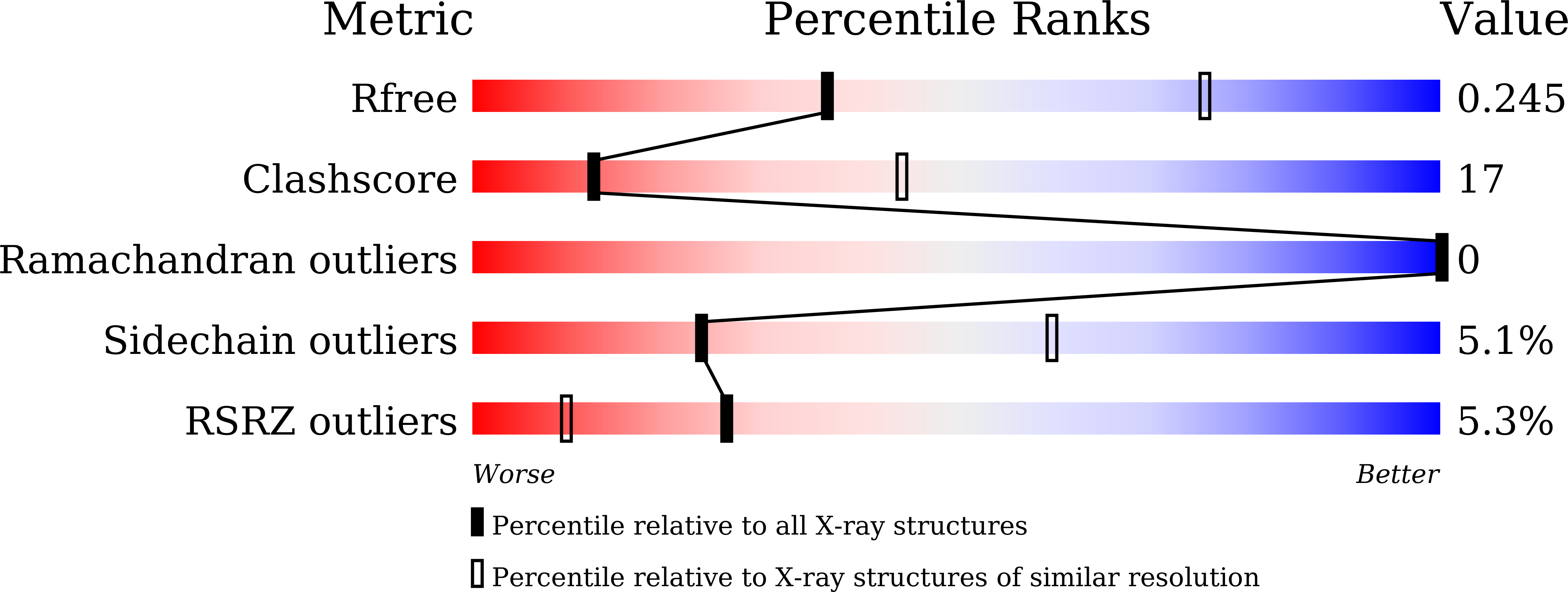
R-Value Free:
0.24
R-Value Work:
0.22
R-Value Observed:
0.22
Space Group:
P 32 2 1
Macromolecular Entities
Structures with similar UniProt ID
Protein Blast
Polymer Type:polypeptide(L)
Molecule:HerA
Gene (Uniprot):DR_0837
Chain IDs:A (auth: B), B (auth: C), C (auth: F), D, E, F (auth: A)
Chain Length:618
Number of Molecules:6
Biological Source:Deinococcus radiodurans
Ligand Molecules
Primary Citation
Structural and DNA end resection study of the bacterial NurA-HerA complex.
Bmc Biol. 21 42 42 (2023)
PMID: 36829173 DOI: 10.1186/s12915-023-01542-0

Abstact

BACKGROUND The nuclease NurA and the ATPase/translocase HerA play a vital role in repair of double-strand breaks (DSB) during the homologous recombination in archaea. A NurA-HerA complex is known to mediate DSB DNA end resection, leading to formation of a free 3' end used to search for the homologous sequence. Despite the structures of individual archaeal types of NurA and HerA having been reported, there is limited information regarding the molecular mechanisms underlying this process. Some bacteria also possess homologs of NurA and HerA; however, the bacterial type of this complex, as well as the detailed mechanisms underlying the joining of NurA-HerA in DSB DNA end resection, remains unclear. RESULTS We report for the first time the crystal structures of Deinococcus radiodurans HerA (drHerA) in the nucleotide-free and ADP-binding modes. A D. radiodurans NurA-HerA complex structure was constructed according to a low-resolution cryo-electron microscopy map. We performed site-directed mutagenesis to map the drNurA-HerA interaction sites, suggesting that their interaction is mainly mediated by ionic links, in contrast to previously characterized archaeal NurA-HerA interactions. The key residues responsible for the DNA translocation activity, DNA unwinding activity, and catalytic activities of the drNurA-HerA complex were identified. A HerA/FtsK-specific translocation-related motif (TR motif) that guarantees the processivity of double-stranded DNA (dsDNA) translocation was identified. Moreover, a mechanism for the translocation-regulated resection of the 5' tail of broken dsDNA and the corresponding generation of a recombinogenic 3' single-stranded DNA tail by the drNurA-HerA complex was elucidated. CONCLUSIONS Our work provides new insights into the mechanism underlying bacterial NurA-HerA-mediated DSB DNA end resection, and the way this complex digests the 5' tail of a DNA duplex and provides long 3' free end for strand invasion in the bacterial homologous recombination process.

Legend

Protein

Chemical

Disease

Primary Citation of related structures
Feedback Form
Name
Email
Institute
Feedback