7VOI image
Deposition Date 2021-10-13
Release Date 2022-06-01
Last Version Date 2023-11-29
Entry Detail
PDB ID:
7VOI
Keywords:
Title:
Structure of the human CNOT1(MIF4G)-CNOT6L-CNOT7 complex
Biological Source:
Source Organism:
Homo sapiens (Taxon ID: 9606)
Host Organism:
Method Details:
Experimental Method:
Resolution:
4.38 Å
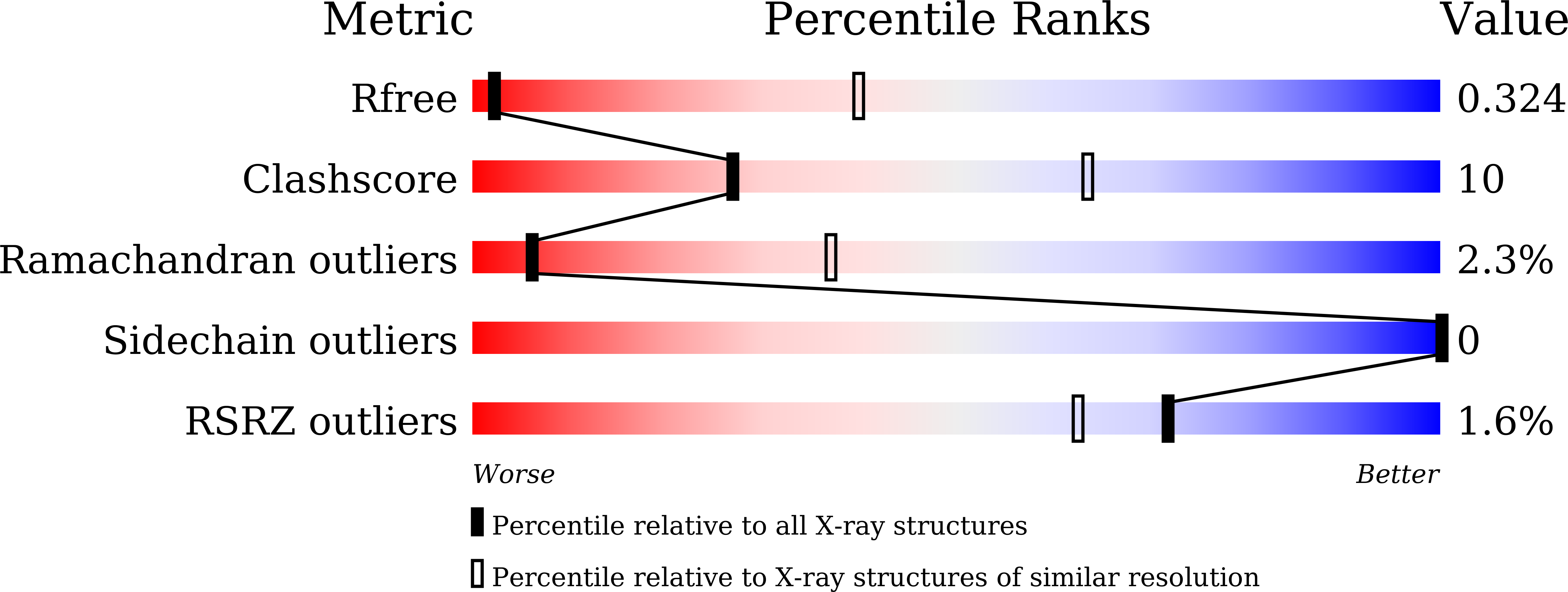
R-Value Free:
0.32
R-Value Work:
0.26
R-Value Observed:
0.26
Space Group:
P 41 21 2
Macromolecular Entities
Structures with similar UniProt ID
Protein Blast
Polymer Type:polypeptide(L)
Molecule:CCR4-NOT transcription complex subunit 1
Gene (Uniprot):CNOT1
Chain IDs:B (auth: A)
Chain Length:229
Number of Molecules:1
Biological Source:Homo sapiens
Structures with similar UniProt ID
Protein Blast
Polymer Type:polypeptide(L)
Molecule:CCR4-NOT transcription complex subunit 7
Gene (Uniprot):CNOT7
Chain IDs:A (auth: B)
Chain Length:285
Number of Molecules:1
Biological Source:Homo sapiens
Structures with similar UniProt ID
Protein Blast
Polymer Type:polypeptide(L)
Molecule:CCR4-NOT transcription complex subunit 6-like
Gene (Uniprot):CNOT6L
Chain IDs:C
Chain Length:555
Number of Molecules:1
Biological Source:Homo sapiens
Ligand Molecules
Primary Citation
Structure of the human Ccr4-Not nuclease module using X-ray crystallography and electron paramagnetic resonance spectroscopy distance measurements.
Protein Sci. 31 758 764 (2022)
PMID: 34923703 DOI: 10.1002/pro.4262

Abstact

Regulated degradation of mature, cytoplasmic mRNA is a key step in eukaryotic gene regulation. This process is typically initiated by the recruitment of deadenylase enzymes by cis-acting elements in the 3' untranslated region resulting in the shortening and removal of the 3' poly(A) tail of the target mRNA. The Ccr4-Not complex, a major eukaryotic deadenylase, contains two exoribonuclease subunits with selectivity toward poly(A): Caf1 and Ccr4. The Caf1 deadenylase subunit binds the MIF4G domain of the large subunit CNOT1 (Not1) that is the scaffold of the complex. The Ccr4 nuclease is connected to the complex via its leucine-rich repeat (LRR) domain, which binds Caf1, whereas the catalytic activity of Ccr4 is provided by its EEP domain. While the relative positions of the MIF4G domain of CNOT1, the Caf1 subunit, and the LRR domain of Ccr4 are clearly defined in current models, the position of the EEP nuclease domain of Ccr4 is ambiguous. Here, we use X-ray crystallography, the AlphaFold resource of predicted protein structures, and pulse electron paramagnetic resonance spectroscopy to determine and validate the position of the EEP nuclease domain of Ccr4 resulting in an improved model of the human Ccr4-Not nuclease module.

Legend

Protein

Chemical

Disease

Primary Citation of related structures
Feedback Form
Name
Email
Institute
Feedback