7VOE image
Deposition Date 2021-10-13
Release Date 2021-12-22
Last Version Date 2024-11-13
Entry Detail
PDB ID:
7VOE
Title:
Crystal structure of 5-HT2AR in complex with aripiprazole
Biological Source:
Source Organism:
Homo sapiens (Taxon ID: 9606)
Host Organism:
Method Details:
Experimental Method:
Resolution:
2.90 Å
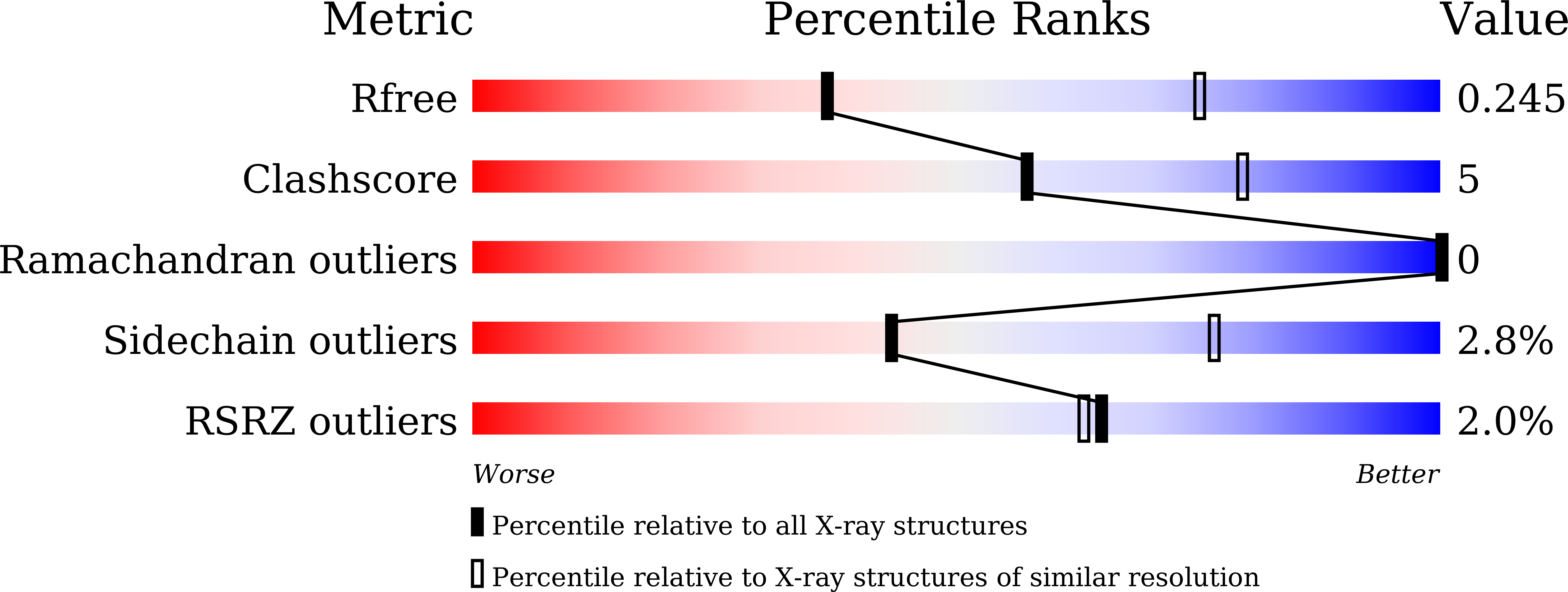
R-Value Free:
0.24
R-Value Work:
0.22
R-Value Observed:
0.22
Space Group:
P 21 2 21
Macromolecular Entities
Protein Blast
Polymer Type:polypeptide(L)
Molecule:5-hydroxytryptamine receptor 2A,Soluble cytochrome b562
Gene (Uniprot):cybC, HTR2A
Mutagens:S162K,N164W,M1007W,R1098I,H1102I,R1106G,S372N
Chain IDs:A
Chain Length:376
Number of Molecules:1
Biological Source:Homo sapiens
Primary Citation
Structure-based design of a novel third-generation antipsychotic drug lead with potential antidepressant properties.
Nat.Neurosci. 25 39 49 (2022)
PMID: 34887590 DOI: 10.1038/s41593-021-00971-w

Abstact

Partial agonist activity at the dopamine D2 receptor (DRD2) is a key feature of third-generation antipsychotics (TGAs). However, TGAs also act as antagonists or weak partial agonists to the serotonin (5-hydroxytryptamine; 5-HT) 2A receptor (5-HT2AR). Here we present the crystal structures of aripiprazole- and cariprazine-bound human 5-HT2AR. Both TGAs adopt an unexpected 'upside-down' pose in the 5-HT2AR binding pocket, with secondary pharmacophores inserted in a similar way to a 'bolt'. This insight into the binding modes of TGAs offered a structural mechanism underlying their varied partial efficacies at 5-HT2AR and DRD2. These structures enabled the design of a partial agonist at DRD2/3 and 5-HT1AR with negligible 5-HT2AR binding that displayed potent antipsychotic-like activity without motor side effects in mice. This TGA lead also had antidepressant-like effects and improved cognitive performance in mouse models via 5-HT1AR. This work indicates that 5-HT2AR affinity is a dispensable contributor to the therapeutic actions of TGAs.

Legend

Protein

Chemical

Disease

Primary Citation of related structures
Feedback Form
Name
Email
Institute
Feedback