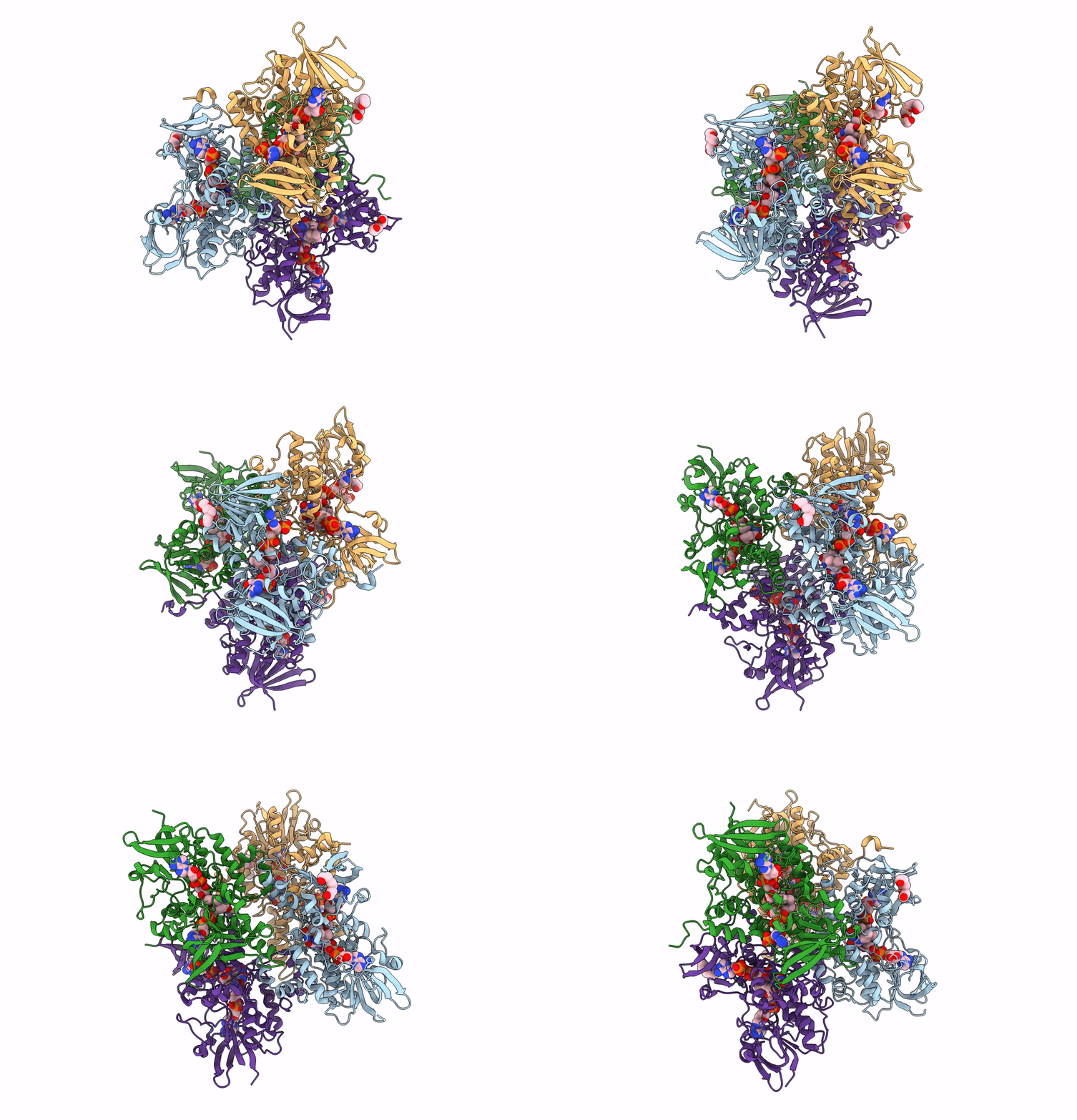
7US3 image
Deposition Date 2022-04-22
Release Date 2022-11-30
Last Version Date 2023-10-25
Entry Detail
PDB ID:
7US3
Keywords:
Title:
Structure of Putrescine N-hydroxylase Involved Complexed with NADP+
Biological Source:
Source Organism:
Host Organism:
Method Details:
Experimental Method:
Resolution:
2.20 Å
R-Value Free:
0.22
R-Value Work:
0.18
R-Value Observed:
0.18
Space Group:
P 21 21 21
Macromolecular Entities
Structures with similar UniProt ID
Protein Blast
Polymer Type:polypeptide(L)
Molecule:Putrescine N-hydroxylase
Chain IDs:A, B, C, D
Chain Length:466
Number of Molecules:4
Biological Source:Acinetobacter baumannii
Primary Citation
Kinetic and Structural Characterization of a Flavin-Dependent Putrescine N -Hydroxylase from Acinetobacter baumannii.
Biochemistry 61 2607 2620 (2022)
PMID: 36314559 DOI: 10.1021/acs.biochem.2c00493

Abstact

Acinetobacter baumannii is a Gram-negative opportunistic pathogen that causes nosocomial infections, especially among immunocompromised individuals. The rise of multidrug resistant strains of A. baumannii has limited the use of standard antibiotics, highlighting a need for new drugs that exploit novel mechanisms of pathogenicity. Disrupting iron acquisition by inhibiting the biosynthesis of iron-chelating molecules (siderophores) secreted by the pathogen is a potential strategy for developing new antibiotics. Here we investigated FbsI, an N-hydroxylating monooxygenase involved in the biosynthesis of fimsbactin A, the major siderophore produced by A. baumannii. FbsI was characterized using steady-state and transient-state kinetics, spectroscopy, X-ray crystallography, and small-angle X-ray scattering. FbsI was found to catalyze the N-hydroxylation of the aliphatic diamines putrescine and cadaverine. Maximum coupling of the reductive and oxidative half-reactions occurs with putrescine, suggesting it is the preferred (in vivo) substrate. FbsI uses both NADPH and NADH as the reducing cofactor with a slight preference for NADPH. The crystal structure of FbsI complexed with NADP+ was determined at 2.2 Å resolution. The structure exhibits the protein fold characteristic of Class B flavin-dependent monooxygenases. FbsI is most similar in 3D structure to the cadaverine N-hydroxylases DesB and DfoA. Small-angle X-ray scattering shows that FbsI forms a tetramer in solution like the N-hydroxylating monooxygenases of the SidA/IucD/PvdA family. A model of putrescine docked into the active site provides insight into substrate recognition. A mechanism for the catalytic cycle is proposed where dehydration of the C4a-hydroxyflavin intermediate is partially rate-limiting, and the hydroxylated putrescine product is released before NADP+.

Legend

Protein

Chemical

Disease

Primary Citation of related structures
Feedback Form
Name
Email
Institute
Feedback