7U6I image
Deposition Date 2022-03-04
Release Date 2023-03-15
Last Version Date 2023-10-25
Entry Detail
PDB ID:
7U6I
Title:
HalB with glycine and succinate
Biological Source:
Source Organism:
Method Details:
Experimental Method:
Resolution:
2.05 Å
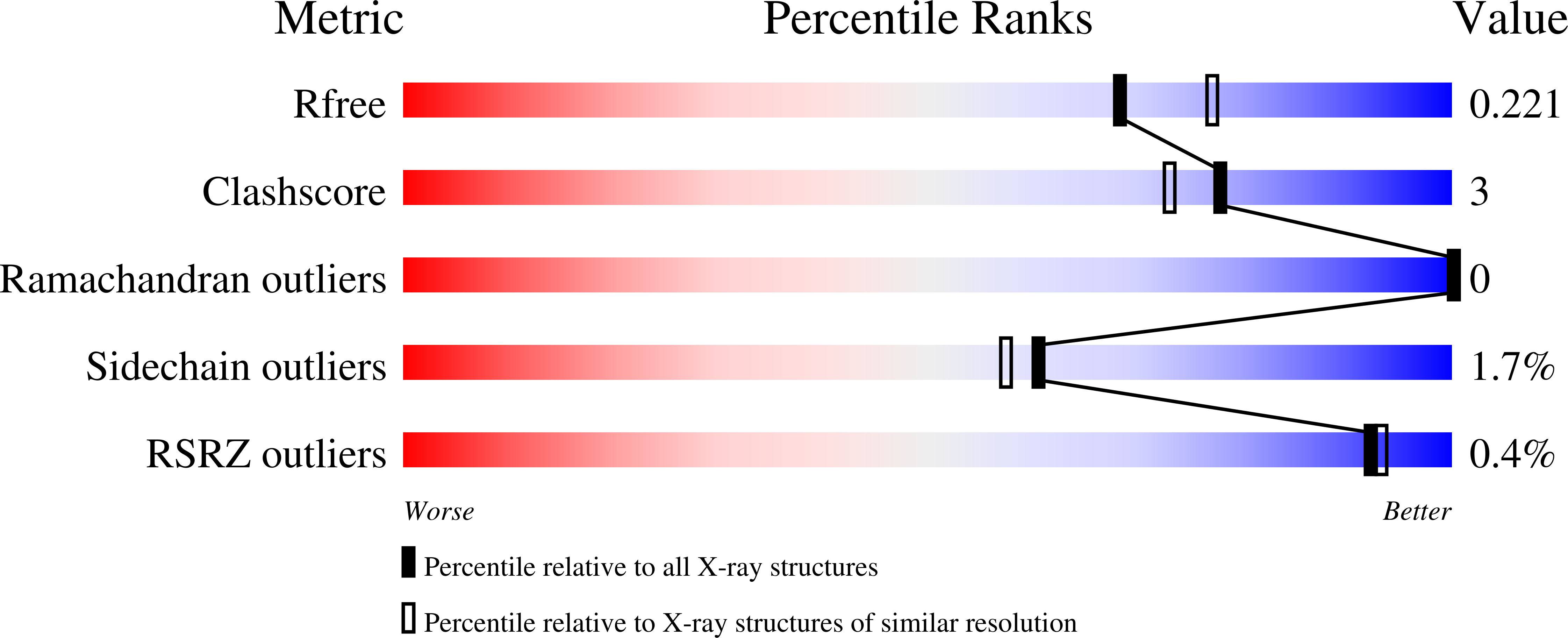
R-Value Free:
0.22
R-Value Work:
0.19
R-Value Observed:
0.19
Space Group:
P 62 2 2
Macromolecular Entities
Structures with similar UniProt ID
Protein Blast
Polymer Type:polypeptide(L)
Molecule:Halogenase B
Gene (Uniprot):SAMN05444921_127108
Chain IDs:A, B
Chain Length:251
Number of Molecules:2
Biological Source:Streptomyces wuyuanensis
Primary Citation
Biocatalytic control of site-selectivity and chain length-selectivity in radical amino acid halogenases.
Proc.Natl.Acad.Sci.USA 120 e2214512120 e2214512120 (2023)
PMID: 36913566 DOI: 10.1073/pnas.2214512120

Abstact

Biocatalytic C-H activation has the potential to merge enzymatic and synthetic strategies for bond formation. FeII/αKG-dependent halogenases are particularly distinguished for their ability both to control selective C-H activation as well as to direct group transfer of a bound anion along a reaction axis separate from oxygen rebound, enabling the development of new transformations. In this context, we elucidate the basis for the selectivity of enzymes that perform selective halogenation to yield 4-Cl-lysine (BesD), 5-Cl-lysine (HalB), and 4-Cl-ornithine (HalD), allowing us to probe how site-selectivity and chain length selectivity are achieved. We now report the crystal structure of the HalB and HalD, revealing the key role of the substrate-binding lid in positioning the substrate for C4 vs C5 chlorination and recognition of lysine vs ornithine. Targeted engineering of the substrate-binding lid further demonstrates that these selectivities can be altered or switched, showcasing the potential to develop halogenases for biocatalytic applications.

Legend

Protein

Chemical

Disease

Primary Citation of related structures
Feedback Form
Name
Email
Institute
Feedback