7TZI image
Deposition Date 2022-02-15
Release Date 2022-10-12
Last Version Date 2023-10-18
Entry Detail
PDB ID:
7TZI
Keywords:
Title:
Structure of a pseudomurein peptide ligase type E from Methanothermobacter thermautotrophicus
Biological Source:
Source Organism:
Host Organism:
Method Details:
Experimental Method:
Resolution:
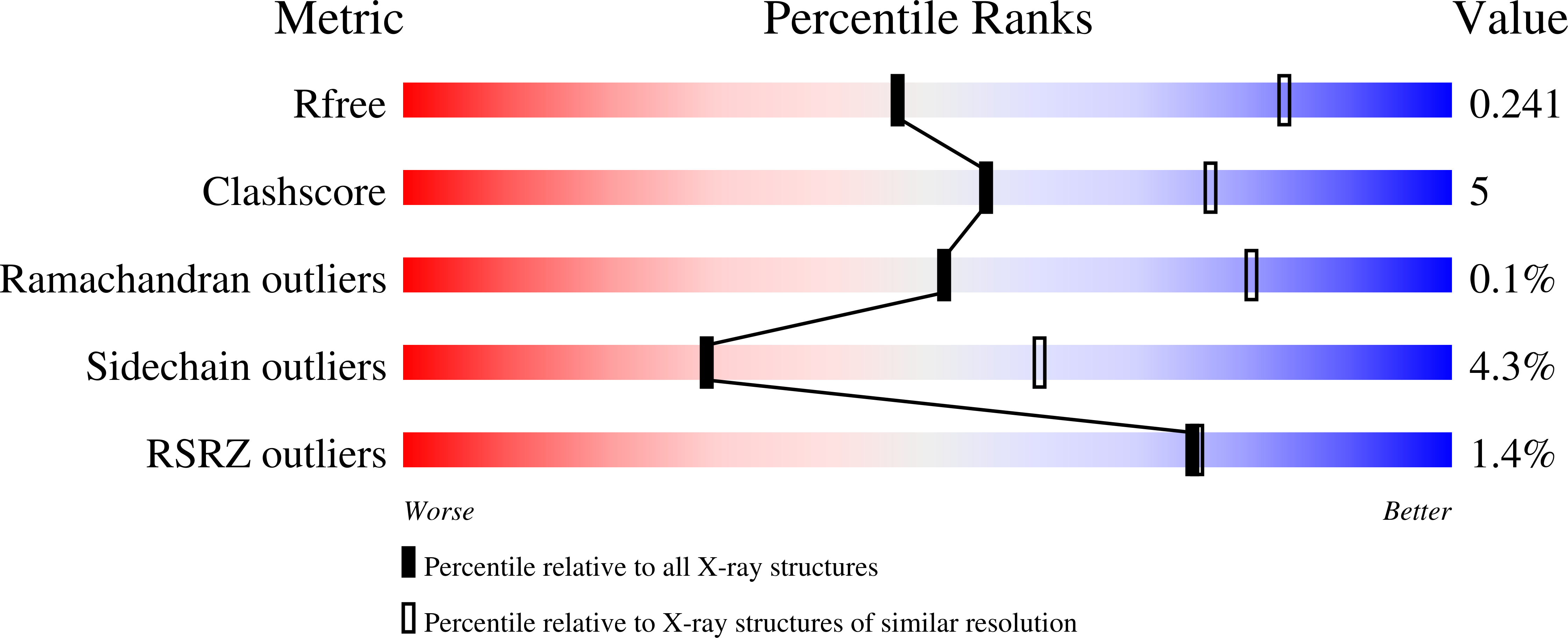
2.91 Å
R-Value Free:
0.24
R-Value Work:
0.21
R-Value Observed:
0.21
Space Group:
P 21 21 21
Macromolecular Entities
Structures with similar UniProt ID
Protein Blast
Polymer Type:polypeptide(L)
Molecule:Mur ligase family protein
Gene (Uniprot):HA285_03230
Chain IDs:A, B
Chain Length:451
Number of Molecules:2
Biological Source:Methanothermobacter thermautotrophicus
Primary Citation
Structural characterisation of methanogen pseudomurein cell wall peptide ligases homologous to bacterial MurE/F murein peptide ligases.
Microbiology (Reading, Engl.) 168 ? ? (2022)
PMID: 36178458 DOI: 10.1099/mic.0.001235

Abstact

Archaea have diverse cell wall types, yet none are identical to bacterial peptidoglycan (murein). Methanogens Methanobacteria and Methanopyrus possess cell walls of pseudomurein, a structural analogue of murein. Pseudomurein differs from murein in containing the unique archaeal sugar N-acetyltalosaminuronic acid instead of N-acetylmuramic acid, β-1,3 glycosidic bonds in place of β-1,4 bonds and only l-amino acids in the peptide cross-links. We have determined crystal structures of methanogen pseudomurein peptide ligases (termed pMurE) from Methanothermus fervidus (Mfer762) and Methanothermobacter thermautotrophicus (Mth734) that are structurally most closely related to bacterial MurE peptide ligases. The homology of the archaeal pMurE and bacterial MurE enzymes is clear both in the overall structure and at the level of each of the three domains. In addition, we identified two UDP-binding sites in Mfer762 pMurE, one at the exterior surface of the interface of the N-terminal and middle domains, and a second site at an inner surface continuous with the highly conserved interface of the three domains. Residues involved in ATP binding in MurE are conserved in pMurE, suggesting that a similar ATP-binding pocket is present at the interface of the middle and the C-terminal domains of pMurE. The presence of pMurE ligases in members of the Methanobacteriales and Methanopyrales, that are structurally related to bacterial MurE ligases, supports the idea that the biosynthetic origins of archaeal pseudomurein and bacterial peptidoglycan cell walls are evolutionarily related.

Legend

Protein

Chemical

Disease

Primary Citation of related structures
Feedback Form
Name
Email
Institute
Feedback