7TTR image
Deposition Date 2022-02-01
Release Date 2022-09-28
Last Version Date 2025-05-14
Entry Detail
PDB ID:
7TTR
Keywords:
Title:
Skd3_ATPyS_FITC-casein Hexamer, AAA+ only
Biological Source:
Source Organism:
Homo sapiens (Taxon ID: 9606)
Bos taurus (Taxon ID: 9913)
Method Details:
Experimental Method:
Resolution:
2.96 Å
Aggregation State:
PARTICLE
Reconstruction Method:
SINGLE PARTICLE
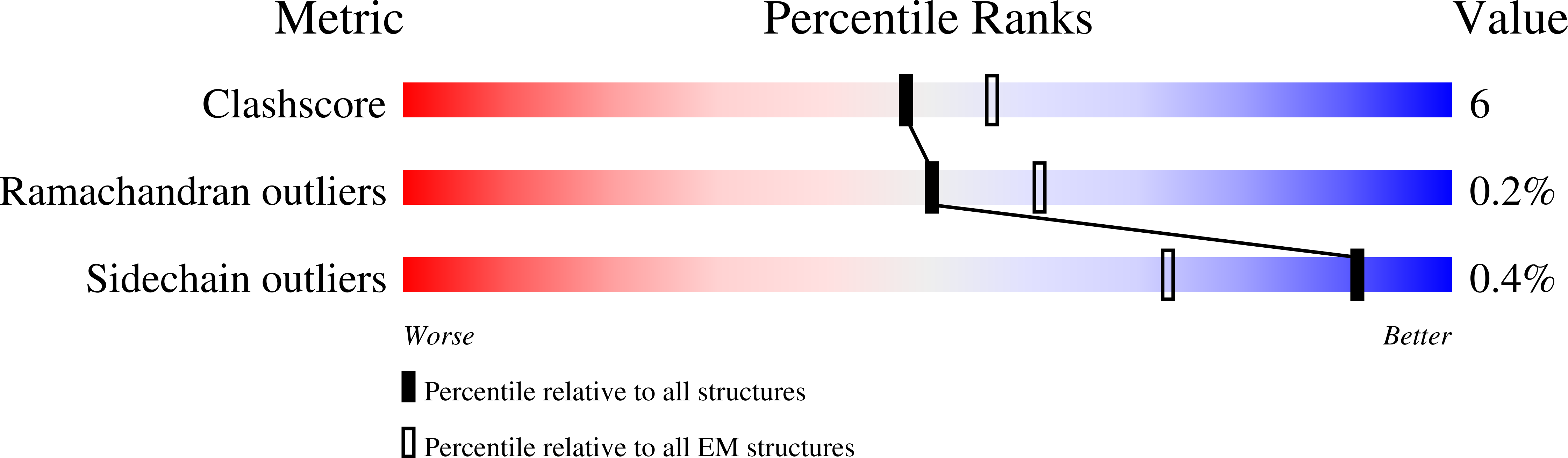
Macromolecular Entities
Structures with similar UniProt ID
Protein Blast
Polymer Type:polypeptide(L)
Molecule:Caseinolytic peptidase B protein homolog
Gene (Uniprot):CLPB
Chain IDs:A, B, C, D, E, F
Chain Length:584
Number of Molecules:6
Biological Source:Homo sapiens
Structures with similar UniProt ID
Protein Blast
Polymer Type:polypeptide(L)
Molecule:Beta-casein
Chain IDs:G (auth: P)
Chain Length:224
Number of Molecules:1
Biological Source:Bos taurus
Primary Citation
Unique structural features govern the activity of a human mitochondrial AAA+ disaggregase, Skd3.
Cell Rep 40 111408 111408 (2022)
PMID: 36170828 DOI: 10.1016/j.celrep.2022.111408

Abstact

The AAA+ protein, Skd3 (human CLPB), solubilizes proteins in the mitochondrial intermembrane space, which is critical for human health. Skd3 variants with defective protein-disaggregase activity cause severe congenital neutropenia (SCN) and 3-methylglutaconic aciduria type 7 (MGCA7). How Skd3 disaggregates proteins remains poorly understood. Here, we report a high-resolution structure of a Skd3-substrate complex. Skd3 adopts a spiral hexameric arrangement that engages substrate via pore-loop interactions in the nucleotide-binding domain (NBD). Substrate-bound Skd3 hexamers stack head-to-head via unique, adaptable ankyrin-repeat domain (ANK)-mediated interactions to form dodecamers. Deleting the ANK linker region reduces dodecamerization and disaggregase activity. We elucidate apomorphic features of the Skd3 NBD and C-terminal domain that regulate disaggregase activity. We also define how Skd3 subunits collaborate to disaggregate proteins. Importantly, SCN-linked subunits sharply inhibit disaggregase activity, whereas MGCA7-linked subunits do not. These advances illuminate Skd3 structure and mechanism, explain SCN and MGCA7 inheritance patterns, and suggest therapeutic strategies.

Legend

Protein

Chemical

Disease

Primary Citation of related structures
Feedback Form
Name
Email
Institute
Feedback