7SQO image
Deposition Date 2021-11-05
Release Date 2022-05-25
Last Version Date 2024-11-06
Entry Detail
PDB ID:
7SQO
Title:
Structure of the orexin-2 receptor(OX2R) bound to TAK-925, Gi and scFv16
Biological Source:
Source Organism:
Homo sapiens (Taxon ID: 9606)
Bos taurus (Taxon ID: 9913)
synthetic construct (Taxon ID: 32630)
Host Organism:
Method Details:
Experimental Method:
Resolution:
3.17 Å
Aggregation State:
PARTICLE
Reconstruction Method:
SINGLE PARTICLE
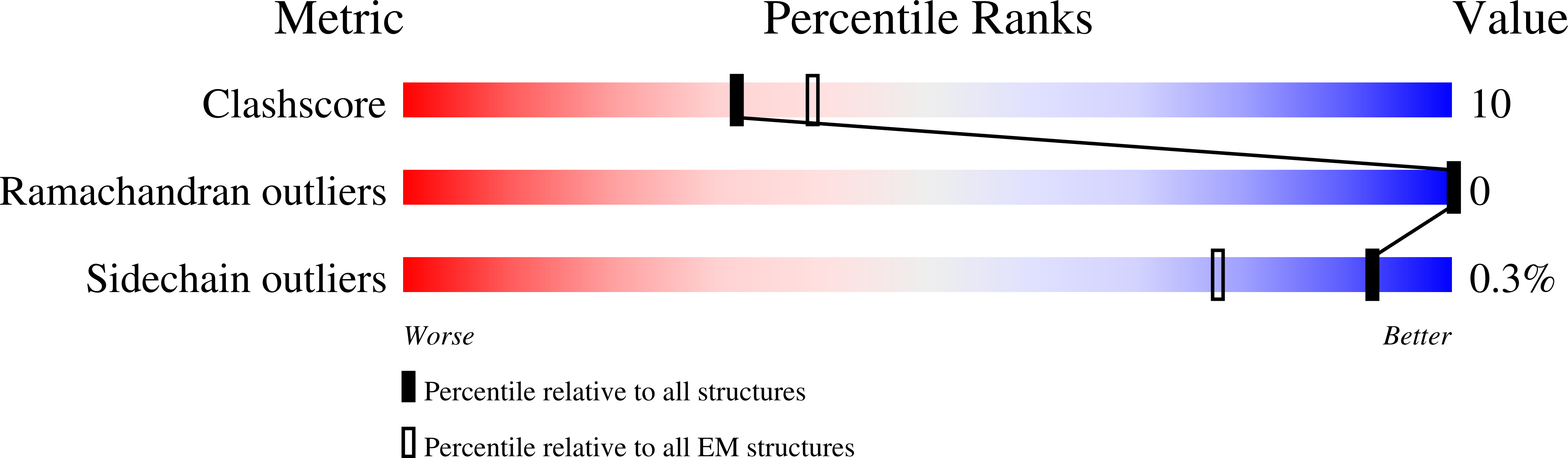
Macromolecular Entities
Structures with similar UniProt ID
Protein Blast
Polymer Type:polypeptide(L)
Molecule:Guanine nucleotide-binding protein G(i) subunit alpha-1
Gene (Uniprot):GNAI1
Chain IDs:B (auth: A)
Chain Length:354
Number of Molecules:1
Biological Source:Homo sapiens
Structures with similar UniProt ID
Protein Blast
Polymer Type:polypeptide(L)
Molecule:Guanine nucleotide-binding protein G(I)/G(S)/G(T) subunit beta-1
Gene (Uniprot):GNB1
Chain IDs:C (auth: B)
Chain Length:354
Number of Molecules:1
Biological Source:Bos taurus
Polymer Type:polypeptide(L)
Molecule:scFv-16
Chain IDs:E
Chain Length:247
Number of Molecules:1
Biological Source:synthetic construct
Structures with similar UniProt ID
Protein Blast
Polymer Type:polypeptide(L)
Molecule:Guanine nucleotide-binding protein G(I)/G(S)/G(O) subunit gamma-2
Gene (Uniprot):GNG2
Chain IDs:D (auth: G)
Chain Length:68
Number of Molecules:1
Biological Source:Bos taurus
Structures with similar UniProt ID
Protein Blast
Polymer Type:polypeptide(L)
Molecule:Orexin receptor type 2
Gene (Uniprot):HCRTR2
Chain IDs:A (auth: R)
Chain Length:444
Number of Molecules:1
Biological Source:Homo sapiens
Primary Citation
Molecular mechanism of the wake-promoting agent TAK-925.
Nat Commun 13 2902 2902 (2022)
PMID: 35614071 DOI: 10.1038/s41467-022-30601-3

Abstact

The OX2 orexin receptor (OX2R) is a highly expressed G protein-coupled receptor (GPCR) in the brain that regulates wakefulness and circadian rhythms in humans. Antagonism of OX2R is a proven therapeutic strategy for insomnia drugs, and agonism of OX2R is a potentially powerful approach for narcolepsy type 1, which is characterized by the death of orexinergic neurons. Until recently, agonism of OX2R had been considered 'undruggable.' We harness cryo-electron microscopy of OX2R-G protein complexes to determine how the first clinically tested OX2R agonist TAK-925 can activate OX2R in a highly selective manner. Two structures of TAK-925-bound OX2R with either a Gq mimetic or Gi reveal that TAK-925 binds at the same site occupied by antagonists, yet interacts with the transmembrane helices to trigger activating microswitches. Our structural and mutagenesis data show that TAK-925's selectivity is mediated by subtle differences between OX1 and OX2 receptor subtypes at the orthosteric pocket. Finally, differences in the polarity of interactions at the G protein binding interfaces help to rationalize OX2R's coupling selectivity for Gq signaling. The mechanisms of TAK-925's binding, activation, and selectivity presented herein will aid in understanding the efficacy of small molecule OX2R agonists for narcolepsy and other circadian disorders.

Legend

Protein

Chemical

Disease

Primary Citation of related structures
Feedback Form
Name
Email
Institute
Feedback