7SHI image
Deposition Date 2021-10-08
Release Date 2022-03-09
Last Version Date 2024-06-19
Entry Detail
PDB ID:
7SHI
Keywords:
Title:
Crystal Structure of Cytochrome P450 AmphL from Streptomyces nodosus and the Structural Basis for Substrate Selectivity in Macrolide Metabolizing P450s
Biological Source:
Source Organism:
Host Organism:
Method Details:
Experimental Method:
Resolution:
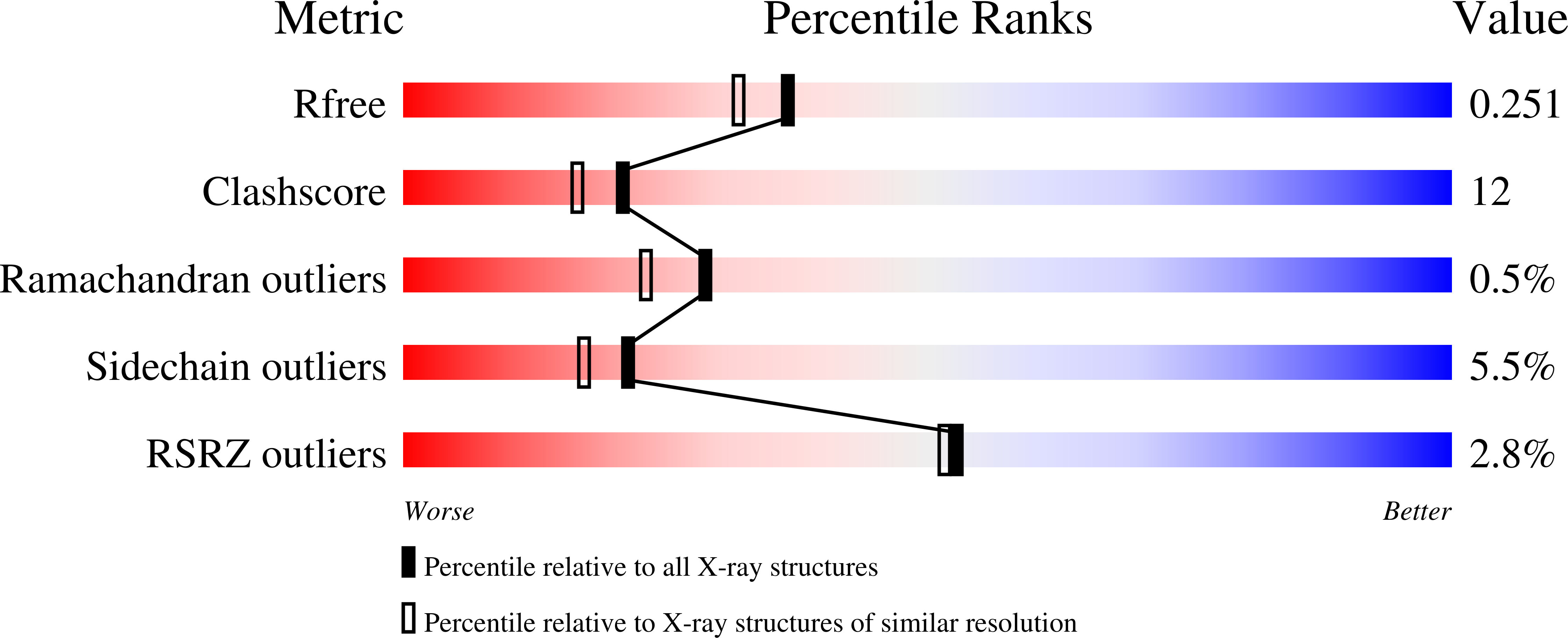
2.00 Å
R-Value Free:
0.24
R-Value Work:
0.18
R-Value Observed:
0.19
Space Group:
P 21 21 21
Macromolecular Entities
Structures with similar UniProt ID
Protein Blast
Polymer Type:polypeptide(L)
Molecule:AmphL
Gene (Uniprot):amphL
Chain IDs:A, B
Chain Length:396
Number of Molecules:2
Biological Source:Streptomyces nodosus
Primary Citation
Structural analysis of P450 AmphL from Streptomyces nodosus provides insights into substrate selectivity of polyene macrolide antibiotic biosynthetic P450s.
J.Biol.Chem. 298 101746 101746 (2022)
PMID: 35189143 DOI: 10.1016/j.jbc.2022.101746

Abstact

AmphL is a cytochrome P450 enzyme that catalyzes the C8 oxidation of 8-deoxyamphotericin B to the polyene macrolide antibiotic, amphotericin B. To understand this substrate selectivity, we solved the crystal structure of AmphL to a resolution of 2.0 Å in complex with amphotericin B and performed molecular dynamics (MD) simulations. A detailed comparison with the closely related P450, PimD, which catalyzes the epoxidation of 4,5-desepoxypimaricin to the macrolide antibiotic, pimaricin, reveals key catalytic structural features responsible for stereo- and regio-selective oxidation. Both P450s have a similar access channel that runs parallel to the active site I helix over the surface of the heme. Molecular dynamics simulations of substrate binding reveal PimD can "pull" substrates further into the P450 access channel owing to additional electrostatic interactions between the protein and the carboxyl group attached to the hemiketal ring of 4,5-desepoxypimaricin. This substrate interaction is absent in AmphL although the additional substrate -OH groups in 8-deoxyamphotericin B help to correctly position the substrate for C8 oxidation. Simulations of the oxy-complex indicates that these -OH groups may also participate in a proton relay network required for O2 activation as has been suggested for two other macrolide P450s, PimD and P450eryF. These findings provide experimentally testable models that can potentially contribute to a new generation of novel macrolide antibiotics with enhanced antifungal and/or antiprotozoal efficacy.

Legend

Protein

Chemical

Disease

Primary Citation of related structures
Feedback Form
Name
Email
Institute
Feedback