7SG3 image
Deposition Date 2021-10-04
Release Date 2021-10-27
Last Version Date 2023-10-18
Entry Detail
PDB ID:
7SG3
Title:
The X-ray crystal structure of the Staphylococcus aureus Fatty Acid Kinase B1 mutant A121I-A158L to 2.35 Angstrom resolution (Open form chain A, Palmitate bound)
Biological Source:
Source Organism:
Host Organism:
Method Details:
Experimental Method:
Resolution:
2.35 Å
R-Value Free:
0.25
R-Value Work:
0.21
R-Value Observed:
0.21
Space Group:
P 1
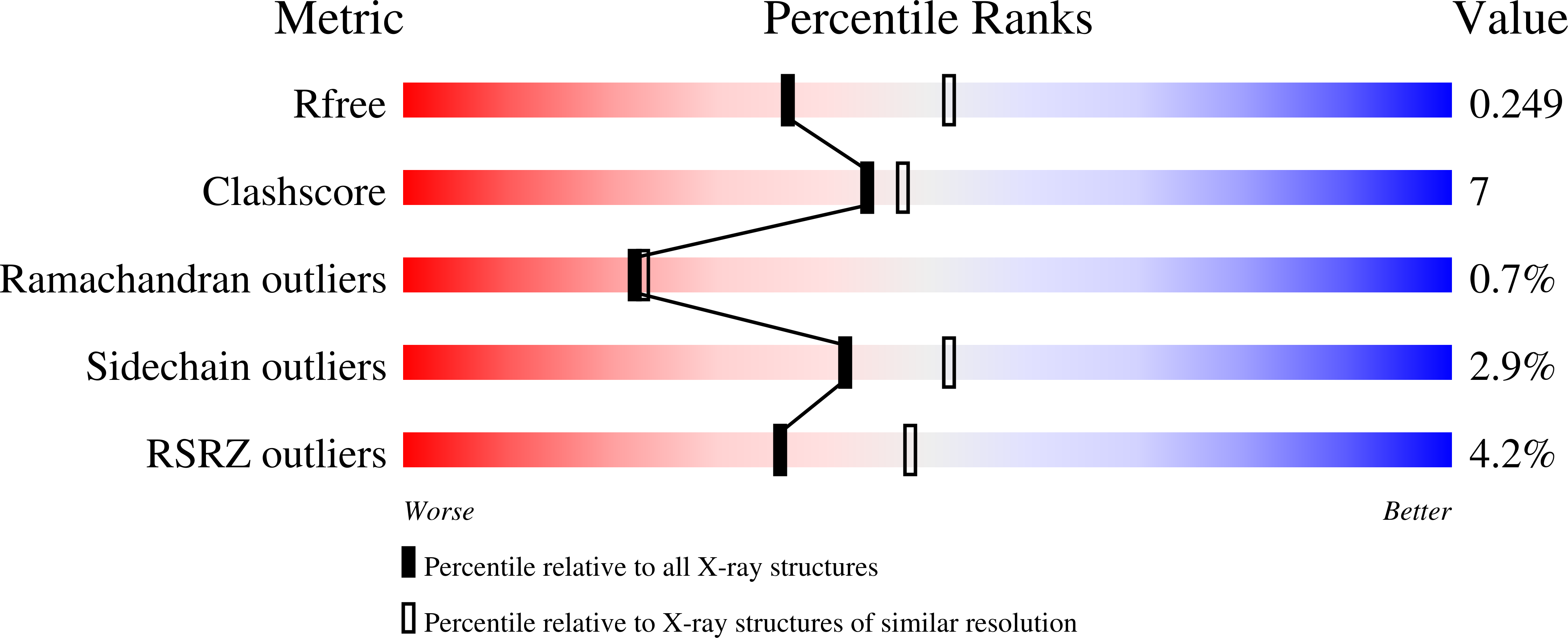
Macromolecular Entities
Structures with similar UniProt ID
Protein Blast
Polymer Type:polypeptide(L)
Molecule:Fatty Acid Kinase B1
Gene (Uniprot):MW0711
Mutagens:A121I, A158L
Chain IDs:A, B
Chain Length:289
Number of Molecules:2
Biological Source:Staphylococcus aureus
Ligand Molecules
Primary Citation
Identification of structural transitions in bacterial fatty acid binding proteins that permit ligand entry and exit at membranes.
J.Biol.Chem. 298 101676 101676 (2022)
PMID: 35122790 DOI: 10.1016/j.jbc.2022.101676

Abstact

Fatty acid (FA) transfer proteins extract FA from membranes and sequester them to facilitate their movement through the cytosol. Detailed structural information is available for these soluble protein-FA complexes, but the structure of the protein conformation responsible for FA exchange at the membrane is unknown. Staphylococcus aureus FakB1 is a prototypical bacterial FA transfer protein that binds palmitate within a narrow, buried tunnel. Here, we define the conformational change from a "closed" FakB1 state to an "open" state that associates with the membrane and provides a path for entry and egress of the FA. Using NMR spectroscopy, we identified a conformationally flexible dynamic region in FakB1, and X-ray crystallography of FakB1 mutants captured the conformation of the open state. In addition, molecular dynamics simulations show that the new amphipathic α-helix formed in the open state inserts below the phosphate plane of the bilayer to create a diffusion channel for the hydrophobic FA tail to access the hydrocarbon core and place the carboxyl group at the phosphate layer. The membrane binding and catalytic properties of site-directed mutants were consistent with the proposed membrane docked structure predicted by our molecular dynamics simulations. Finally, the structure of the bilayer-associated conformation of FakB1 has local similarities with mammalian FA binding proteins and provides a conceptual framework for how these proteins interact with the membrane to create a diffusion channel from the FA location in the bilayer to the protein interior.

Legend

Protein

Chemical

Disease

Primary Citation of related structures
Feedback Form
Name
Email
Institute
Feedback