7S24 image
Deposition Date 2021-09-03
Release Date 2022-08-10
Last Version Date 2023-10-25
Entry Detail
PDB ID:
7S24
Title:
Crystal structure of the Na+/H+ antiporter NhaA at pH 6.5
Biological Source:
Source Organism:
Escherichia coli (Taxon ID: 562)
Host Organism:
Method Details:
Experimental Method:
Resolution:
2.20 Å
R-Value Free:
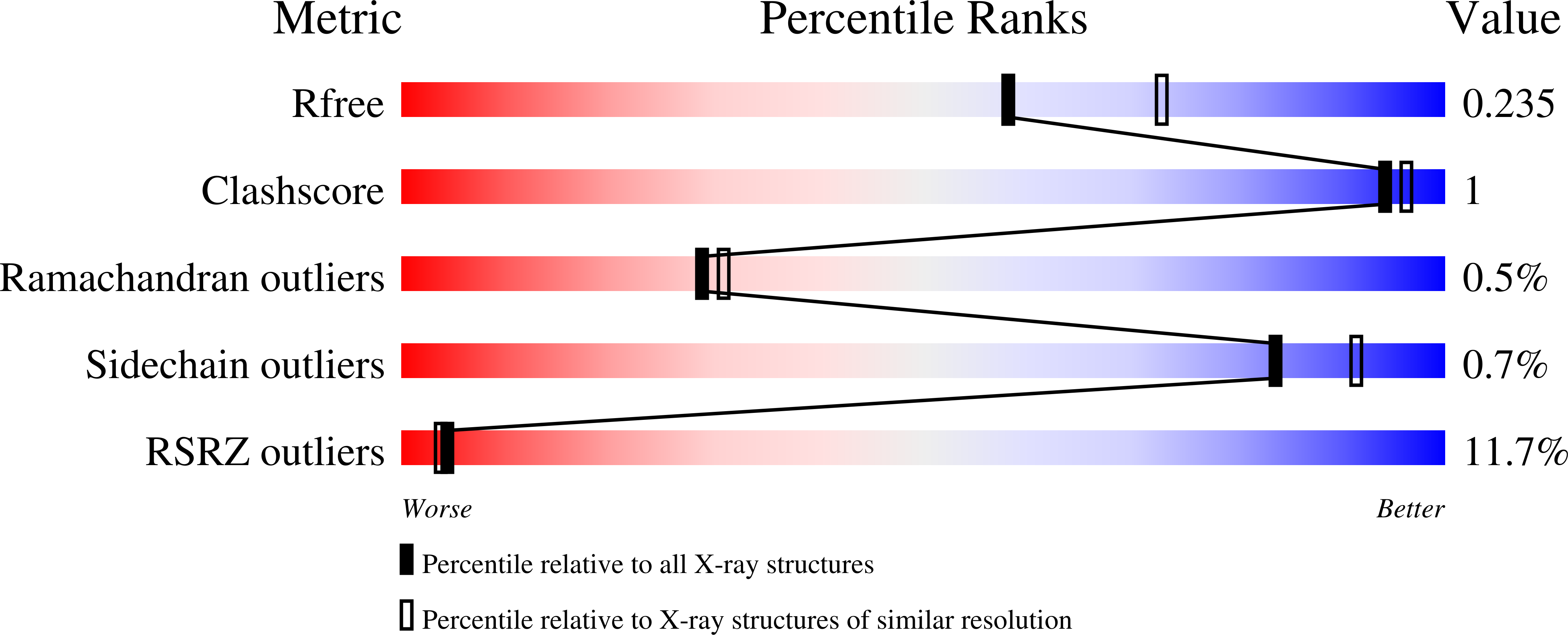
0.23
R-Value Work:
0.20
R-Value Observed:
0.21
Space Group:
P 1
Macromolecular Entities
Structures with similar UniProt ID
Protein Blast
Polymer Type:polypeptide(L)
Molecule:Na(+)/H(+) antiporter NhaA
Chain IDs:A
Chain Length:396
Number of Molecules:1
Biological Source:Escherichia coli
Primary Citation
Crystal structure of the Na + /H + antiporter NhaA at active pH reveals the mechanistic basis for pH sensing.
Nat Commun 13 6383 6383 (2022)
PMID: 36289233 DOI: 10.1038/s41467-022-34120-z

Abstact

The strict exchange of protons for sodium ions across cell membranes by Na+/H+ exchangers is a fundamental mechanism for cell homeostasis. At active pH, Na+/H+ exchange can be modelled as competition between H+ and Na+ to an ion-binding site, harbouring either one or two aspartic-acid residues. Nevertheless, extensive analysis on the model Na+/H+ antiporter NhaA from Escherichia coli, has shown that residues on the cytoplasmic surface, termed the pH sensor, shifts the pH at which NhaA becomes active. It was unclear how to incorporate the pH senor model into an alternating-access mechanism based on the NhaA structure at inactive pH 4. Here, we report the crystal structure of NhaA at active pH 6.5, and to an improved resolution of 2.2 Å. We show that at pH 6.5, residues in the pH sensor rearrange to form new salt-bridge interactions involving key histidine residues that widen the inward-facing cavity. What we now refer to as a pH gate, triggers a conformational change that enables water and Na+ to access the ion-binding site, as supported by molecular dynamics (MD) simulations. Our work highlights a unique, channel-like switch prior to substrate translocation in a secondary-active transporter.

Legend

Protein

Chemical

Disease

Primary Citation of related structures
Feedback Form
Name
Email
Institute
Feedback