7RRM image
Deposition Date 2021-08-10
Release Date 2021-10-20
Last Version Date 2024-11-06
Entry Detail
PDB ID:
7RRM
Title:
Structure of the human TMED1 (p24gamma1) Golgi dynamics Domain
Biological Source:
Source Organism:
Homo sapiens (Taxon ID: 9606)
Host Organism:
Method Details:
Experimental Method:
Resolution:
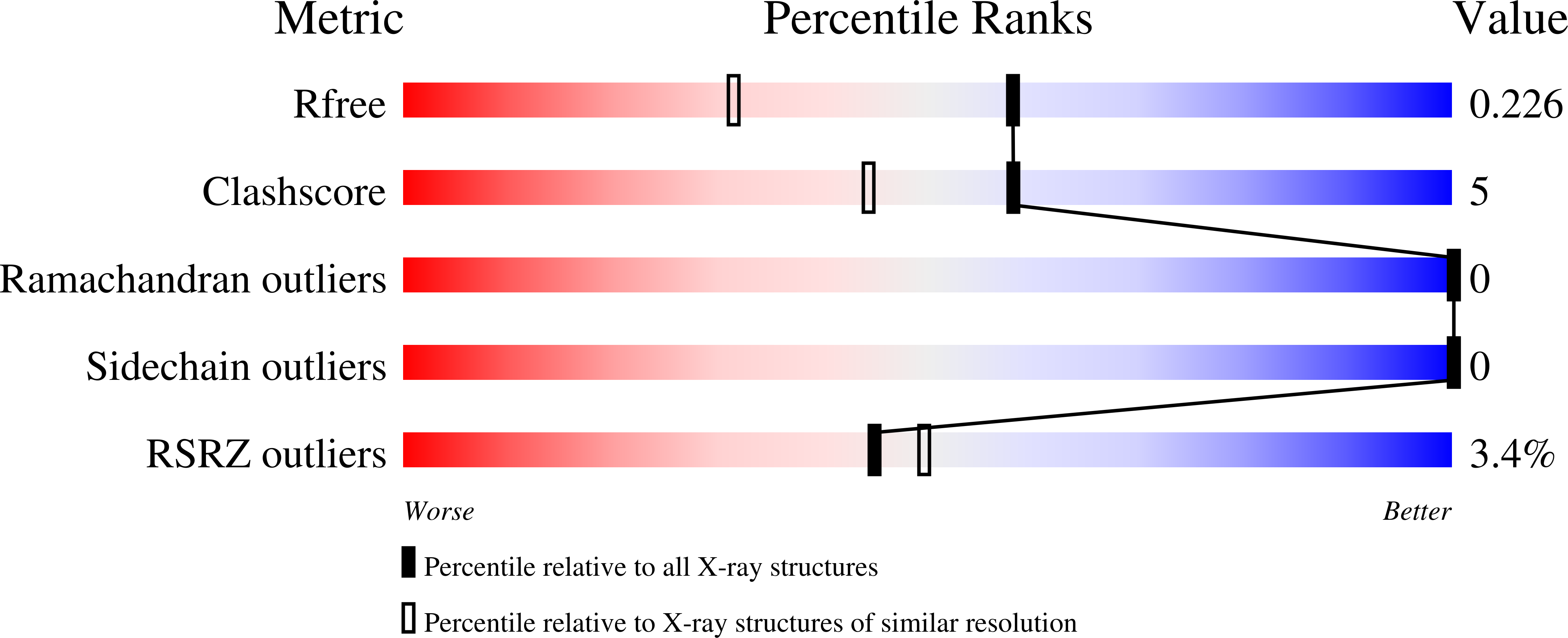
1.72 Å
R-Value Free:
0.22
R-Value Work:
0.19
R-Value Observed:
0.19
Space Group:
P 6 2 2
Macromolecular Entities
Structures with similar UniProt ID
Protein Blast
Polymer Type:polypeptide(L)
Molecule:Transmembrane emp24 domain-containing protein 1
Gene (Uniprot):TMED1
Chain IDs:A (auth: C), B (auth: A), C (auth: B)
Chain Length:135
Number of Molecules:3
Biological Source:Homo sapiens
Primary Citation
Structural and thermodynamic analyses of human TMED1 (p24 gamma 1) Golgi dynamics.
Biochimie 192 72 82 (2022)
PMID: 34634369 DOI: 10.1016/j.biochi.2021.10.002

Abstact

The transmembrane emp24 domain-containing (TMED) proteins, also called p24 proteins, are members of a family of sorting receptors present in all representatives of the Eukarya and abundantly present in all subcompartments of the early secretory pathway, namely the endoplasmic reticulum (ER), the Golgi, and the intermediate compartment. Although essential during the bidirectional transport between the ER and the Golgi, there is still a lack of information regarding the TMED's structure across different subfamilies. Besides, although the presence of a TMED homo-oligomerization was suggested previously based on crystallographic contacts observed for the isolated Golgi Dynamics (GOLD) domain, no further analyses of its presence in solution were done. Here, we describe the first high-resolution structure of a TMED1 GOLD representative and its biophysical characterization in solution. The crystal structure showed a dimer formation that is also present in solution in a salt-dependent manner, suggesting that the GOLD domain can form homodimers in solution even in the absence of the TMED1 coiled-coil region. A molecular dynamics description of the dimer stabilization, with a phylogenetic analysis of the residues important for the oligomerization and a model for the orientation towards the lipid membrane, are also presented.

Legend

Protein

Chemical

Disease

Primary Citation of related structures
Feedback Form
Name
Email
Institute
Feedback