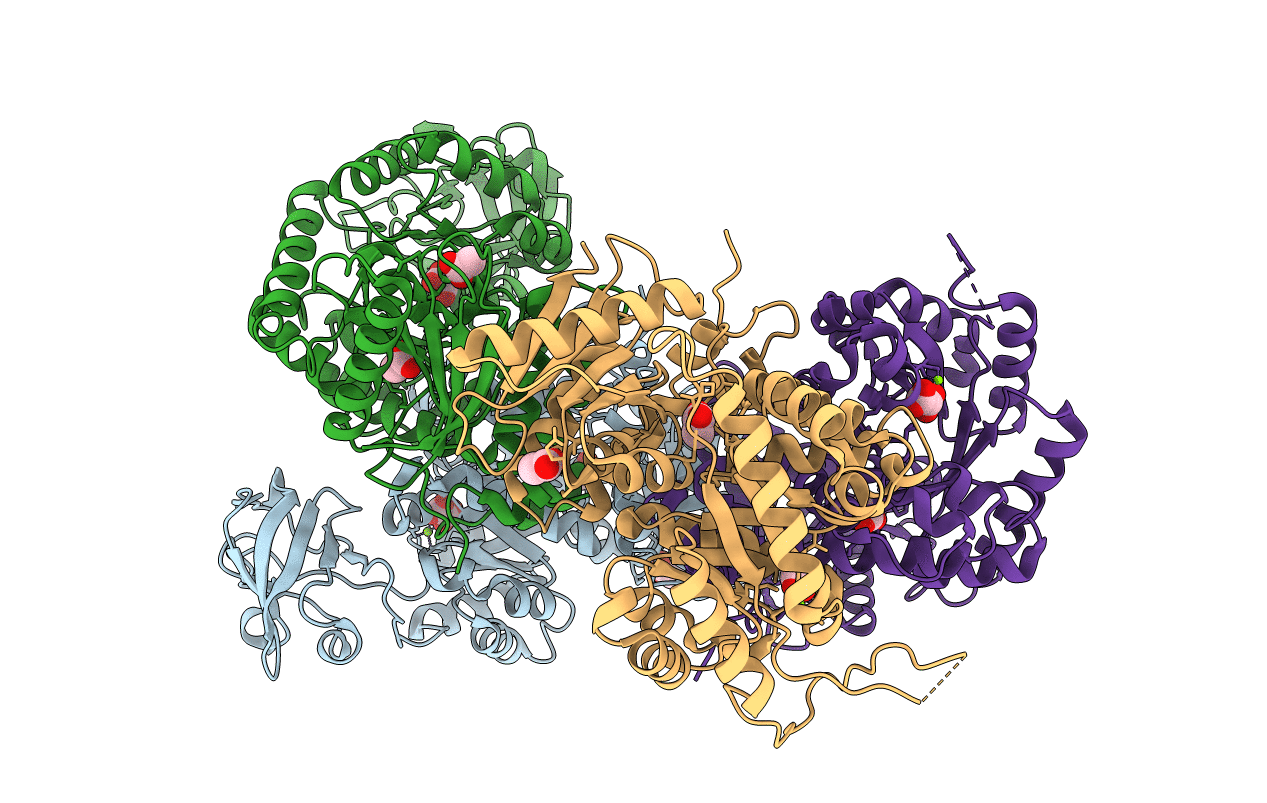
7R6Y image
Deposition Date 2021-06-24
Release Date 2022-05-25
Last Version Date 2023-10-18
Entry Detail
PDB ID:
7R6Y
Keywords:
Title:
E117K mutant pyruvate kinase from rabbit muscle
Biological Source:
Source Organism:
Host Organism:
Method Details:
Experimental Method:
Resolution:
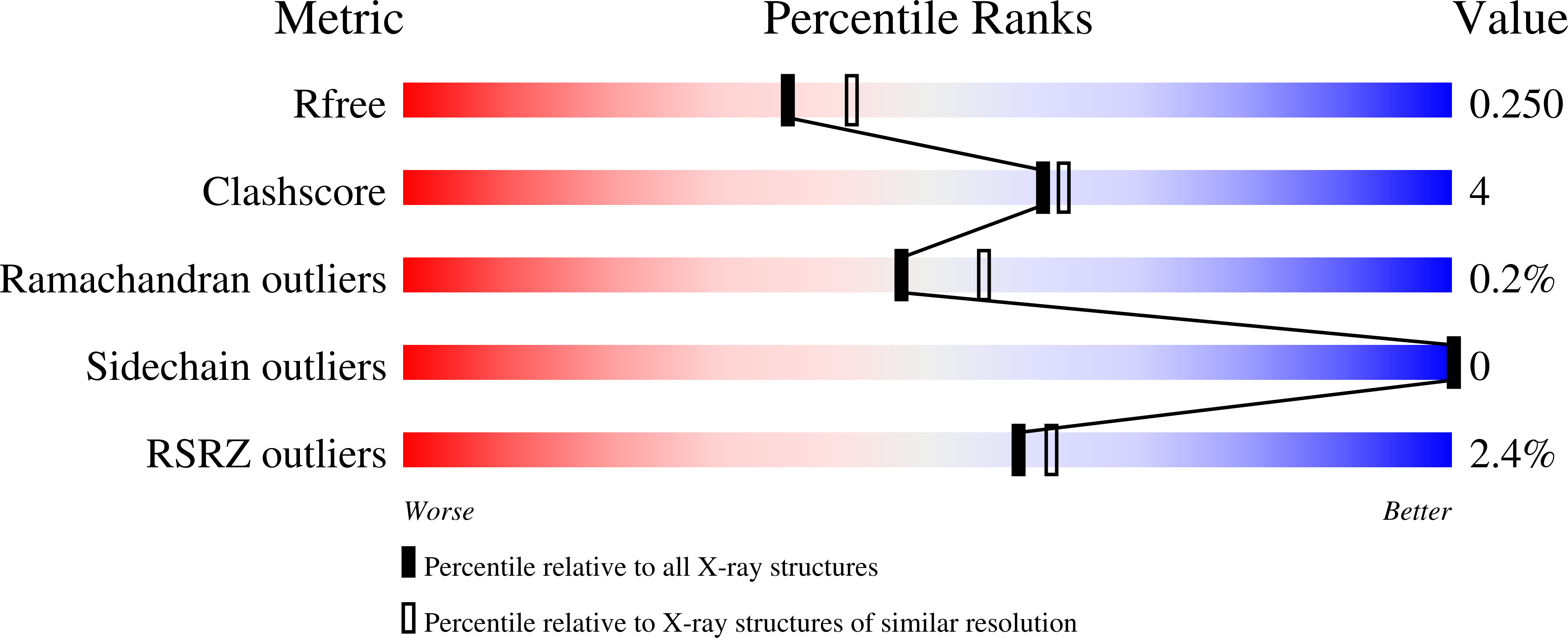
2.25 Å
R-Value Free:
0.24
R-Value Work:
0.20
R-Value Observed:
0.20
Space Group:
P 21 21 21
Macromolecular Entities
Structures with similar UniProt ID
Protein Blast
Polymer Type:polypeptide(L)
Molecule:Pyruvate kinase PKM
Gene (Uniprot):PKM
Mutagens:E117K
Chain IDs:A, B, C, D
Chain Length:531
Number of Molecules:4
Biological Source:Oryctolagus cuniculus
Primary Citation
The K + -Dependent and -Independent Pyruvate Kinases Acquire the Active Conformation by Different Mechanisms.
Int J Mol Sci 23 ? ? (2022)
PMID: 35163274 DOI: 10.3390/ijms23031347

Abstact

Eukarya pyruvate kinases possess glutamate at position 117 (numbering of rabbit muscle enzyme), whereas bacteria have either glutamate or lysine. Those with E117 are K+-dependent, whereas those with K117 are K+-independent. In a phylogenetic tree, 80% of the sequences with E117 are occupied by T113/K114/T120 and 77% of those with K117 possess L113/Q114/(L,I,V)120. This work aims to understand these residues' contribution to the K+-independent pyruvate kinases using the K+-dependent rabbit muscle enzyme. Residues 117 and 120 are crucial in the differences between the K+-dependent and -independent mutants. K+-independent activity increased with L113 and Q114 to K117, but L120 induced structural differences that inactivated the enzyme. T120 appears to be key in folding the protein and closure of the lid of the active site to acquire its active conformation in the K+-dependent enzymes. E117K mutant was K+-independent and the enzyme acquired the active conformation by a different mechanism. In the K+-independent apoenzyme of Mycobacterium tuberculosis, K72 (K117) flips out of the active site; in the holoenzyme, K72 faces toward the active site bridging the substrates through water molecules. The results provide evidence that two different mechanisms have evolved for the catalysis of this reaction.

Legend

Protein

Chemical

Disease

Primary Citation of related structures
Feedback Form
Name
Email
Institute
Feedback