7QZJ image
Deposition Date 2022-01-31
Release Date 2023-02-15
Last Version Date 2024-02-07
Entry Detail
PDB ID:
7QZJ
Title:
1.55 A X-ray crystallographic structure of SapH from Streptomyces sp. (HPH0547) involved in Pseudouridimycin biosynthesis
Biological Source:
Source Organism:
Host Organism:
Method Details:
Experimental Method:
Resolution:
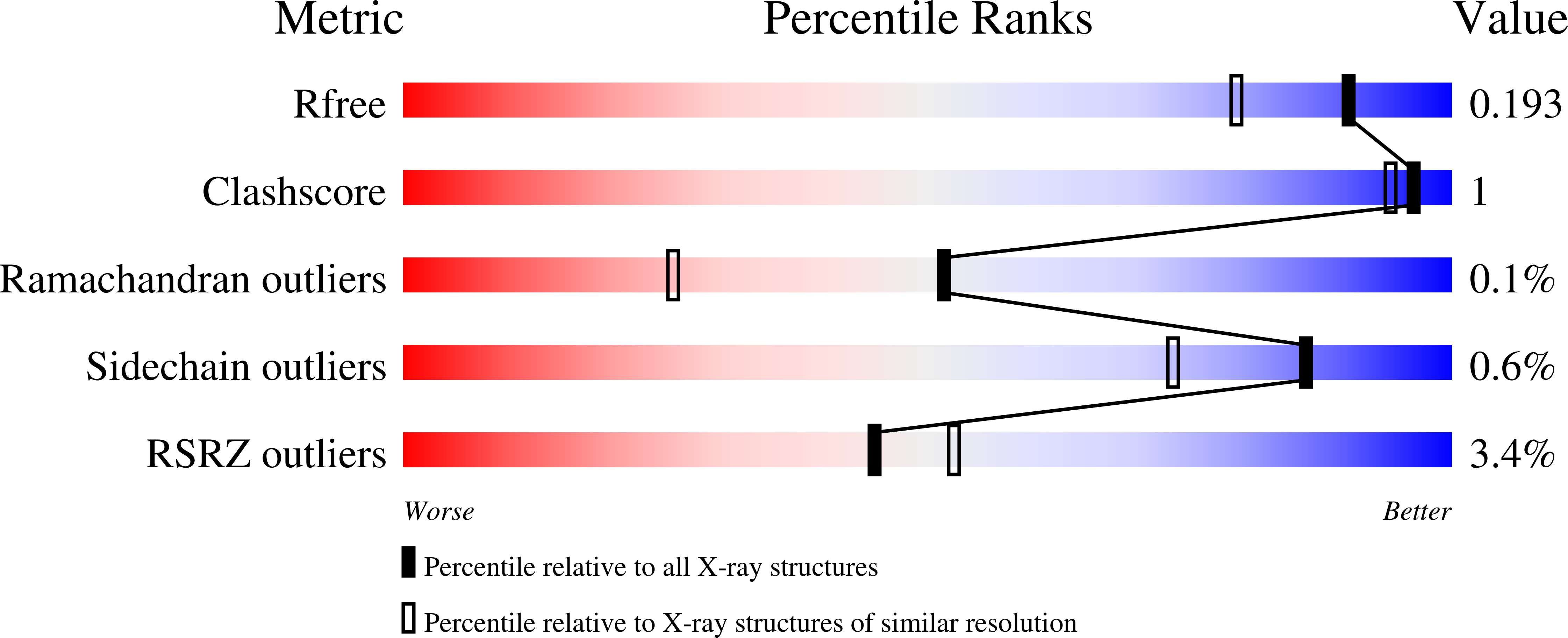
1.55 Å
R-Value Free:
0.18
R-Value Work:
0.15
R-Value Observed:
0.16
Space Group:
P 21 21 21
Macromolecular Entities
Structures with similar UniProt ID
Protein Blast
Polymer Type:polypeptide(L)
Molecule:Aspartate aminotransferase family protein
Gene (Uniprot):HMPREF1486_04341
Chain IDs:A, B
Chain Length:450
Number of Molecules:2
Biological Source:Streptomyces sp. HPH0547
Primary Citation
Pseudouridine-Modifying Enzymes SapB and SapH Control Entry into the Pseudouridimycin Biosynthetic Pathway.
Acs Chem.Biol. 18 794 802 (2023)
PMID: 37005433 DOI: 10.1021/acschembio.2c00826

Abstact

Pseudouridimycin is a microbial C-nucleoside natural product that specifically inhibits bacterial RNA polymerases by binding to the active site and competing with uridine triphosphate for the nucleoside triphosphate (NTP) addition site. Pseudouridimycin consists of 5'-aminopseudouridine and formamidinylated, N-hydroxylated Gly-Gln dipeptide moieties to allow Watson-Crick base pairing and to mimic protein-ligand interactions of the triphosphates of NTP, respectively. The metabolic pathway of pseudouridimycin has been studied in Streptomyces species, but no biosynthetic steps have been characterized biochemically. Here, we show that the flavin-dependent oxidase SapB functions as a gate-keeper enzyme selecting pseudouridine (KM = 34 μM) over uridine (KM = 901 μM) in the formation of pseudouridine aldehyde. The pyridoxal phosphate (PLP)-dependent SapH catalyzes transamination, resulting in 5'-aminopseudouridine with a preference for arginine, methionine, or phenylalanine as cosubstrates as amino group donors. The binary structure of SapH in complex with pyridoxamine-5'-phosphate and site-directed mutagenesis identified Lys289 and Trp32 as key residues for catalysis and substrate binding, respectively. The related C-nucleoside oxazinomycin was accepted as a substrate by SapB with moderate affinity (KM = 181 μM) and was further converted by SapH, which opens possibilities for metabolic engineering to generate hybrid C-nucleoside pseudouridimycin analogues in Streptomyces.

Legend

Protein

Chemical

Disease

Primary Citation of related structures
Feedback Form
Name
Email
Institute
Feedback