7Q0N image
Deposition Date 2021-10-15
Release Date 2022-06-01
Last Version Date 2024-01-31
Entry Detail
PDB ID:
7Q0N
Title:
Arbitrium receptor from Katmira phage
Biological Source:
Source Organism:
Bacillaceae (Taxon ID: 186817)
Host Organism:
Method Details:
Experimental Method:
Resolution:
2.50 Å
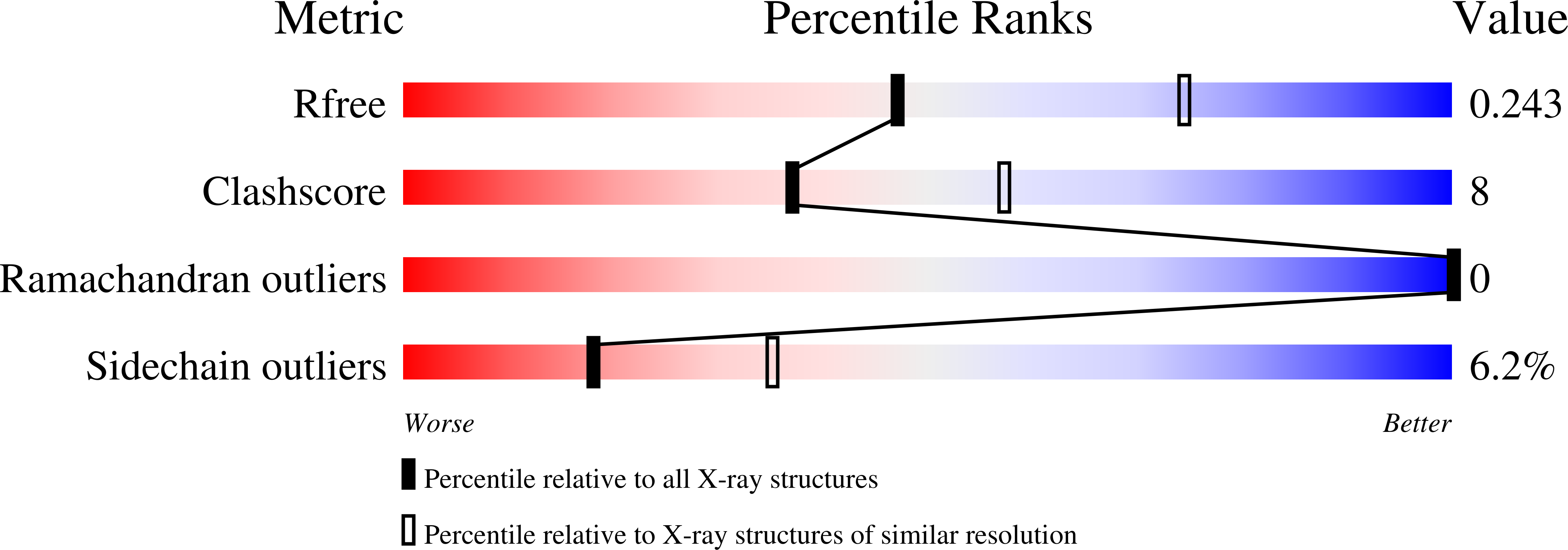
R-Value Free:
0.24
R-Value Work:
0.20
R-Value Observed:
0.20
Space Group:
P 1 21 1
Macromolecular Entities
Structures with similar UniProt ID
Protein Blast
Polymer Type:polypeptide(L)
Molecule:Arbitrium receptor
Gene (Uniprot):aimR
Chain IDs:A, B
Chain Length:386
Number of Molecules:2
Biological Source:Bacillaceae
Polymer Type:polydeoxyribonucleotide
Molecule:DNA (45-MER)
Chain IDs:C
Chain Length:45
Number of Molecules:1
Biological Source:Bacillaceae
Polymer Type:polydeoxyribonucleotide
Molecule:DNA (45-MER)
Chain IDs:D
Chain Length:45
Number of Molecules:1
Biological Source:Bacillaceae
Ligand Molecules
Primary Citation
Insights into the mechanism of action of the arbitrium communication system in SPbeta phages.
Nat Commun 13 3627 3627 (2022)
PMID: 35750663 DOI: 10.1038/s41467-022-31144-3

Abstact

The arbitrium system is employed by phages of the SPbeta family to communicate with their progeny during infection to decide either to follow the lytic or the lysogenic cycle. The system is controlled by a peptide, AimP, that binds to the regulator AimR, inhibiting its DNA-binding activity and expression of aimX. Although the structure of AimR has been elucidated for phages SPβ and phi3T, there is still controversy regarding the molecular mechanism of AimR function, with two different proposed models for SPβ. In this study, we deepen our understanding of the system by solving the structure of an additional AimR that shows chimerical characteristics with the SPβ receptor. The crystal structures of this AimR (apo, AimP-bound and DNA-bound) together with in vitro and in vivo analyses confirm a mechanism of action by AimP-induced conformational restriction, shedding light on peptide specificity and cross regulation with relevant biological implications.

Legend

Protein

Chemical

Disease

Primary Citation of related structures
Feedback Form
Name
Email
Institute
Feedback