7PLP image
Deposition Date 2021-09-01
Release Date 2022-02-02
Last Version Date 2024-11-13
Entry Detail
PDB ID:
7PLP
Keywords:
Title:
Human Teneurin-4 C-rich domain
Biological Source:
Source Organism:
Homo sapiens (Taxon ID: 9606)
Host Organism:
Method Details:
Experimental Method:
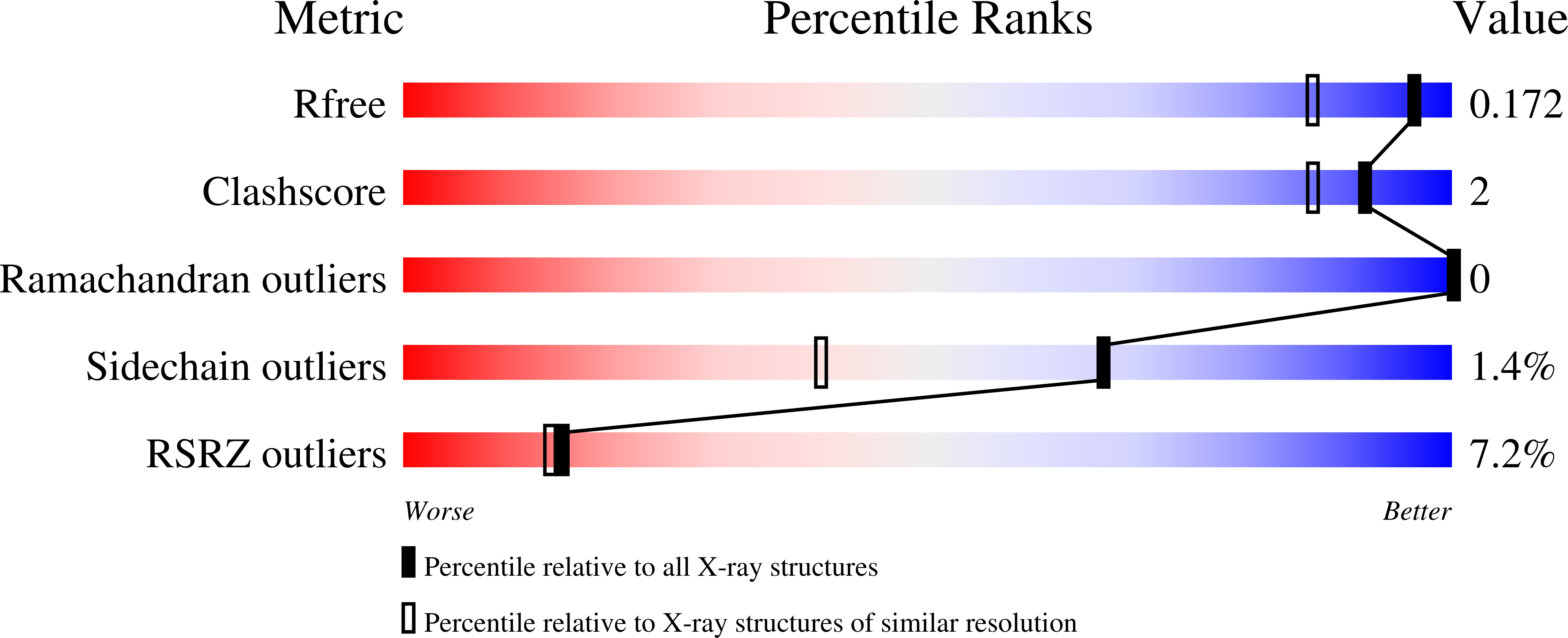
Resolution:
1.40 Å
R-Value Free:
0.17
R-Value Work:
0.15
R-Value Observed:
0.15
Space Group:
P 21 3
Macromolecular Entities
Structures with similar UniProt ID
Protein Blast
Polymer Type:polypeptide(L)
Molecule:Teneurin-4
Gene (Uniprot):TENM4
Chain IDs:A, B
Chain Length:49
Number of Molecules:2
Biological Source:Homo sapiens
Primary Citation
Teneurin4 dimer structures reveal a calcium-stabilized compact conformation supporting homomeric trans-interactions.
Embo J. 41 e107505 e107505 (2022)
PMID: 35099835 DOI: 10.15252/embj.2020107505

Abstact

Establishment of correct synaptic connections is a crucial step during neural circuitry formation. The Teneurin family of neuronal transmembrane proteins promotes cell-cell adhesion via homophilic and heterophilic interactions, and is required for synaptic partner matching in the visual and hippocampal systems in vertebrates. It remains unclear how individual Teneurins form macromolecular cis- and trans-synaptic protein complexes. Here, we present a 2.7 Å cryo-EM structure of the dimeric ectodomain of human Teneurin4. The structure reveals a compact conformation of the dimer, stabilized by interactions mediated by the C-rich, YD-shell, and ABD domains. A 1.5 Å crystal structure of the C-rich domain shows three conserved calcium binding sites, and thermal unfolding assays and SAXS-based rigid-body modeling demonstrate that the compactness and stability of Teneurin4 dimers are calcium-dependent. Teneurin4 dimers form a more extended conformation in conditions that lack calcium. Cellular assays reveal that the compact cis-dimer is compatible with homomeric trans-interactions. Together, these findings support a role for teneurins as a scaffold for macromolecular complex assembly and the establishment of cis- and trans-synaptic interactions to construct functional neuronal circuits.

Legend

Protein

Chemical

Disease

Primary Citation of related structures
Feedback Form
Name
Email
Institute
Feedback