7OJN image
Deposition Date 2021-05-16
Release Date 2021-12-01
Last Version Date 2025-07-02
Entry Detail
PDB ID:
7OJN
Keywords:
Title:
Lassa virus L protein in an elongation conformation [ELONGATION]
Biological Source:
Source Organism:
Host Organism:
Method Details:
Experimental Method:
Resolution:
2.92 Å
Aggregation State:
PARTICLE
Reconstruction Method:
SINGLE PARTICLE
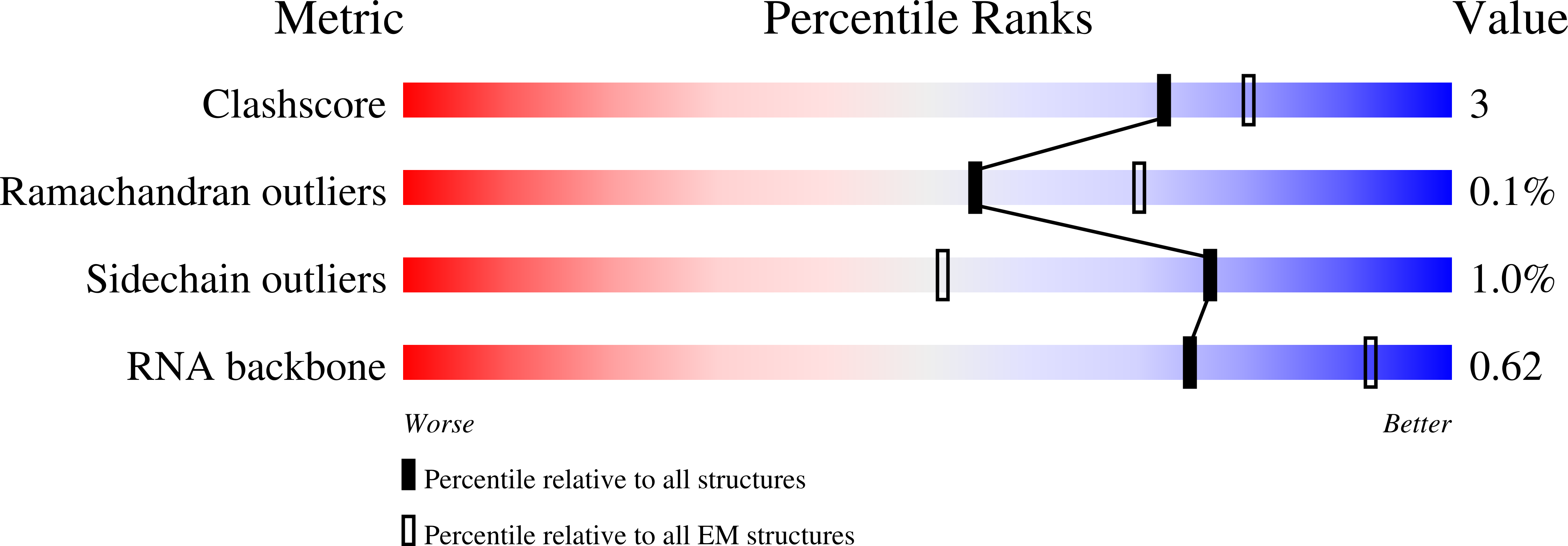
Macromolecular Entities
Polymer Type:polyribonucleotide
Molecule:5' RNA
Chain IDs:B (auth: D)
Chain Length:20
Number of Molecules:1
Biological Source:Lassa mammarenavirus
Structures with similar UniProt ID
Protein Blast
Polymer Type:polypeptide(L)
Molecule:RNA-directed RNA polymerase L
Gene (Uniprot):L
Chain IDs:A (auth: L)
Chain Length:2217
Number of Molecules:1
Biological Source:Lassa mammarenavirus
Polymer Type:polyribonucleotide
Molecule:product RNA
Chain IDs:D (auth: M)
Chain Length:9
Number of Molecules:1
Biological Source:Lassa mammarenavirus
Polymer Type:polyribonucleotide
Molecule:3' RNA
Chain IDs:C (auth: R), E
Chain Length:19
Number of Molecules:2
Biological Source:Lassa mammarenavirus
Primary Citation
Conformational changes in Lassa virus L protein associated with promoter binding and RNA synthesis activity.
Nat Commun 12 7018 7018 (2021)
PMID: 34857749 DOI: 10.1038/s41467-021-27305-5

Abstact

Lassa virus is endemic in West Africa and can cause severe hemorrhagic fever. The viral L protein transcribes and replicates the RNA genome via its RNA-dependent RNA polymerase activity. Here, we present nine cryo-EM structures of the L protein in the apo-, promoter-bound pre-initiation and active RNA synthesis states. We characterize distinct binding pockets for the conserved 3' and 5' promoter RNAs and show how full-promoter binding induces a distinct pre-initiation conformation. In the apo- and early elongation states, the endonuclease is inhibited by two distinct L protein peptides, whereas in the pre-initiation state it is uninhibited. In the early elongation state, a template-product duplex is bound in the active site cavity together with an incoming non-hydrolysable nucleotide and the full C-terminal region of the L protein, including the putative cap-binding domain, is well-ordered. These data advance our mechanistic understanding of how this flexible and multifunctional molecular machine is activated.

Legend

Protein

Chemical

Disease

Primary Citation of related structures
Feedback Form
Name
Email
Institute
Feedback