7O52 image
Deposition Date 2021-04-07
Release Date 2021-07-28
Last Version Date 2024-11-13
Entry Detail
PDB ID:
7O52
Keywords:
Title:
CD22 d6-d7 in complex with Fab m971
Biological Source:
Source Organism(s):
Homo sapiens (Taxon ID: 9606)
Expression System(s):
Method Details:
Experimental Method:
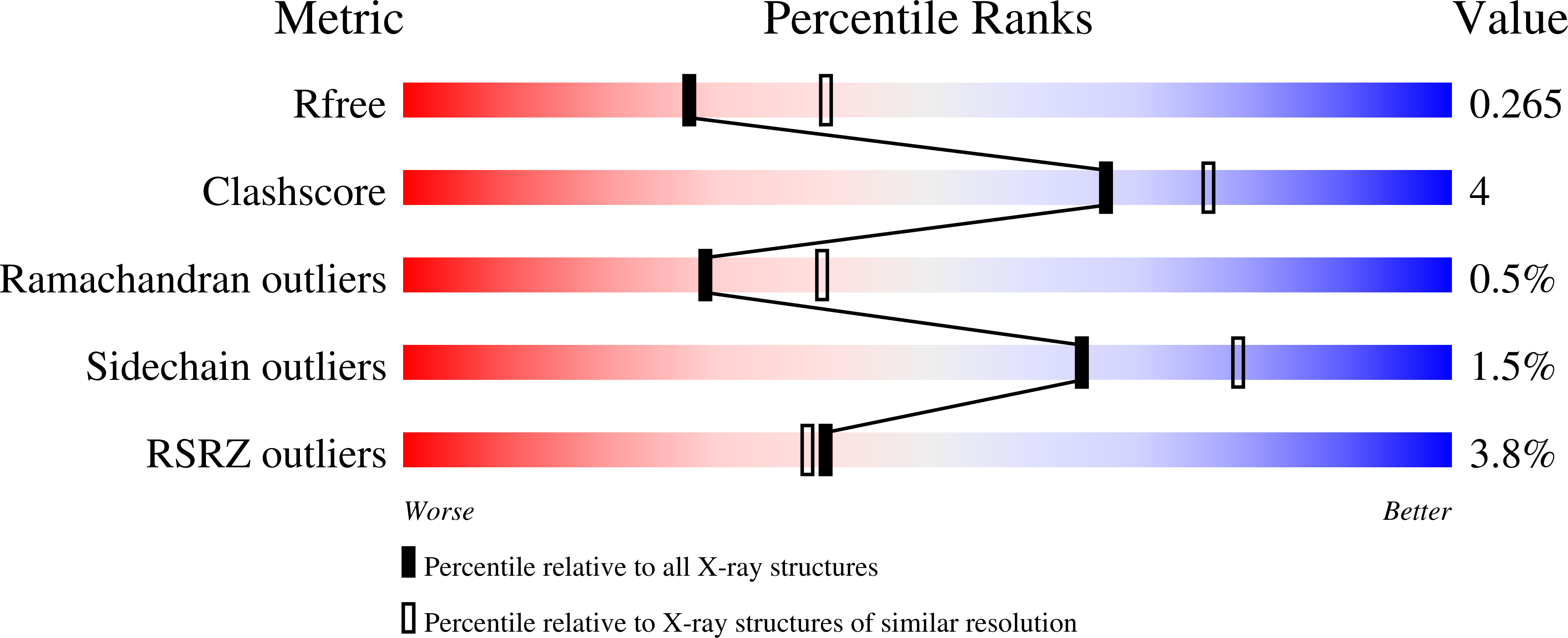
Resolution:
2.41 Å
R-Value Free:
0.26
R-Value Work:
0.22
Space Group:
I 2 2 2
Macromolecular Entities
Polymer Type:polypeptide(L)
Molecule:m971 Fab Heavy chain
Chain IDs:A (auth: H)
Chain Length:229
Number of Molecules:1
Biological Source:Homo sapiens
Polymer Type:polypeptide(L)
Molecule:m971 Fab Light chain
Chain IDs:B (auth: L)
Chain Length:216
Number of Molecules:1
Biological Source:Homo sapiens
Structures with similar UniProt ID
Protein Blast
Polymer Type:polypeptide(L)
Molecule:CD22 d6-d7 Ig domains
Chain IDs:C (auth: U)
Chain Length:194
Number of Molecules:1
Biological Source:Homo sapiens
Primary Citation
Structural details of monoclonal antibody m971 recognition of the membrane-proximal domain of CD22.
J.Biol.Chem. 297 100966 100966 (2021)
PMID: 34273351 DOI: 10.1016/j.jbc.2021.100966

Abstact

Cluster of differentiation-22 (CD22) belongs to the sialic acid-binding immunoglobulin (Ig)-like lectin family of receptors that is expressed on the surface of B cells. It has been classified as an inhibitory coreceptor for the B-cell receptor because of its function in establishing a baseline level of B-cell inhibition. The restricted expression of CD22 on B cells and its inhibitory function make it an attractive target for B-cell depletion in cases of B-cell malignancies. Genetically modified T cells with chimeric antigen receptors (CARs) derived from the m971 antibody have shown promise when used as an immunotherapeutic agent against B-cell acute lymphoblastic leukemia. A key aspect of the efficacy of this CAR-T was its ability to target a membrane-proximal epitope on the CD22 extracellular domain; however, the molecular details of m971 recognition of CD22 have thus far remained elusive. Here, we report the crystal structure of the m971 fragment antigen-binding in complex with the two most membrane-proximal Ig-like domains of CD22 (CD22d6-d7). The m971 epitope on CD22 resides at the most proximal Ig domain (d7) to the membrane, and the antibody paratope contains electrostatic surfaces compatible with interactions with phospholipid head groups. Together, our data identify molecular details underlying the successful transformation of an antibody epitope on CD22 into an effective CAR immunotherapeutic target.

Legend

Protein

Chemical

Disease

Primary Citation of related structures
Feedback Form
Name
Email
Institute
Feedback