7NS3 image
Deposition Date 2021-03-05
Release Date 2021-05-05
Last Version Date 2025-07-09
Entry Detail
PDB ID:
7NS3
Keywords:
Title:
Substrate receptor scaffolding module of yeast Chelator-GID SR4 E3 ubiquitin ligase bound to Fbp1 substrate
Biological Source:
Method Details:
Experimental Method:
Resolution:
3.50 Å
Aggregation State:
PARTICLE
Reconstruction Method:
SINGLE PARTICLE
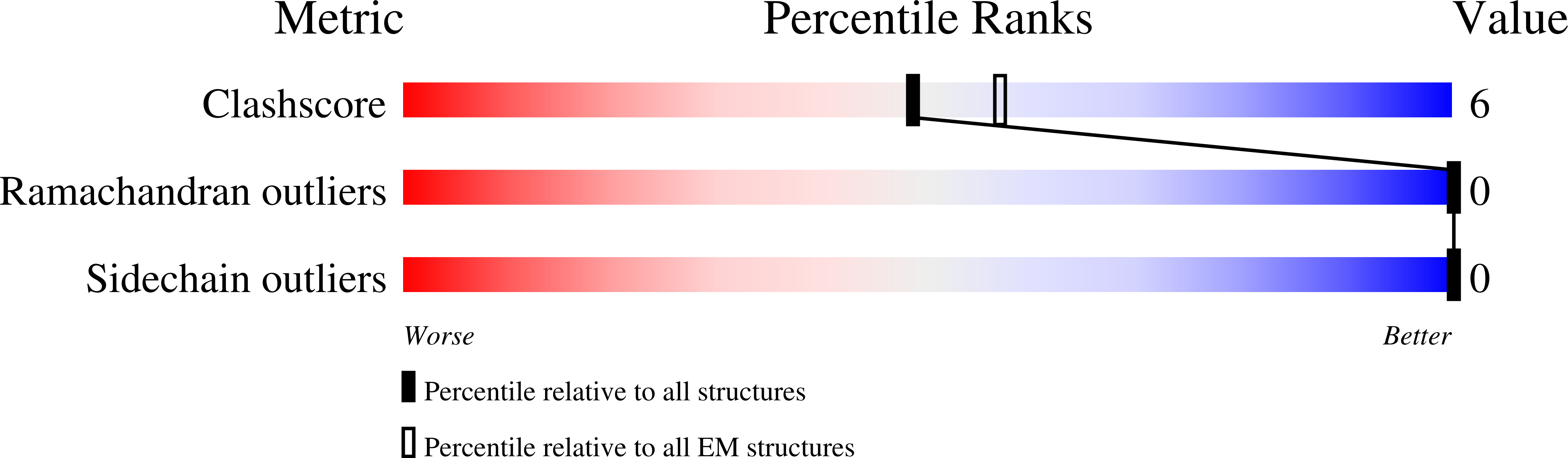
Macromolecular Entities
Polymer Type:polypeptide(L)
Molecule:BJ4_G0018240.mRNA.1.CDS.1
Chain IDs:C (auth: 1)
Chain Length:958
Number of Molecules:1
Biological Source:Saccharomyces cerevisiae
Polymer Type:polypeptide(L)
Molecule:Vacuolar import and degradation protein 24
Chain IDs:E (auth: 4)
Chain Length:362
Number of Molecules:1
Biological Source:Saccharomyces cerevisiae
Structures with similar UniProt ID
Protein Blast
Polymer Type:polypeptide(L)
Molecule:Vacuolar import and degradation protein 28
Gene (Uniprot):VID28
Chain IDs:A (auth: 5)
Chain Length:921
Number of Molecules:1
Biological Source:Saccharomyces cerevisiae (strain ATCC 204508 / S288c)
Structures with similar UniProt ID
Protein Blast
Polymer Type:polypeptide(L)
Molecule:Glucose-induced degradation protein 8
Gene (Uniprot):GID8
Chain IDs:B (auth: 8)
Chain Length:493
Number of Molecules:1
Biological Source:Saccharomyces cerevisiae (strain ATCC 204508 / S288c)
Polymer Type:polypeptide(L)
Molecule:Protein FYV10
Chain IDs:D (auth: 9)
Chain Length:516
Number of Molecules:1
Biological Source:Saccharomyces cerevisiae
Polymer Type:polypeptide(L)
Molecule:Fructose-bisphosphatase
Chain IDs:F (auth: Fb)
Chain Length:348
Number of Molecules:1
Biological Source:Saccharomyces cerevisiae
Ligand Molecules
Primary Citation
GID E3 ligase supramolecular chelate assembly configures multipronged ubiquitin targeting of an oligomeric metabolic enzyme.
Mol.Cell 81 2445 ? (2021)
PMID: 33905682 DOI: 10.1016/j.molcel.2021.03.025

Abstact

How are E3 ubiquitin ligases configured to match substrate quaternary structures? Here, by studying the yeast GID complex (mutation of which causes deficiency in glucose-induced degradation of gluconeogenic enzymes), we discover supramolecular chelate assembly as an E3 ligase strategy for targeting an oligomeric substrate. Cryoelectron microscopy (cryo-EM) structures show that, to bind the tetrameric substrate fructose-1,6-bisphosphatase (Fbp1), two minimally functional GID E3s assemble into the 20-protein Chelator-GIDSR4, which resembles an organometallic supramolecular chelate. The Chelator-GIDSR4 assembly avidly binds multiple Fbp1 degrons so that multiple Fbp1 protomers are simultaneously ubiquitylated at lysines near the allosteric and substrate binding sites. Importantly, key structural and biochemical features, including capacity for supramolecular assembly, are preserved in the human ortholog, the CTLH E3. Based on our integrative structural, biochemical, and cell biological data, we propose that higher-order E3 ligase assembly generally enables multipronged targeting, capable of simultaneously incapacitating multiple protomers and functionalities of oligomeric substrates.

Legend

Protein

Chemical

Disease

Primary Citation of related structures
Feedback Form
Name
Email
Institute
Feedback