7NOW image
Deposition Date 2021-02-26
Release Date 2021-04-07
Last Version Date 2024-10-16
Entry Detail
PDB ID:
7NOW
Keywords:
Title:
Complex of Nucleoporin-98 and nanobody MS98-27 solved at 1.85A resolution
Biological Source:
Source Organism(s):
Expression System(s):
Method Details:
Experimental Method:
Resolution:
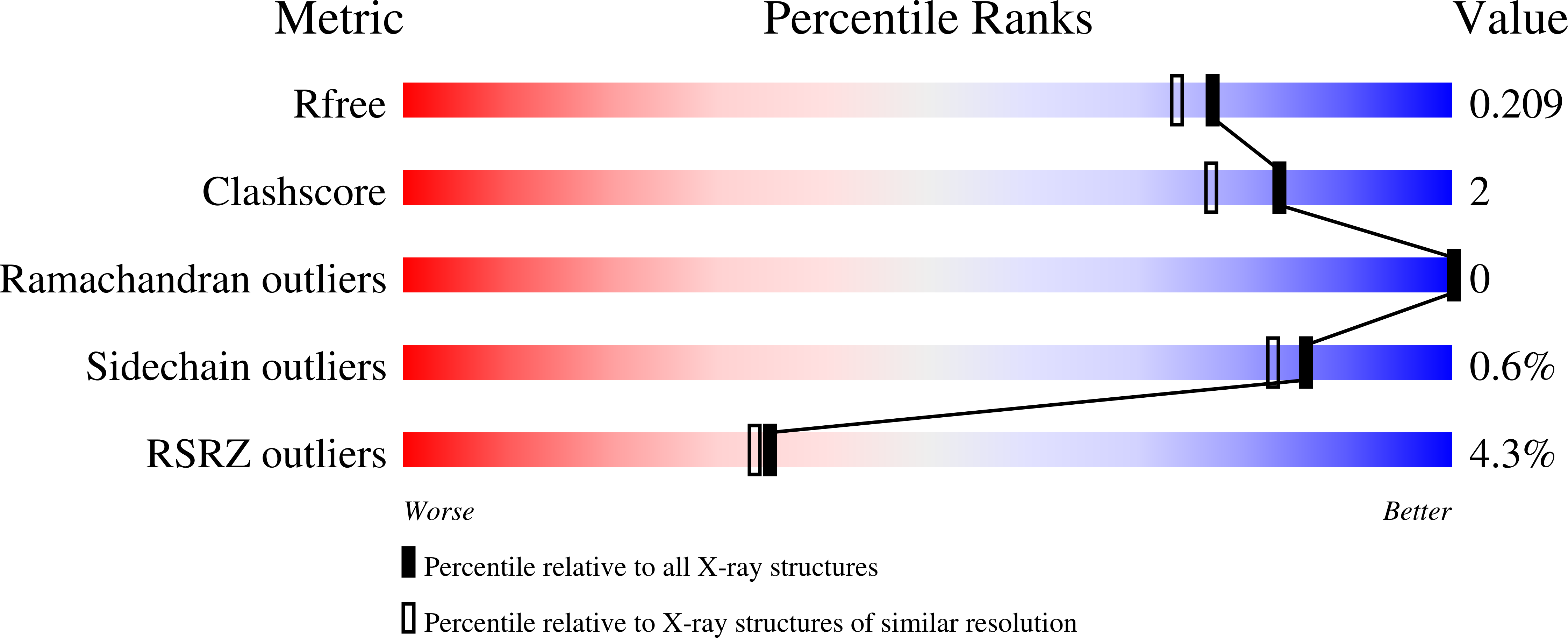
1.85 Å
R-Value Free:
0.20
R-Value Work:
0.18
R-Value Observed:
0.18
Space Group:
C 1 2 1
Macromolecular Entities
Polymer Type:polypeptide(L)
Molecule:Anti-Nup98 nanobody MS98-27
Chain IDs:A, C
Chain Length:129
Number of Molecules:2
Biological Source:Vicugna pacos
Structures with similar UniProt ID
Protein Blast
Polymer Type:polypeptide(L)
Molecule:Nuclear pore complex protein Nup98
Gene (Uniprot):nup98
Chain IDs:B, D
Chain Length:153
Number of Molecules:2
Biological Source:Xenopus tropicalis
Primary Citation
A checkpoint function for Nup98 in nuclear pore formation suggested by novel inhibitory nanobodies.
Embo J. ? ? ? (2024)
PMID: 38649536 DOI: 10.1038/s44318-024-00081-w

Abstact

Nuclear pore complex (NPC) biogenesis is a still enigmatic example of protein self-assembly. We now introduce several cross-reacting anti-Nup nanobodies for imaging intact nuclear pore complexes from frog to human. We also report a simplified assay that directly tracks postmitotic NPC assembly with added fluorophore-labeled anti-Nup nanobodies. During interphase, NPCs are inserted into a pre-existing nuclear envelope. Monitoring this process is challenging because newly assembled NPCs are indistinguishable from pre-existing ones. We overcame this problem by inserting Xenopus-derived NPCs into human nuclear envelopes and using frog-specific anti-Nup nanobodies for detection. We further asked whether anti-Nup nanobodies could serve as NPC assembly inhibitors. Using a selection strategy against conserved epitopes, we obtained anti-Nup93, Nup98, and Nup155 nanobodies that block Nup-Nup interfaces and arrest NPC assembly. We solved structures of nanobody-target complexes and identified roles for the Nup93 α-solenoid domain in recruiting Nup358 and the Nup214·88·62 complex, as well as for Nup155 and the Nup98 autoproteolytic domain in NPC scaffold assembly. The latter suggests a checkpoint linking pore formation to the assembly of the Nup98-dominated permeability barrier.

Legend

Protein

Chemical

Disease

Primary Citation of related structures
Feedback Form
Name
Email
Institute
Feedback