7N72 image
Deposition Date 2021-06-09
Release Date 2021-11-10
Last Version Date 2025-05-21
Entry Detail
PDB ID:
7N72
Title:
Cryo-EM structure of ATP13A2 in the AlF-bound E2-Pi-like state
Biological Source:
Source Organism:
Homo sapiens (Taxon ID: 9606)
Host Organism:
Method Details:
Experimental Method:
Resolution:
2.50 Å
Aggregation State:
PARTICLE
Reconstruction Method:
SINGLE PARTICLE
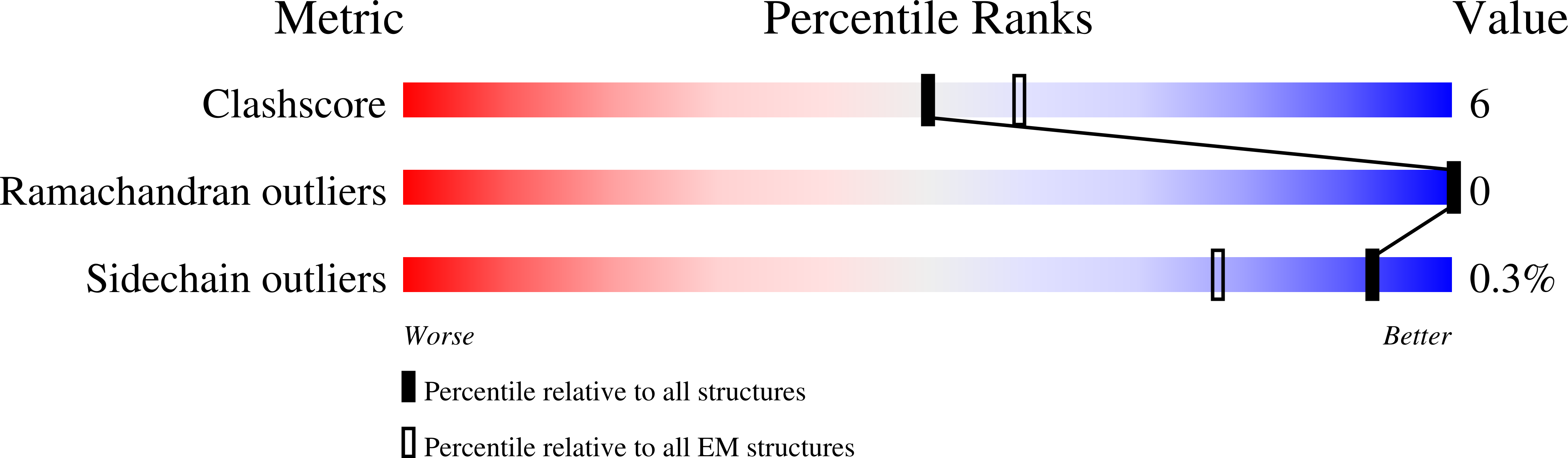
Macromolecular Entities
Structures with similar UniProt ID
Protein Blast
Polymer Type:polypeptide(L)
Molecule:Isoform 3 of Polyamine-transporting ATPase 13A2
Gene (Uniprot):ATP13A2
Chain IDs:A
Chain Length:1175
Number of Molecules:1
Biological Source:Homo sapiens
Primary Citation
Structural basis of polyamine transport by human ATP13A2 (PARK9).
Mol.Cell 81 4635 4649.e8 (2021)
PMID: 34715013 DOI: 10.1016/j.molcel.2021.08.017

Abstact

Polyamines are small, organic polycations that are ubiquitous and essential to all forms of life. Currently, how polyamines are transported across membranes is not understood. Recent studies have suggested that ATP13A2 and its close homologs, collectively known as P5B-ATPases, are polyamine transporters at endo-/lysosomes. Loss-of-function mutations of ATP13A2 in humans cause hereditary early-onset Parkinson's disease. To understand the polyamine transport mechanism of ATP13A2, we determined high-resolution cryoelectron microscopy (cryo-EM) structures of human ATP13A2 in five distinct conformational intermediates, which together, represent a near-complete transport cycle of ATP13A2. The structural basis of the polyamine specificity was revealed by an endogenous polyamine molecule bound to a narrow, elongated cavity within the transmembrane domain. The structures show an atypical transport path for a water-soluble substrate, in which polyamines may exit within the cytosolic leaflet of the membrane. Our study provides important mechanistic insights into polyamine transport and a framework to understand the functions and mechanisms of P5B-ATPases.

Legend

Protein

Chemical

Disease

Primary Citation of related structures
Feedback Form
Name
Email
Institute
Feedback