7MTA image
Deposition Date 2021-05-13
Release Date 2021-07-07
Last Version Date 2024-11-06
Entry Detail
PDB ID:
7MTA
Title:
Rhodopsin kinase (GRK1)-S5E/S488E/T489E in complex with rhodopsin and Fab1
Biological Source:
Source Organism:
Bos taurus (Taxon ID: 9913)
Homo sapiens (Taxon ID: 9606)
Host Organism:
Method Details:
Experimental Method:
Resolution:
4.10 Å
Aggregation State:
PARTICLE
Reconstruction Method:
SINGLE PARTICLE
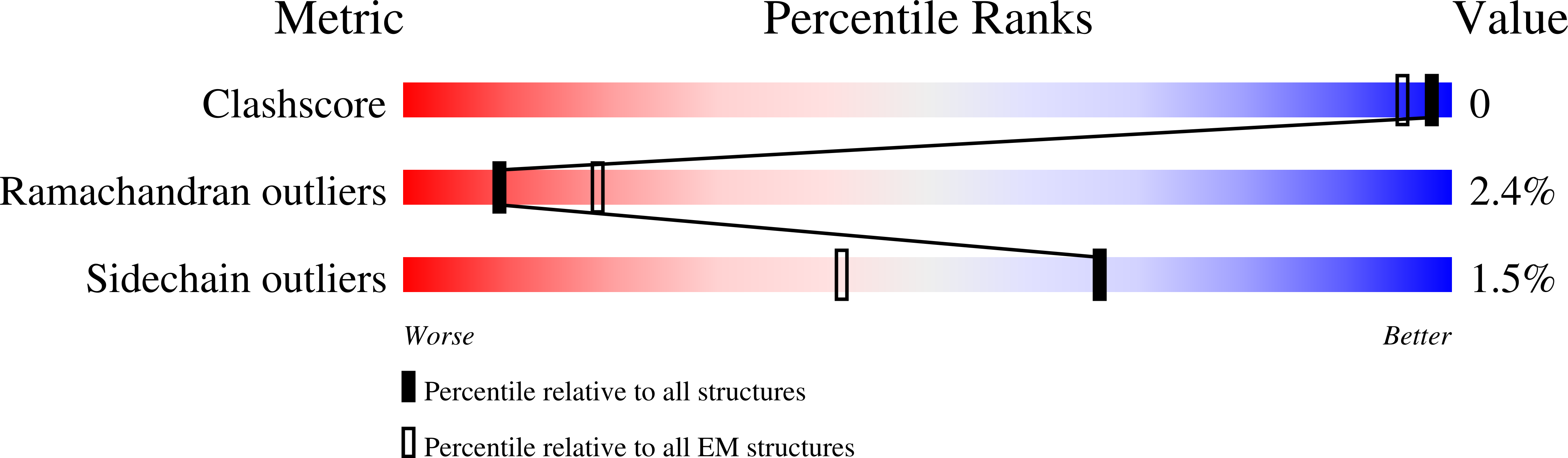
Macromolecular Entities
Structures with similar UniProt ID
Protein Blast
Polymer Type:polypeptide(L)
Molecule:Rhodopsin kinase GRK1
Gene (Uniprot):GRK1
Mutagens:S5E, S488E, T489E
Chain IDs:A (auth: G)
Chain Length:543
Number of Molecules:1
Biological Source:Bos taurus
Polymer Type:polypeptide(L)
Molecule:Fab1 Heavy chain
Chain IDs:B (auth: H)
Chain Length:234
Number of Molecules:1
Biological Source:Homo sapiens
Polymer Type:polypeptide(L)
Molecule:Fab1 Light chain
Chain IDs:C (auth: L)
Chain Length:217
Number of Molecules:1
Biological Source:Homo sapiens
Structures with similar UniProt ID
Protein Blast
Polymer Type:polypeptide(L)
Molecule:Rhodopsin
Gene (Uniprot):RHO
Chain IDs:D (auth: R)
Chain Length:348
Number of Molecules:1
Biological Source:Bos taurus
Primary Citation
Structures of rhodopsin in complex with G-protein-coupled receptor kinase 1.
Nature 595 600 605 (2021)
PMID: 34262173 DOI: 10.1038/s41586-021-03721-x

Abstact

G-protein-coupled receptor (GPCR) kinases (GRKs) selectively phosphorylate activated GPCRs, thereby priming them for desensitization1. Although it is unclear how GRKs recognize these receptors2-4, a conserved region at the GRK N terminus is essential for this process5-8. Here we report a series of cryo-electron microscopy single-particle reconstructions of light-activated rhodopsin (Rho*) bound to rhodopsin kinase (GRK1), wherein the N terminus of GRK1 forms a helix that docks into the open cytoplasmic cleft of Rho*. The helix also packs against the GRK1 kinase domain and stabilizes it in an active configuration. The complex is further stabilized by electrostatic interactions between basic residues that are conserved in most GPCRs and acidic residues that are conserved in GRKs. We did not observe any density for the regulator of G-protein signalling homology domain of GRK1 or the C terminus of rhodopsin. Crosslinking with mass spectrometry analysis confirmed these results and revealed dynamic behaviour in receptor-bound GRK1 that would allow the phosphorylation of multiple sites in the receptor tail. We have identified GRK1 residues whose mutation augments kinase activity and crosslinking with Rho*, as well as residues that are involved in activation by acidic phospholipids. From these data, we present a general model for how a small family of protein kinases can recognize and be activated by hundreds of different GPCRs.

Legend

Protein

Chemical

Disease

Primary Citation of related structures
Feedback Form
Name
Email
Institute
Feedback