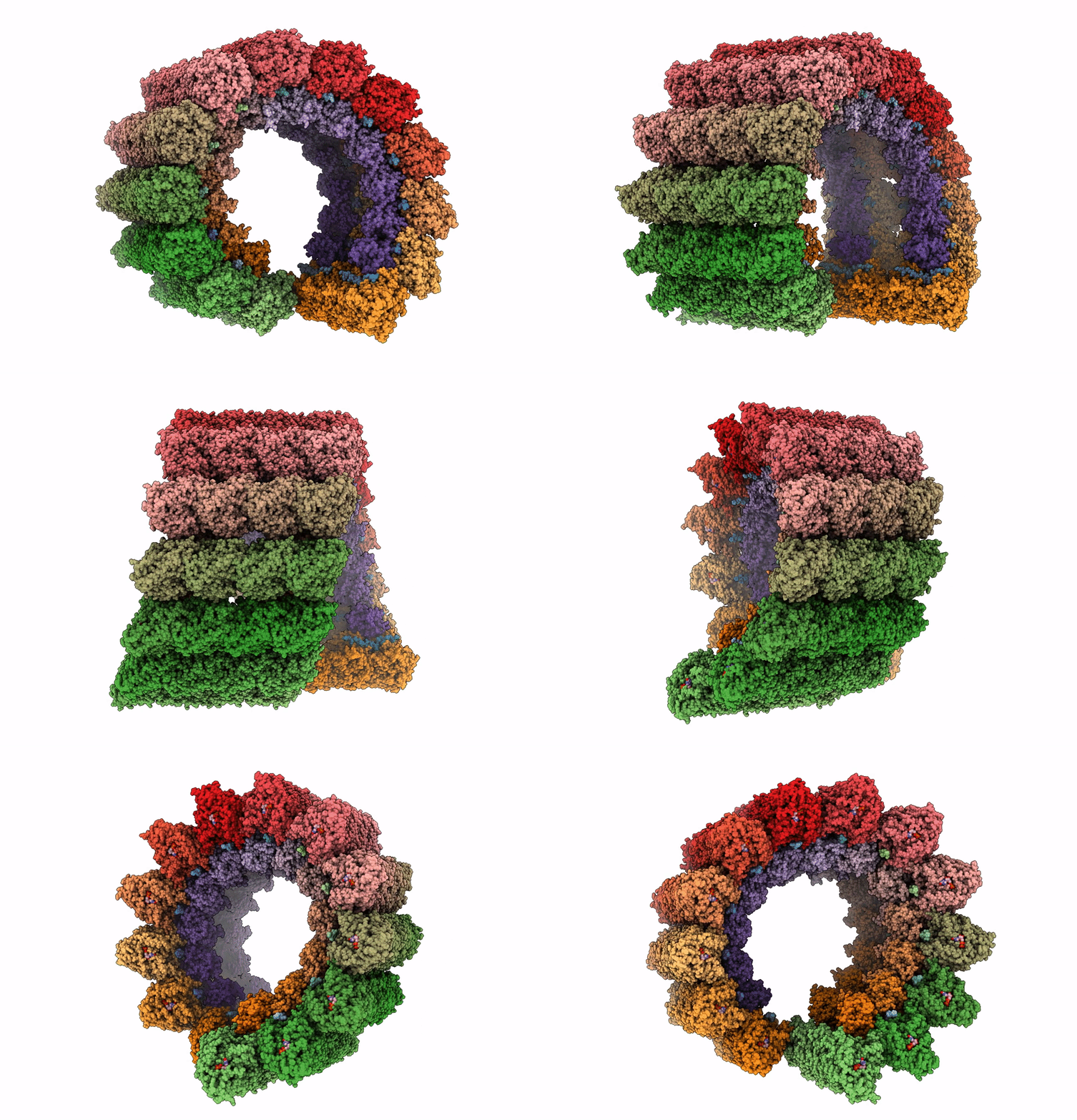
7MIZ image
Deposition Date 2021-04-18
Release Date 2021-06-02
Last Version Date 2024-10-23
Entry Detail
PDB ID:
7MIZ
Title:
Atomic structure of cortical microtubule from Toxoplasma gondii
Biological Source:
Source Organism:
Method Details:
Experimental Method:
Resolution:
3.40 Å
Aggregation State:
FILAMENT
Reconstruction Method:
SINGLE PARTICLE

Macromolecular Entities
Structures with similar UniProt ID
Protein Blast
Polymer Type:polypeptide(L)
Molecule:Microtubule associated protein SPM1
Gene (Uniprot):TGRH88_067480
Chain IDs:A (auth: 0), B (auth: 1), C (auth: 2), D (auth: 3), E (auth: 4), F (auth: 5), G (auth: 6), H (auth: 7), I (auth: 8), J (auth: 9), K (auth: 10), L (auth: 11), M (auth: 12), N (auth: 13), O (auth: 14), P (auth: 15), Q (auth: 16), R (auth: 17), S (auth: 18), T (auth: 19), U (auth: 20), V (auth: 21), SC (auth: 22), TC (auth: 23)
Chain Length:351
Number of Molecules:24
Biological Source:Toxoplasma gondii
Structures with similar UniProt ID
Protein Blast
Polymer Type:polypeptide(L)
Molecule:Tubulin alpha chain
Chain IDs:W (auth: A0), Y (auth: A2), AA (auth: A4), CA (auth: A6), EA (auth: A8), GA (auth: B0), IA (auth: B2), KA (auth: B4), MA (auth: B6), OA (auth: B8), QA (auth: C0), SA (auth: C2), UA (auth: C4), WA (auth: C6), YA (auth: C8), AB (auth: D0), CB (auth: D2), EB (auth: D4), GB (auth: D6), IB (auth: D8), KB (auth: E0), MB (auth: E2), OB (auth: E4), QB (auth: E6), SB (auth: E8), UB (auth: F0)
Chain Length:453
Number of Molecules:26
Biological Source:Toxoplasma gondii
Structures with similar UniProt ID
Protein Blast
Polymer Type:polypeptide(L)
Molecule:Tubulin beta chain
Gene (Uniprot):BTUB
Chain IDs:X (auth: A1), Z (auth: A3), BA (auth: A5), DA (auth: A7), FA (auth: A9), HA (auth: B1), JA (auth: B3), LA (auth: B5), NA (auth: B7), PA (auth: B9), RA (auth: C1), TA (auth: C3), VA (auth: C5), XA (auth: C7), ZA (auth: C9), BB (auth: D1), DB (auth: D3), FB (auth: D5), HB (auth: D7), JB (auth: D9), LB (auth: E1), NB (auth: E3), PB (auth: E5), RB (auth: E7), TB (auth: E9), VB (auth: F1)
Chain Length:449
Number of Molecules:26
Biological Source:Toxoplasma gondii
Structures with similar UniProt ID
Protein Blast
Polymer Type:polypeptide(L)
Molecule:PDI family protein
Gene (Uniprot):p25
Chain IDs:WB (auth: a), XB (auth: b), YB (auth: c), ZB (auth: d), AC (auth: e), BC (auth: f), CC (auth: g), DC (auth: h), EC (auth: i), FC (auth: j), IC (auth: o), JC (auth: p), KC (auth: q), LC (auth: r), MC (auth: s), NC (auth: t), OC (auth: u), PC (auth: v), UC (auth: n), VC (auth: m)
Chain Length:220
Number of Molecules:20
Biological Source:Toxoplasma gondii
Structures with similar UniProt ID
Protein Blast
Polymer Type:polypeptide(L)
Molecule:PDI family protein
Gene (Uniprot):TGRH88_045420
Chain IDs:GC (auth: k), HC (auth: l), QC (auth: w), RC (auth: x)
Chain Length:189
Number of Molecules:4
Biological Source:Toxoplasma gondii
Primary Citation
Cryo-EM structure of cortical microtubules from human parasite Toxoplasma gondii identifies their microtubule inner proteins.
Nat Commun 12 3065 3065 (2021)
PMID: 34031406 DOI: 10.1038/s41467-021-23351-1

Abstact

In living cells, microtubules (MTs) play pleiotropic roles, which require very different mechanical properties. Unlike the dynamic MTs found in the cytoplasm of metazoan cells, the specialized cortical MTs from Toxoplasma gondii, a prevalent human pathogen, are extraordinarily stable and resistant to detergent and cold treatments. Using single-particle cryo-EM, we determine their ex vivo structure and identify three proteins (TrxL1, TrxL2 and SPM1) as bona fide microtubule inner proteins (MIPs). These three MIPs form a mesh on the luminal surface and simultaneously stabilize the tubulin lattice in both longitudinal and lateral directions. Consistent with previous observations, deletion of the identified MIPs compromises MT stability and integrity under challenges by chemical treatments. We also visualize a small molecule like density at the Taxol-binding site of β-tubulin. Our results provide the structural basis to understand the stability of cortical MTs and suggest an evolutionarily conserved mechanism of MT stabilization from the inside.

Legend

Protein

Chemical

Disease

Primary Citation of related structures
Feedback Form
Name
Email
Institute
Feedback