7LJ1 image
Deposition Date 2021-01-28
Release Date 2021-07-14
Last Version Date 2024-11-06
Entry Detail
PDB ID:
7LJ1
Keywords:
Title:
Human Prx1-Srx Decameric Complex
Biological Source:
Source Organism:
Homo sapiens (Taxon ID: 9606)
Host Organism:
Method Details:
Experimental Method:
Resolution:
2.97 Å
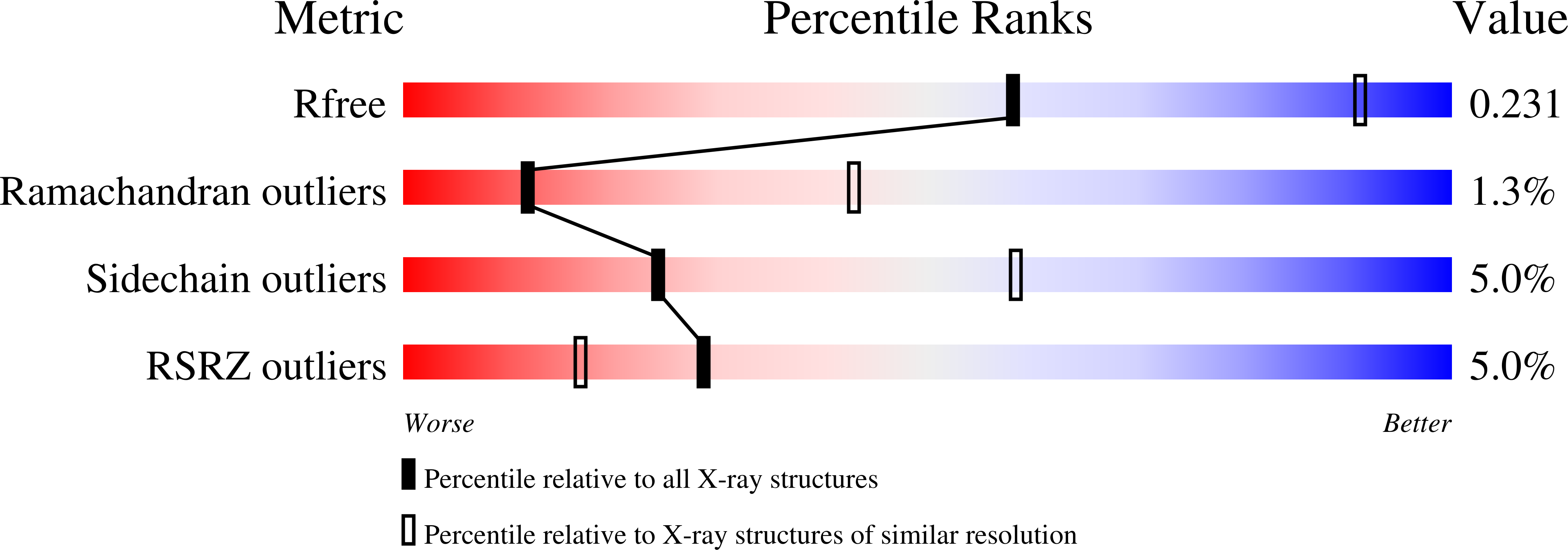
R-Value Free:
0.23
R-Value Work:
0.19
R-Value Observed:
0.19
Space Group:
C 1 2 1
Macromolecular Entities
Structures with similar UniProt ID
Protein Blast
Polymer Type:polypeptide(L)
Molecule:Peroxiredoxin-1
Gene (Uniprot):PRDX1
Mutagens:C71S,C83V,C173S
Chain IDs:A, C (auth: B), D (auth: C), E (auth: D), F (auth: E), G (auth: F), H (auth: G), I (auth: H), J (auth: I), K (auth: J), L (auth: K), M (auth: L), N (auth: M), O (auth: N), P (auth: O), Q (auth: P), R (auth: Q), S (auth: R), T (auth: S), U (auth: T)
Chain Length:199
Number of Molecules:20
Biological Source:Homo sapiens
Structures with similar UniProt ID
Protein Blast
Polymer Type:polypeptide(L)
Molecule:Sulfiredoxin-1
Gene (Uniprot):SRXN1
Chain IDs:B (auth: a), V (auth: b), W (auth: c), X (auth: d), Y (auth: e), Z (auth: f), AA (auth: g), BA (auth: h), CA (auth: i), DA (auth: j), EA (auth: k), FA (auth: l), GA (auth: m), HA (auth: n), IA (auth: o), JA (auth: p), KA (auth: q), LA (auth: r), MA (auth: s), NA (auth: t)
Chain Length:199
Number of Molecules:20
Biological Source:Homo sapiens
Primary Citation
Specificity of Human Sulfiredoxin for Reductant and Peroxiredoxin Oligomeric State.
Antioxidants (Basel) 10 ? ? (2021)
PMID: 34208049 DOI: 10.3390/antiox10060946

Abstact

Human peroxiredoxins (Prx) are a family of antioxidant enzymes involved in a myriad of cellular functions and diseases. During the reaction with peroxides (e.g., H2O2), the typical 2-Cys Prxs change oligomeric structure between higher order (do)decamers and disulfide-linked dimers, with the hyperoxidized inactive state (-SO2H) favoring the multimeric structure of the reduced enzyme. Here, we present a study on the structural requirements for the repair of hyperoxidized 2-Cys Prxs by human sulfiredoxin (Srx) and the relative efficacy of physiological reductants hydrogen sulfide (H2S) and glutathione (GSH) in this reaction. The crystal structure of the toroidal Prx1-Srx complex shows an extended active site interface. The loss of this interface within engineered Prx2 and Prx3 dimers yielded variants more resistant to hyperoxidation and repair by Srx. Finally, we reveal for the first time Prx isoform-dependent use of and potential cooperation between GSH and H2S in supporting Srx activity.

Legend

Protein

Chemical

Disease

Primary Citation of related structures
Feedback Form
Name
Email
Institute
Feedback