7L9P image
Deposition Date 2021-01-04
Release Date 2021-03-03
Last Version Date 2025-05-28
Entry Detail
PDB ID:
7L9P
Keywords:
Title:
Structure of human SHLD2-SHLD3-REV7-TRIP13(E253Q) complex
Biological Source:
Source Organism:
Homo sapiens (Taxon ID: 9606)
Method Details:
Experimental Method:
Resolution:
3.60 Å
Aggregation State:
PARTICLE
Reconstruction Method:
SINGLE PARTICLE
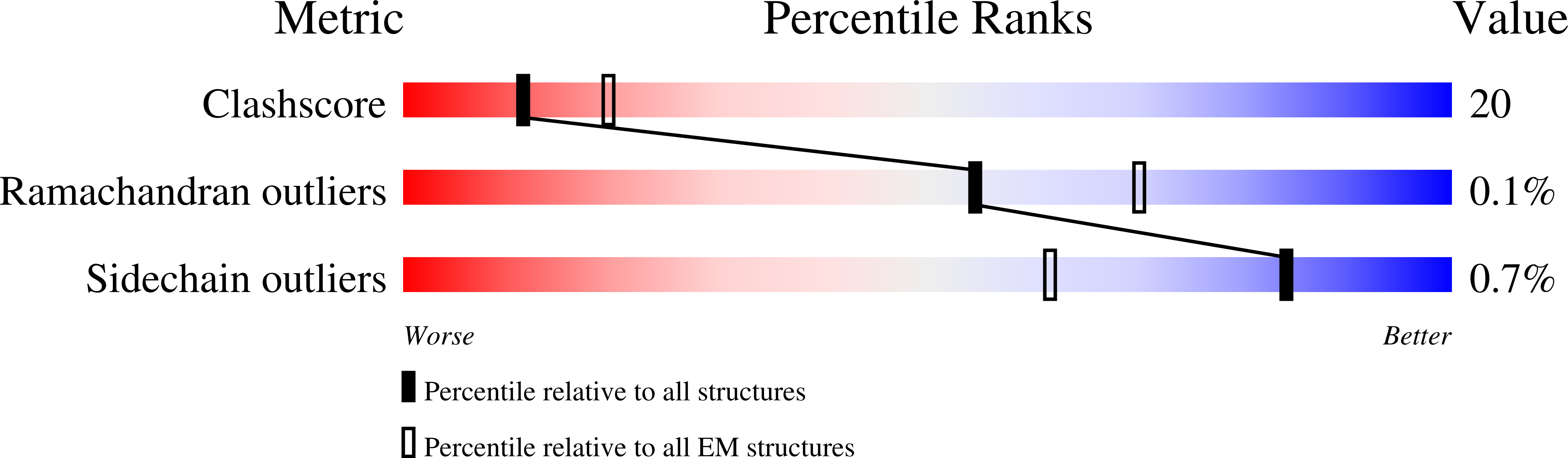
Macromolecular Entities
Structures with similar UniProt ID
Protein Blast
Polymer Type:polypeptide(L)
Molecule:Pachytene checkpoint protein 2 homolog
Gene (Uniprot):TRIP13
Mutagens:E253Q
Chain IDs:A, B, C, D, E, F
Chain Length:432
Number of Molecules:6
Biological Source:Homo sapiens
Structures with similar UniProt ID
Protein Blast
Polymer Type:polypeptide(L)
Molecule:Mitotic spindle assembly checkpoint protein MAD2B
Gene (Uniprot):MAD2L2
Chain IDs:G, H (auth: I), I (auth: J), J (auth: K)
Chain Length:211
Number of Molecules:4
Biological Source:Homo sapiens
Protein Blast
Polymer Type:polypeptide(L)
Molecule:Shieldin complex subunit 2, Shieldin complex subunit 3 chimera
Gene (Uniprot):SHLD3, SHLD2
Chain IDs:K (auth: Y), L (auth: X)
Chain Length:99
Number of Molecules:2
Biological Source:Homo sapiens
Ligand Molecules
Primary Citation
Molecular mechanisms of assembly and TRIP13-mediated remodeling of the human Shieldin complex.
Proc.Natl.Acad.Sci.USA 118 ? ? (2021)
PMID: 33597306 DOI: 10.1073/pnas.2024512118

Abstact

The Shieldin complex, composed of REV7, SHLD1, SHLD2, and SHLD3, protects DNA double-strand breaks (DSBs) to promote nonhomologous end joining. The AAA+ ATPase TRIP13 remodels Shieldin to regulate DNA repair pathway choice. Here we report crystal structures of human SHLD3-REV7 binary and fused SHLD2-SHLD3-REV7 ternary complexes, revealing that assembly of Shieldin requires fused SHLD2-SHLD3 induced conformational heterodimerization of open (O-REV7) and closed (C-REV7) forms of REV7. We also report the cryogenic electron microscopy (cryo-EM) structures of the ATPγS-bound fused SHLD2-SHLD3-REV7-TRIP13 complexes, uncovering the principles underlying the TRIP13-mediated disassembly mechanism of the Shieldin complex. We demonstrate that the N terminus of REV7 inserts into the central channel of TRIP13, setting the stage for pulling the unfolded N-terminal peptide of C-REV7 through the central TRIP13 hexameric channel. The primary interface involves contacts between the safety-belt segment of C-REV7 and a conserved and negatively charged loop of TRIP13. This process is mediated by ATP hydrolysis-triggered rotatory motions of the TRIP13 ATPase, thereby resulting in the disassembly of the Shieldin complex.

Legend

Protein

Chemical

Disease

Primary Citation of related structures
Feedback Form
Name
Email
Institute
Feedback