7L5F image
Deposition Date 2020-12-22
Release Date 2021-07-28
Last Version Date 2023-10-18
Entry Detail
PDB ID:
7L5F
Title:
Crystal Structure of N-(2-oxocyclobutyl) decanamide Bound AiiA-Co
Biological Source:
Source Organism:
Host Organism:
Method Details:
Experimental Method:
Resolution:
1.51 Å
R-Value Free:
0.18
R-Value Work:
0.13
R-Value Observed:
0.13
Space Group:
P 21 21 21
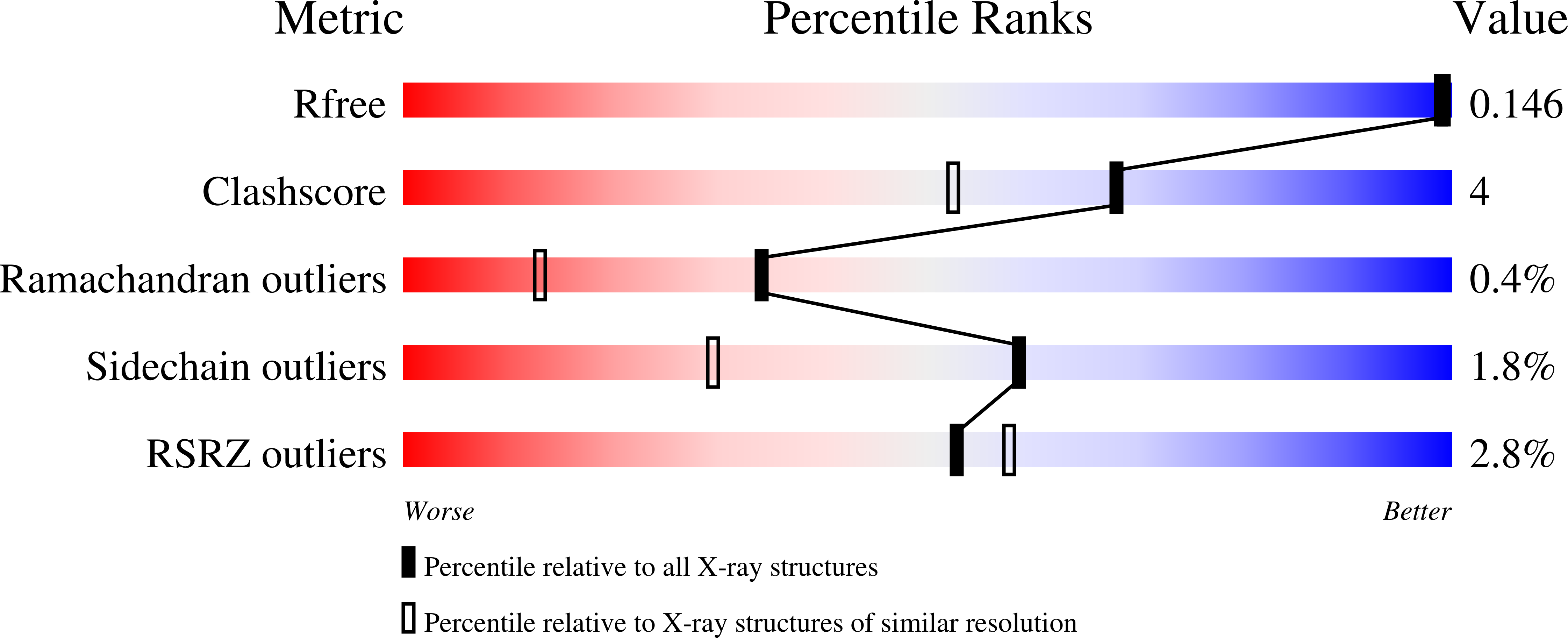
Macromolecular Entities
Structures with similar UniProt ID
Protein Blast
Polymer Type:polypeptide(L)
Molecule:N-acyl homoserine lactonase AiiA
Gene (Uniprot):aiiA
Chain IDs:A
Chain Length:250
Number of Molecules:1
Biological Source:Bacillus thuringiensis subsp. kurstaki
Primary Citation
Cyclobutanone Inhibitor of Cobalt-Functionalized Metallo-gamma-Lactonase AiiA with Cyclobutanone Ring Opening in the Active Site.
Acs Omega 6 13567 13578 (2021)
PMID: 34095651 DOI: 10.1021/acsomega.0c06348

Abstact

An α-amido cyclobutanone possessing a C10 hydrocarbon tail was designed as a potential transition-state mimetic for the quorum-quenching metallo-γ-lactonase autoinducer inactivator A (AiiA) with the support of in-house modeling techniques and found to be a competitive inhibitor of dicobalt(II) AiiA with an inhibition constant of K i = 0.007 ± 0.002 mM. The catalytic mechanism of AiiA was further explored using our product-based transition-state modeling (PBTSM) computational approach, providing substrate-intermediate models arising during enzyme turnover and further insight into substrate-enzyme interactions governing native substrate catalysis. These interactions were targeted in the docking of cyclobutanone hydrates into the active site of AiiA. The X-ray crystal structure of dicobalt(II) AiiA cocrystallized with this cyclobutanone inhibitor unexpectedly revealed an N-(2-oxocyclobutyl)decanamide ring-opened acyclic product bound to the enzyme active site (PDB 7L5F). The C10 alkyl chain and its interaction with the hydrophobic phenylalanine clamp region of AiiA adjacent to the active site enabled atomic placement of the ligand atoms, including the C10 alkyl chain. A mechanistic hypothesis for the ring opening is proposed involving a radical-mediated process.

Legend

Protein

Chemical

Disease

Primary Citation of related structures
Feedback Form
Name
Email
Institute
Feedback