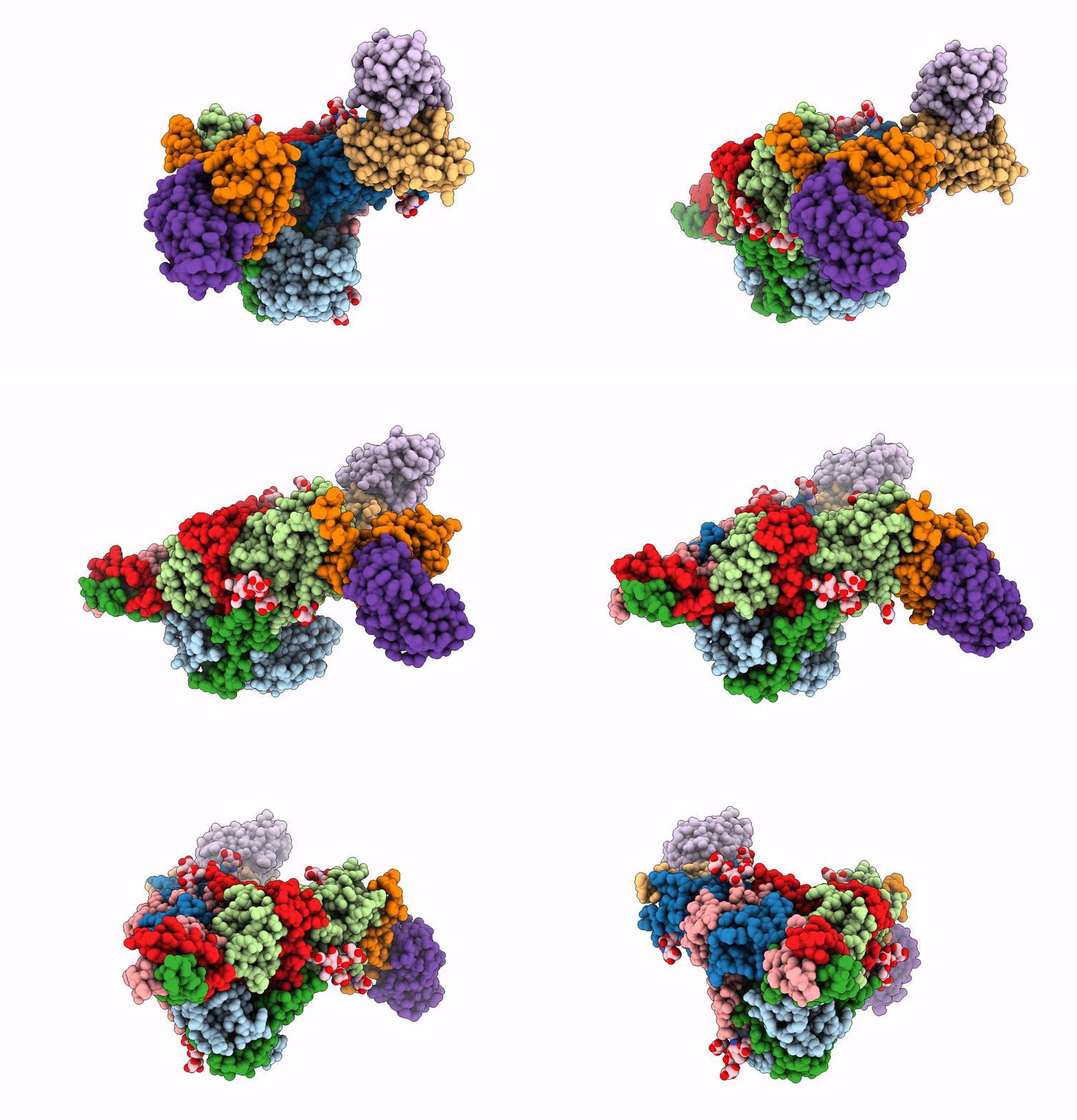
7KFE image
Deposition Date 2020-10-13
Release Date 2021-04-28
Last Version Date 2024-11-06
Entry Detail
PDB ID:
7KFE
Title:
Bundibugyo virus GP (mucin deleted) bound to antibody Fab BDBV-329
Biological Source:
Source Organism:
Host Organism:
Method Details:
Experimental Method:
Resolution:
6.60 Å
Aggregation State:
PARTICLE
Reconstruction Method:
SINGLE PARTICLE
Macromolecular Entities
Structures with similar UniProt ID
Protein Blast
Polymer Type:polypeptide(L)
Molecule:Spike glycoprotein 1
Chain IDs:E (auth: A), G (auth: B), I (auth: C)
Chain Length:343
Number of Molecules:3
Biological Source:Bundibugyo ebolavirus
Structures with similar UniProt ID
Protein Blast
Polymer Type:polypeptide(L)
Molecule:Envelope glycoprotein 2
Gene (Uniprot):GP
Chain IDs:F (auth: D), H (auth: E), J (auth: F)
Chain Length:177
Number of Molecules:3
Biological Source:Bundibugyo ebolavirus
Polymer Type:polypeptide(L)
Molecule:Antibody BDBV-329 heavy chain
Chain IDs:A (auth: H), C (auth: G)
Chain Length:244
Number of Molecules:2
Biological Source:Homo sapiens
Polymer Type:polypeptide(L)
Molecule:Antibody BDBV-329 light chain
Chain IDs:B (auth: J), D (auth: I)
Chain Length:215
Number of Molecules:2
Biological Source:Homo sapiens
Ligand Molecules
Primary Citation
Convergence of a common solution for broad ebolavirus neutralization by glycan cap-directed human antibodies.
Cell Rep 35 108984 108984 (2021)
PMID: 33852862 DOI: 10.1016/j.celrep.2021.108984

Abstact

Antibodies that target the glycan cap epitope on the ebolavirus glycoprotein (GP) are common in the adaptive response of survivors. A subset is known to be broadly neutralizing, but the details of their epitopes and basis for neutralization are not well understood. Here, we present cryoelectron microscopy (cryo-EM) structures of diverse glycan cap antibodies that variably synergize with GP base-binding antibodies. These structures describe a conserved site of vulnerability that anchors the mucin-like domains (MLDs) to the glycan cap, which we call the MLD anchor and cradle. Antibodies that bind to the MLD cradle share common features, including use of IGHV1-69 and IGHJ6 germline genes, which exploit hydrophobic residues and form β-hairpin structures to mimic the MLD anchor, disrupt MLD attachment, destabilize GP quaternary structure, and block cleavage events required for receptor binding. Our results provide a molecular basis for ebolavirus neutralization by broadly reactive glycan cap antibodies.

Legend

Protein

Chemical

Disease

Primary Citation of related structures
Feedback Form
Name
Email
Institute
Feedback