7K34 image
Deposition Date 2020-09-10
Release Date 2020-12-30
Last Version Date 2023-11-15
Entry Detail
PDB ID:
7K34
Title:
Crystal structure of L-threonine transaldolase from Pseudomonas fluorescens in internal aldimine state
Biological Source:
Source Organism:
Method Details:
Experimental Method:
Resolution:
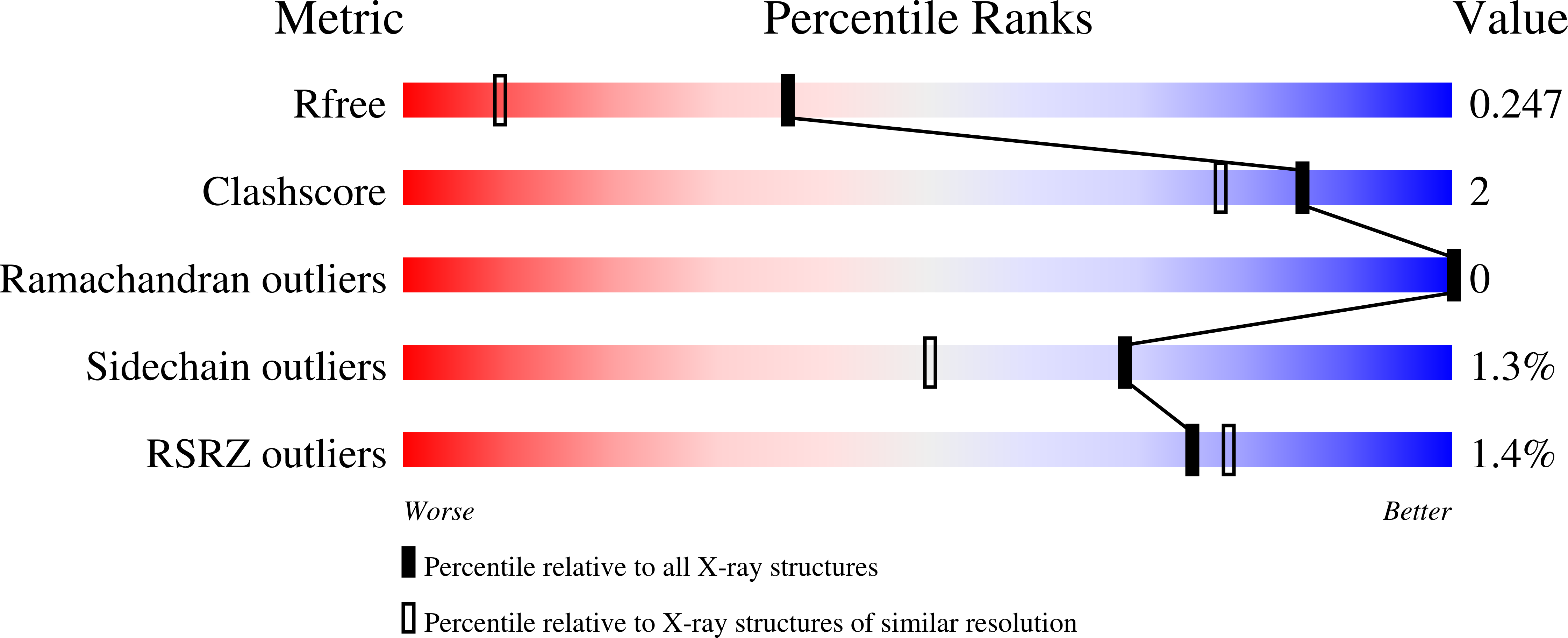
1.66 Å
R-Value Free:
0.24
R-Value Work:
0.21
Space Group:
P 41
Macromolecular Entities
Structures with similar UniProt ID
Protein Blast
Polymer Type:polypeptide(L)
Molecule:Threonine aldolase
Gene (Uniprot):obiH
Chain IDs:A, B, C, D
Chain Length:452
Number of Molecules:4
Biological Source:Pseudomonas fluorescens
Modified Residue
Compound ID Chain ID Parent Comp ID Details 2D Image
LLP A LYS modified residue
Ligand Molecules
Primary Citation
l-Threonine Transaldolase Activity Is Enabled by a Persistent Catalytic Intermediate.
Acs Chem.Biol. 16 86 95 (2021)
PMID: 33337128 DOI: 10.1021/acschembio.0c00753

Abstact

l-Threonine transaldolases (lTTAs) are a poorly characterized class of pyridoxal-5'-phosphate (PLP) dependent enzymes responsible for the biosynthesis of diverse β-hydroxy amino acids. Here, we study the catalytic mechanism of ObiH, an lTTA essential for biosynthesis of the β-lactone natural product obafluorin. Heterologously expressed ObiH purifies as a mixture of chemical states including a catalytically inactive form of the PLP cofactor. Photoexcitation of ObiH promotes the conversion of the inactive state of the enzyme to the active form. UV-vis spectroscopic analysis reveals that ObiH catalyzes the retro-aldol cleavage of l-threonine to form a remarkably persistent glycyl quinonoid intermediate, with a half-life of ∼3 h. Protonation of this intermediate is kinetically disfavored, enabling on-cycle reactivity with aldehydes to form β-hydroxy amino acids. We demonstrate the synthetic potential of ObiH via the single step synthesis of (2S,3R)-β-hydroxyleucine. To further understand the structural features underpinning this desirable reactivity, we determined the crystal structure of ObiH bound to PLP as the Schiff's base at 1.66 Å resolution. This high-resolution model revealed a unique active site configuration wherein the evolutionarily conserved Asp that traditionally H-bonds to the cofactor is swapped for a neighboring Glu. Molecular dynamics simulations combined with mutagenesis studies indicate that a structural rearrangement is associated with l-threonine entry into the catalytic cycle. Together, these data explain the basis for the unique reactivity of lTTA enzymes and provide a foundation for future engineering and mechanistic analysis.

Legend

Protein

Chemical

Disease

Primary Citation of related structures
Feedback Form
Name
Email
Institute
Feedback