7K16 image
Deposition Date 2020-09-07
Release Date 2020-10-14
Last Version Date 2025-05-21
Entry Detail
PDB ID:
7K16
Keywords:
Title:
Tamana Bat Virus xrRNA1
Biological Source:
Source Organism:
Method Details:
Experimental Method:
Resolution:
2.10 Å
R-Value Free:
0.24
R-Value Work:
0.18
R-Value Observed:
0.19
Space Group:
P 31 2 1
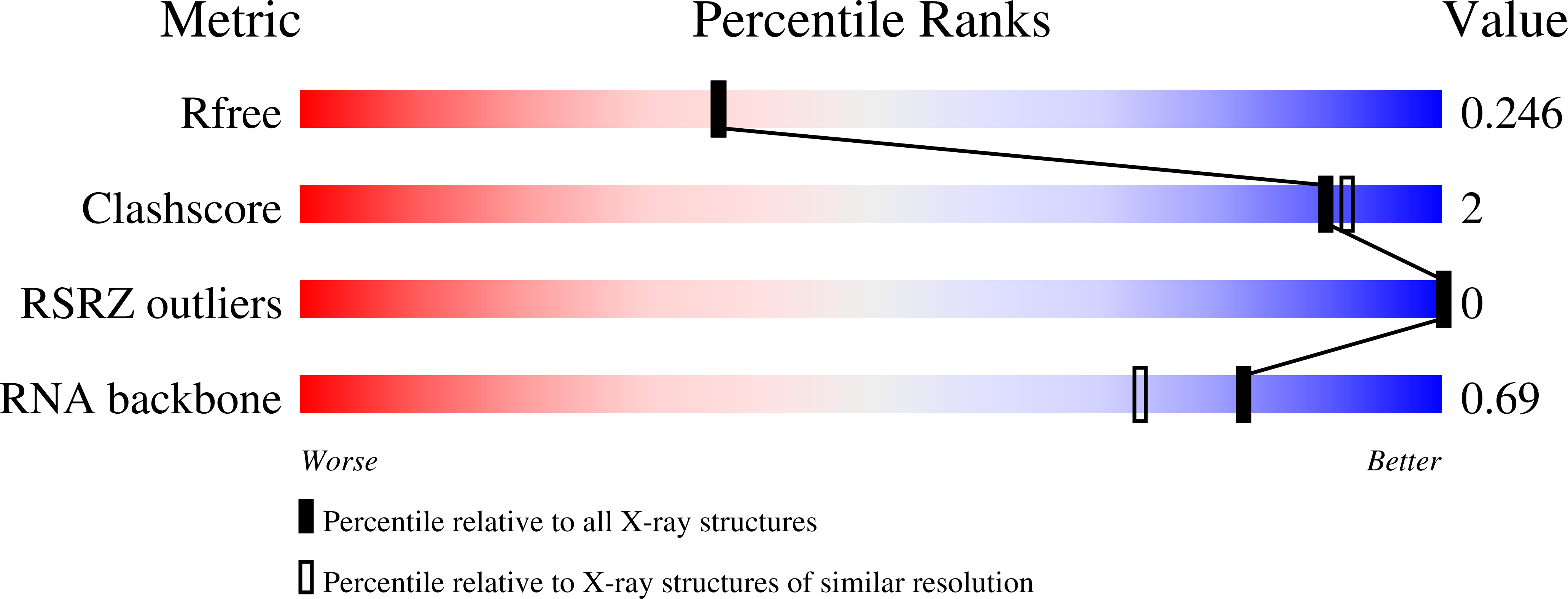
Macromolecular Entities
Polymer Type:polyribonucleotide
Molecule:RNA (51-MER)
Chain IDs:A (auth: P)
Chain Length:51
Number of Molecules:1
Biological Source:Tamana bat virus
Primary Citation
Different tertiary interactions create the same important 3D features in a distinct flavivirus xrRNA.
Rna 27 54 65 (2021)
PMID: 33004436 DOI: 10.1261/rna.077065.120

Abstact

During infection by a flavivirus (FV), cells accumulate noncoding subgenomic flavivirus RNAs (sfRNAs) that interfere with several antiviral pathways. These sfRNAs are formed by structured RNA elements in the 3' untranslated region (UTR) of the viral genomic RNA, which block the progression of host cell exoribonucleases that have targeted the viral RNA. Previous work on these exoribonuclease-resistant RNAs (xrRNAs) from mosquito-borne FVs revealed a specific three-dimensional fold with a unique topology in which a ring-like structure protectively encircles the 5' end of the xrRNA. Conserved nucleotides make specific tertiary interactions that support this fold. Examination of more divergent FVs reveals differences in their 3' UTR sequences, raising the question of whether they contain xrRNAs and if so, how they fold. To answer this, we demonstrated the presence of an authentic xrRNA in the 3' UTR of the Tamana bat virus (TABV) and solved its structure by X-ray crystallography. The structure reveals conserved features from previously characterized xrRNAs, but in the TABV version these features are created through a novel set of tertiary interactions not previously seen in xrRNAs. This includes two important A-C interactions, four distinct backbone kinks, several ordered Mg2+ ions, and a C+-G-C base triple. The discovery that the same overall architecture can be achieved by very different sequences and interactions in distantly related flaviviruses provides insight into the diversity of this type of RNA and will inform searches for undiscovered xrRNAs in viruses and beyond.

Legend

Protein

Chemical

Disease

Primary Citation of related structures
Feedback Form
Name
Email
Institute
Feedback