7F5N image
Deposition Date 2021-06-22
Release Date 2021-12-29
Last Version Date 2023-11-29
Entry Detail
PDB ID:
7F5N
Keywords:
Title:
Crystal structure of TCPTP catalytic domain
Biological Source:
Source Organism:
Homo sapiens (Taxon ID: 9606)
Host Organism:
Method Details:
Experimental Method:
Resolution:
1.93 Å
R-Value Free:
0.23
R-Value Work:
0.18
Space Group:
P 1
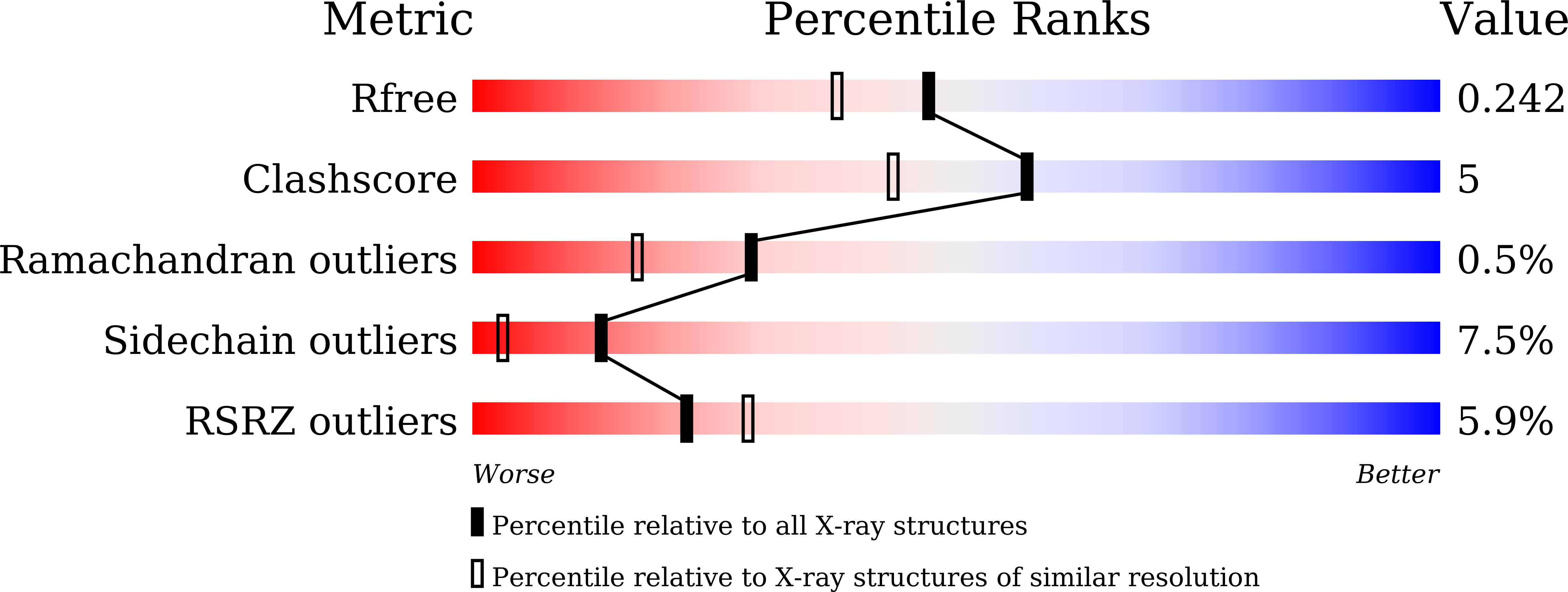
Macromolecular Entities
Structures with similar UniProt ID
Protein Blast
Polymer Type:polypeptide(L)
Molecule:Tyrosine-protein phosphatase non-receptor type 2
Gene (Uniprot):PTPN2
Chain IDs:A, B, C
Chain Length:317
Number of Molecules:3
Biological Source:Homo sapiens
Primary Citation
Crystal Structure of TCPTP Unravels an Allosteric Regulatory Role of Helix alpha 7 in Phosphatase Activity.
Biochemistry 60 3856 3867 (2021)
PMID: 34910875 DOI: 10.1021/acs.biochem.1c00519

Abstact

The T-cell protein tyrosine phosphatase (TCPTP/PTPN2) targets a broad variety of substrates across different subcellular compartments. In spite of that, the structural basis for the regulation of TCPTP's activity remains elusive. Here, we investigated whether the activity of TCPTP is regulated by a potential allosteric site in a comparable manner to its most similar PTP family member (PTP1B/PTPN1). We determined two crystal structures of TCPTP at 1.7 and 1.9 Å resolutions that include helix α7 at the TCPTP C-terminus. Helix α7 has been functionally characterized in PTP1B and was identified as its allosteric switch. However, its function is unknown in TCPTP. Here, we demonstrate that truncation or deletion of helix α7 reduced the catalytic efficiency of TCPTP by ∼4-fold. Collectively, our data supports an allosteric role of helix α7 in regulation of TCPTP's activity, similar to its function in PTP1B, and highlights that the coordination of helix α7 with the core catalytic domain is essential for the efficient catalytic function of TCPTP.

Legend

Protein

Chemical

Disease

Primary Citation of related structures
Feedback Form
Name
Email
Institute
Feedback