7EQI image
Deposition Date 2021-05-02
Release Date 2021-06-09
Last Version Date 2023-11-29
Entry Detail
PDB ID:
7EQI
Keywords:
Title:
ChlB3 [Aceyltransferase]
Biological Source:
Source Organism:
Method Details:
Experimental Method:
Resolution:
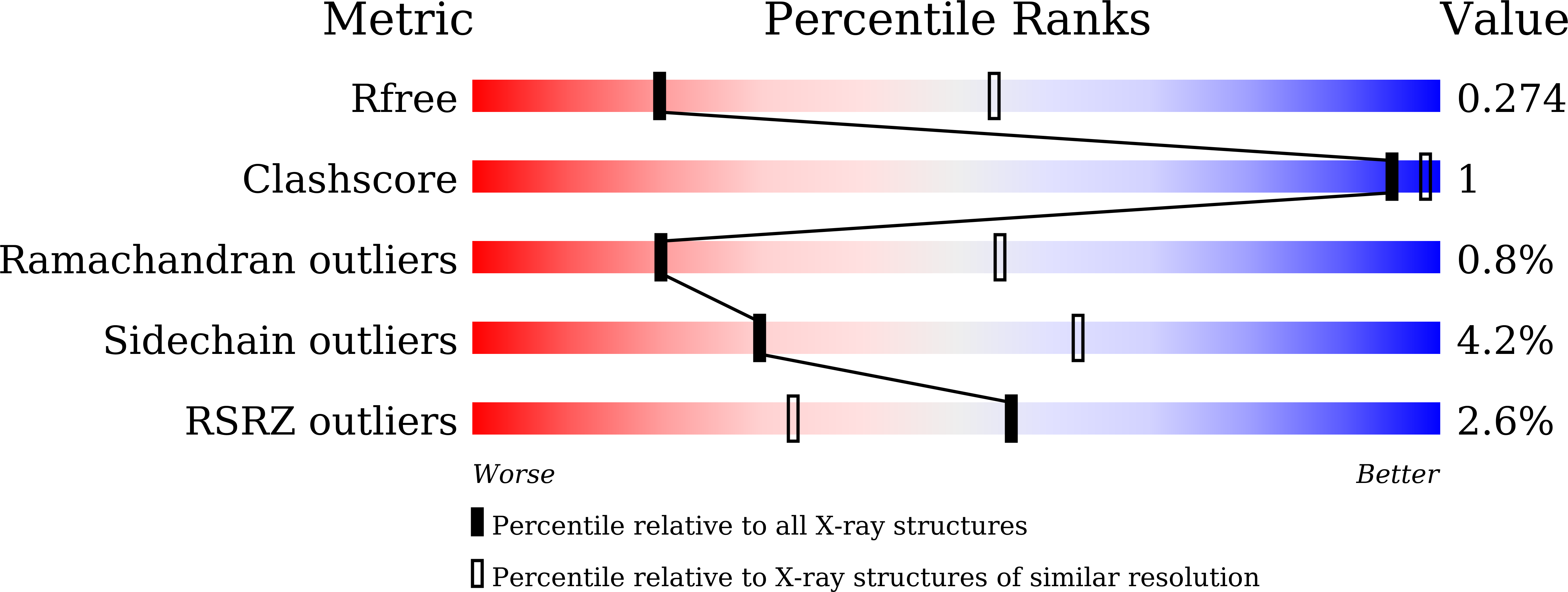
3.10 Å
R-Value Free:
0.25
R-Value Work:
0.22
R-Value Observed:
0.22
Space Group:
P 21 21 21
Macromolecular Entities
Structures with similar UniProt ID
Protein Blast
Polymer Type:polypeptide(L)
Molecule:ChlB3
Chain IDs:A, B, C, D, E, F, G, H
Chain Length:347
Number of Molecules:8
Biological Source:Streptomyces antibioticus
Primary Citation
Structural Insight of KSIII ( beta-Ketoacyl-ACP Synthase)-like Acyltransferase ChlB3 in the Biosynthesis of Chlorothricin.
Molecules 27 ? ? (2022)
PMID: 36234941 DOI: 10.3390/molecules27196405

Abstact

Chlorothricin (CHL) belongs to a spirotetronate antibiotic family produced by Streptomyces antibioticus that inhibits pyruvate carboxylase and malate dehydrogenase. For the biosynthesis of CHL, ChlB3 plays a crucial role by introducing the 6-methylsalicylic acid (6MSA) moiety to ChlB2, an acyl carrier protein (ACP). However, the structural insight and catalytic mechanism of ChlB3 was unclear. In the current study, the crystal structure of ChlB3 was solved at 3.1 Å-resolution and a catalytic mechanism was proposed on the basis of conserved residues of structurally related enzymes. ChlB3 is a dimer having the same active sites as CerJ (a structural homologous enzyme) and uses a KSIII-like fold to work as an acyltransferase. The relaxed substrate specificity of ChlB3 was defined by its catalytic efficiencies (kcat/Km) for non-ACP tethered synthetic substrates such as 6MSA-SNAC, acetyl-SNAC, and cyclohexonyl-SNAC. ChlB3 successfully detached the 6MSA moiety from 6MSA-SNAC substrate and this hydrolytic activity demonstrated that ChlB3 has the potential to catalyze non-ACP tethered substrates. Structural comparison indicated that ChlB3 belongs to FabH family and showed 0.6-2.5 Å root mean square deviation (RMSD) with structural homologous enzymes. Molecular docking and dynamics simulations were implemented to understand substrate active site and structural behavior such as the open and closed conformation of the ChlB3 protein. The resultant catalytic and substrate recognition mechanism suggested that ChlB3 has the potential to use non-native substrates and minimize the labor of expressing ACP protein. This versatile acyltransferase activity may pave the way for manufacturing CHL variants and may help to hydrolyze several thioester-based compounds.

Legend

Protein

Chemical

Disease

Primary Citation of related structures
Feedback Form
Name
Email
Institute
Feedback