7EC0 image
Deposition Date 2021-03-11
Release Date 2021-09-29
Last Version Date 2023-11-29
Entry Detail
PDB ID:
7EC0
Keywords:
Title:
Crystal structure of juvenile hormone acid methyltransferase JHAMT in complex with S-Adenosyl homocysteine and methyl farnesoate
Biological Source:
Source Organism:
Bombyx mori (Taxon ID: 7091)
Host Organism:
Method Details:
Experimental Method:
Resolution:
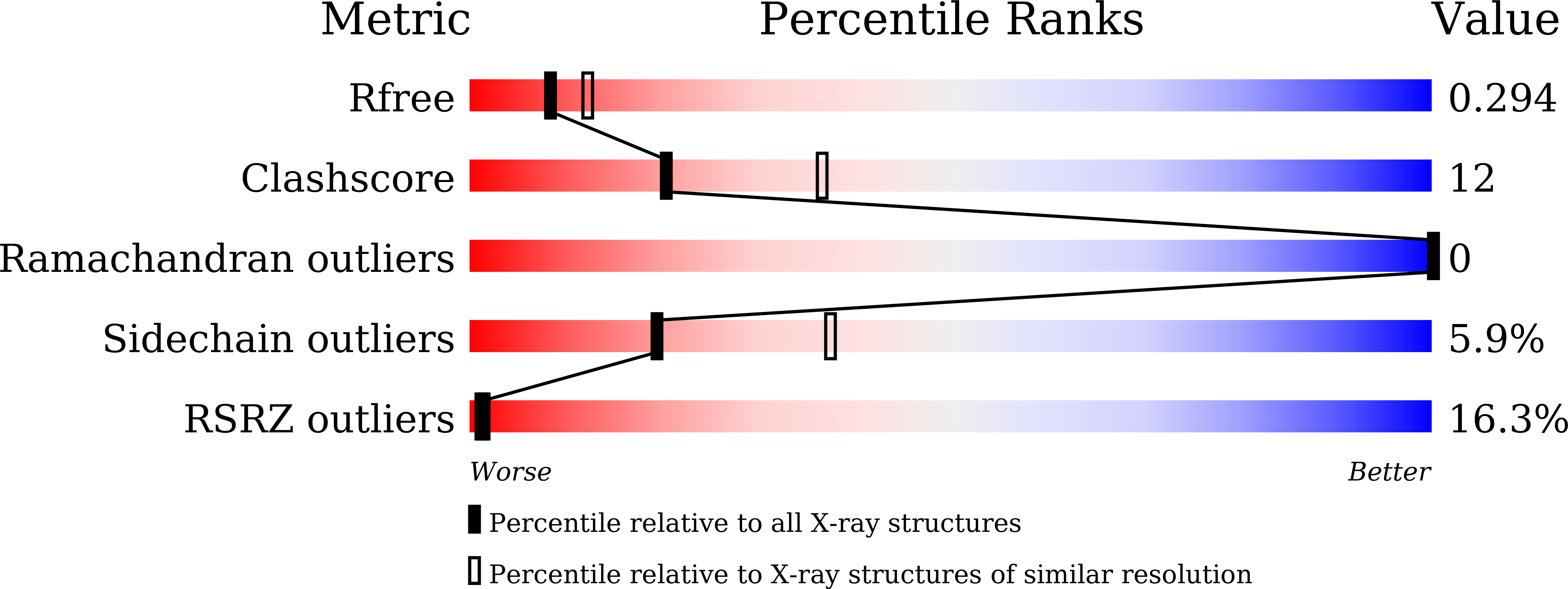
2.49 Å
R-Value Free:
0.29
R-Value Work:
0.24
Space Group:
P 1 21 1
Macromolecular Entities
Structures with similar UniProt ID
Protein Blast
Polymer Type:polypeptide(L)
Molecule:Juvenile hormone acid methyltransferase
Chain IDs:A, B (auth: D), C (auth: G), D (auth: J), E (auth: M), F (auth: P)
Chain Length:288
Number of Molecules:6
Biological Source:Bombyx mori
Primary Citation
Structural basis for juvenile hormone biosynthesis by the juvenile hormone acid methyltransferase.
J.Biol.Chem. 297 101234 101234 (2021)
PMID: 34562453 DOI: 10.1016/j.jbc.2021.101234

Abstact

Juvenile hormone (JH) acid methyltransferase (JHAMT) is a rate-limiting enzyme that converts JH acids or inactive precursors of JHs to active JHs at the final step of JH biosynthesis in insects and thus presents an excellent target for the development of insect growth regulators or insecticides. However, the three-dimensional properties and catalytic mechanism of this enzyme are not known. Herein, we report the crystal structure of the JHAMT apoenzyme, the three-dimensional holoprotein in binary complex with its cofactor S-adenosyl-l-homocysteine, and the ternary complex with S-adenosyl-l-homocysteine and its substrate methyl farnesoate. These structures reveal the ultrafine definition of the binding patterns for JHAMT with its substrate/cofactor. Comparative structural analyses led to novel findings concerning the structural specificity of the progressive conformational changes required for binding interactions that are induced in the presence of cofactor and substrate. Importantly, structural and biochemical analyses enabled identification of one strictly conserved catalytic Gln/His pair within JHAMTs required for catalysis and further provide a molecular basis for substrate recognition and the catalytic mechanism of JHAMTs. These findings lay the foundation for the mechanistic understanding of JH biosynthesis by JHAMTs and provide a rational framework for the discovery and development of specific JHAMT inhibitors as insect growth regulators or insecticides.

Legend

Protein

Chemical

Disease

Primary Citation of related structures
Feedback Form
Name
Email
Institute
Feedback