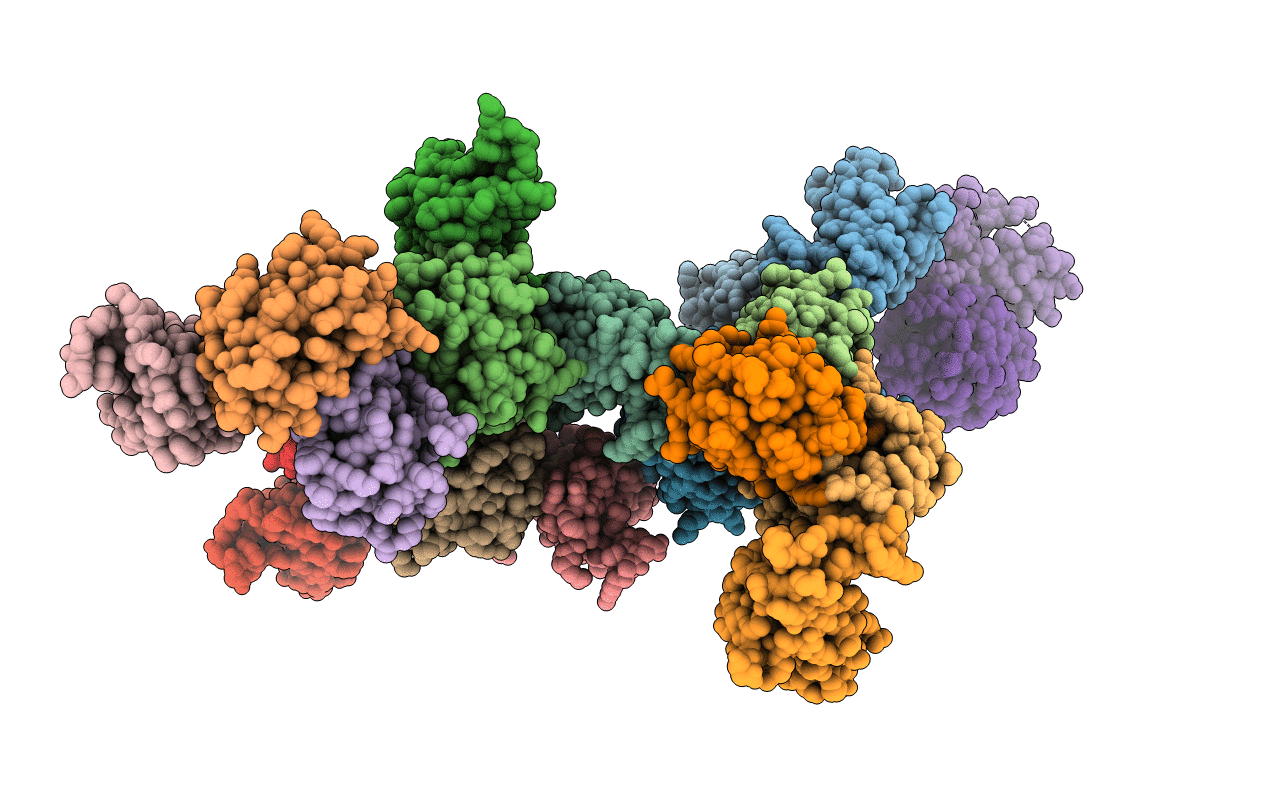
7C3F image
Deposition Date 2020-05-12
Release Date 2020-10-14
Last Version Date 2024-11-06
Entry Detail
PDB ID:
7C3F
Title:
Crystal structure of ferredoxin: thioredoxin reductase and thioredoxin m2 complex
Biological Source:
Source Organism:
Host Organism:
Method Details:
Experimental Method:
Resolution:
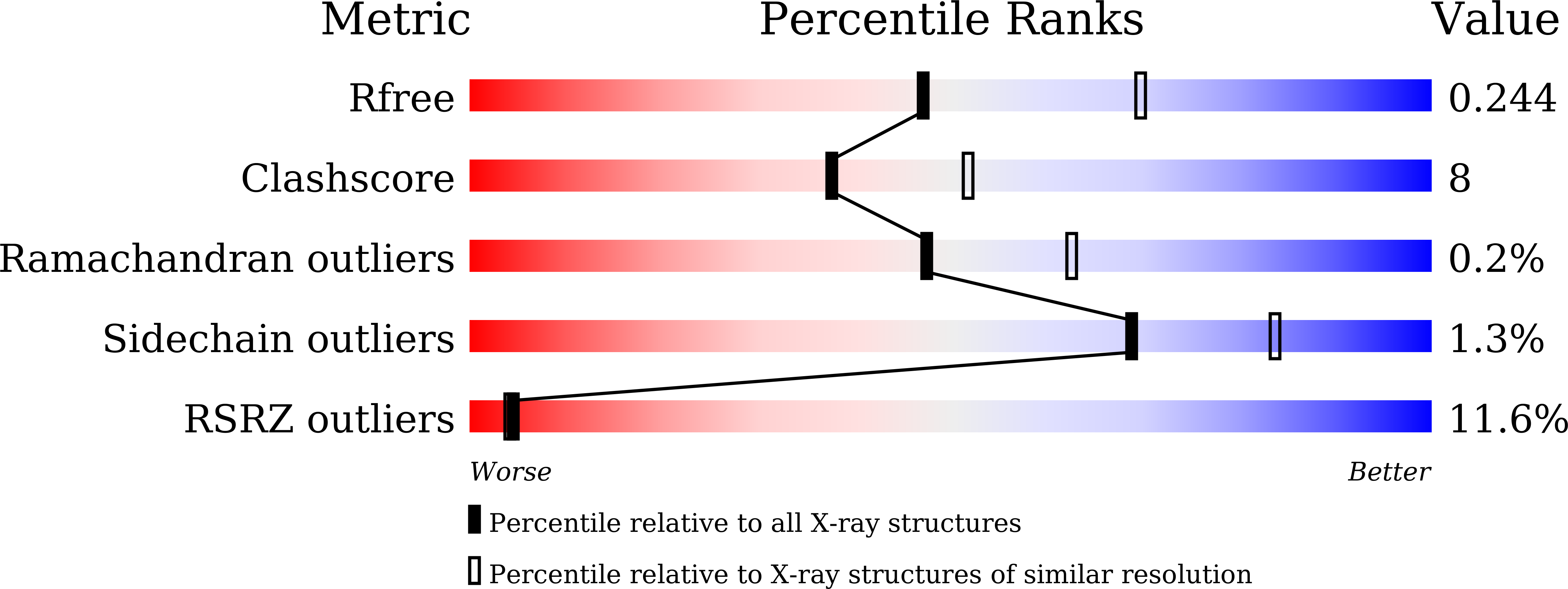
2.40 Å
R-Value Free:
0.24
R-Value Work:
0.20
R-Value Observed:
0.21
Space Group:
C 1 2 1
Macromolecular Entities
Structures with similar UniProt ID
Protein Blast
Polymer Type:polypeptide(L)
Molecule:Ferredoxin-thioredoxin reductase catalytic chain, chloroplastic
Gene (Uniprot):FTRC
Chain IDs:A, D, G, J, M, P, S, W (auth: V)
Chain Length:115
Number of Molecules:8
Biological Source:Arabidopsis thaliana
Structures with similar UniProt ID
Protein Blast
Polymer Type:polypeptide(L)
Molecule:Ferredoxin-thioredoxin reductase variable chain, chloroplastic
Gene (Uniprot):FTRA2
Chain IDs:B, E, H, K, N, Q, T
Chain Length:112
Number of Molecules:7
Biological Source:Arabidopsis thaliana
Structures with similar UniProt ID
Protein Blast
Polymer Type:polypeptide(L)
Molecule:Thioredoxin M2, chloroplastic
Gene (Uniprot):TRXM2
Mutagens:C41S
Chain IDs:C, F, I, L, O, R, U, V (auth: W)
Chain Length:114
Number of Molecules:8
Biological Source:Arabidopsis thaliana
Primary Citation
Structural basis for thioredoxin isoform-based fine-tuning of ferredoxin-thioredoxin reductase activity.
Protein Sci. 29 2538 2545 (2020)
PMID: 33015914 DOI: 10.1002/pro.3964

Abstact

Photosynthetic electron transport occurs on the thylakoid membrane of chloroplasts. Ferredoxin (Fd), the final acceptor in the electron transport chain, distributes electrons to several Fd-dependent enzymes including Fd-thioredoxin reductase (FTR). A cascade from Fd to FTR further reduces Thioredoxin (Trx), which tunes the activity of target metabolic enzymes eventually in a light-dependent manner. We previously reported that 10 Trx isoforms in Arabidopsis thaliana can be clustered into three classes based on the kinetics of the FTR-dependent reduction (high-, middle-, and low-efficiency classes). In this study, we determined the X-ray structure of three electron transfer complexes of FTR and Trx isoform, Trx-y1, Trx-f2, and Trx-m2, as representative examples of each class. Superposition of the FTR structure with/without Trx showed no main chain structural changes upon complex formation. There was no significant conformational change for single and complexed Trx-m structures. Nonetheless, the interface of FTR:Trx complexes displayed significant variation. Comparative analysis of the three structures showed two types of intermolecular interactions; (i) common interactions shared by all three complexes and (ii) isoform-specific interactions, which might be important for fine-tuning FTR:Trx activity. Differential electrostatic potentials of Trx isoforms may be key to isoform-specific interactions.

Legend

Protein

Chemical

Disease

Primary Citation of related structures
Feedback Form
Name
Email
Institute
Feedback