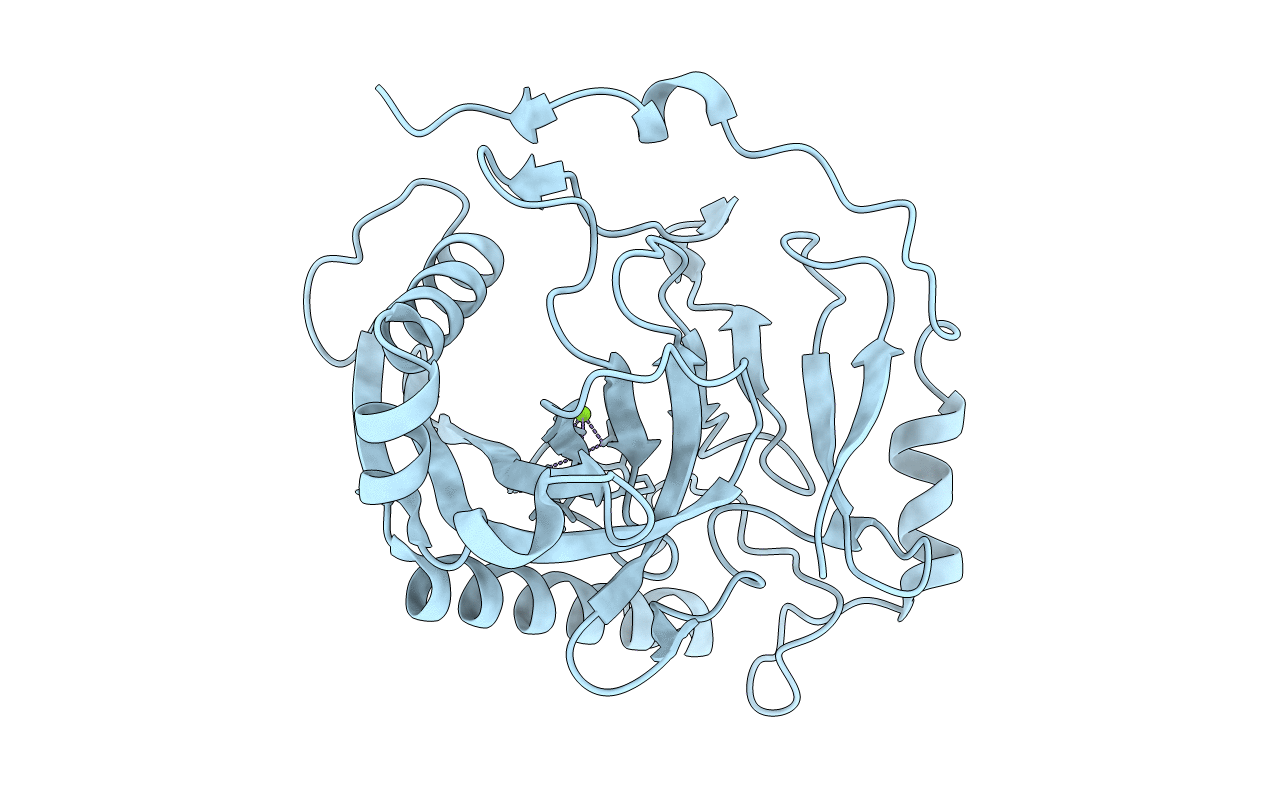
7BTN image
Deposition Date 2020-04-02
Release Date 2020-10-21
Last Version Date 2023-11-29
Entry Detail
PDB ID:
7BTN
Keywords:
Title:
Crystal structure of human inorganic pyrophosphatase with metal ions
Biological Source:
Source Organism:
Homo sapiens (Taxon ID: 9606)
Method Details:
Experimental Method:
Resolution:
2.38 Å
R-Value Free:
0.21
R-Value Work:
0.17
R-Value Observed:
0.18
Space Group:
C 2 2 21

Macromolecular Entities
Structures with similar UniProt ID
Protein Blast
Polymer Type:polypeptide(L)
Molecule:Inorganic pyrophosphatase
Gene (Uniprot):PPA1
Chain IDs:A
Chain Length:309
Number of Molecules:1
Biological Source:Homo sapiens
Ligand Molecules
Primary Citation
Structural and biochemical characterization of inorganic pyrophosphatase from Homo sapiens.
Biochem.Biophys.Res.Commun. 533 1115 1121 (2020)
PMID: 33036755 DOI: 10.1016/j.bbrc.2020.09.139

Abstact

Inorganic pyrophosphatase (PPase) plays an essential role in energy conservation and provides energy for many biosynthetic pathways. Here, we present two three-dimensional structures of PPase from Homo sapiens (Hu-PPase) at 2.38 Å and 3.40 Å in different crystallization conditions. One of the Hu-PPase structures complex of two magnesium metal ions was determined to be a monomer (Hu-PPase-mono) here, while the other one to be a dimer-dimer (Hu-PPase-dd). In each asymmetric unit of Hu-PPase-mono, there are four α-helices and ten β-strands and folds as a barrel structure, and the active site contains two magnesium ions. Like PPases from many species, we found that Hu-PPase was able to undergo self-assembly. To our surprise, disruption of the self-assembly of Hu-PPase did not influence its enzymatic activity or the ability to promote cell growth. Our work uncovered that different structure forms of Hu-PPase and found that the pyrophosphatase activity of Hu-PPase is independent of its self-assembly.

Legend

Protein

Chemical

Disease

Primary Citation of related structures
Feedback Form
Name
Email
Institute
Feedback