7B5G image
Deposition Date 2020-12-03
Release Date 2022-09-14
Last Version Date 2024-11-13
Entry Detail
PDB ID:
7B5G
Keywords:
Title:
Crystal structure of E.coli LexA in complex with nanobody NbSOS3(Nb14527)
Biological Source:
Source Organism:
Method Details:
Experimental Method:
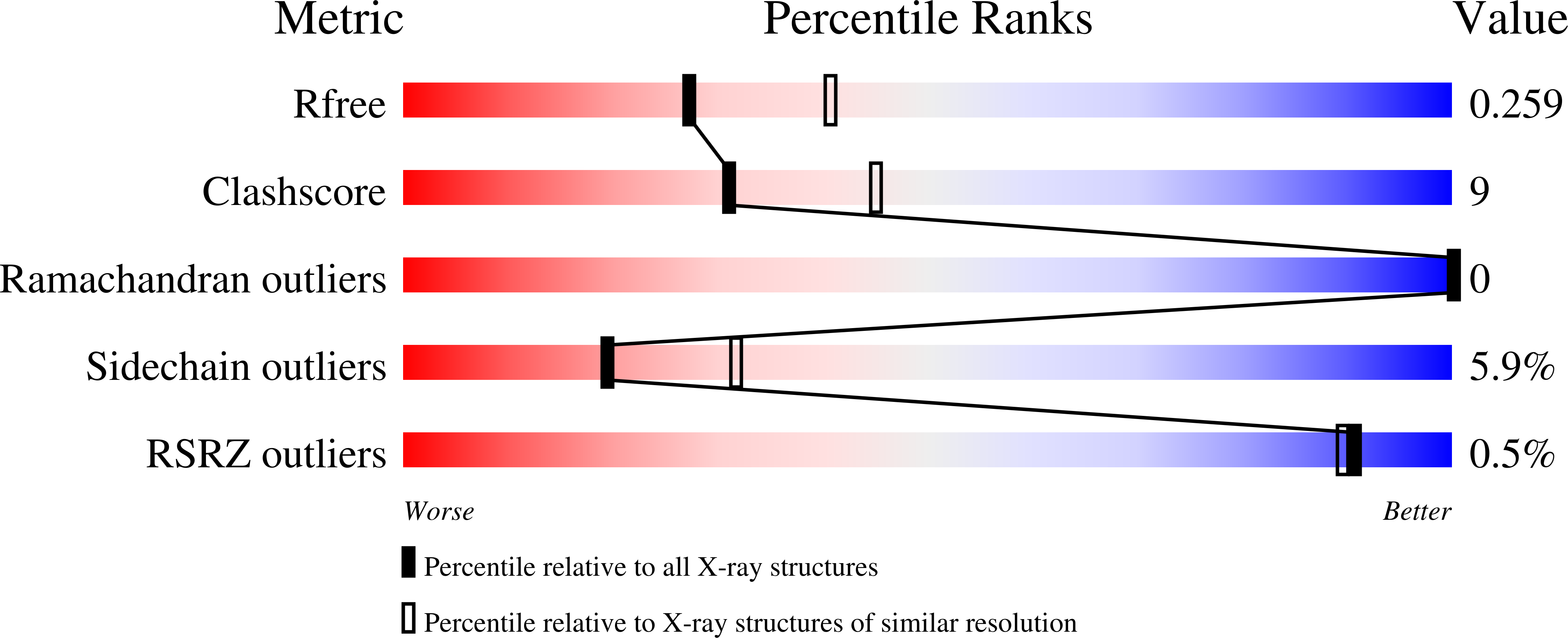
Resolution:
2.40 Å
R-Value Free:
0.25
R-Value Work:
0.20
Space Group:
P 1
Macromolecular Entities
Structures with similar UniProt ID
Protein Blast
Polymer Type:polypeptide(L)
Molecule:LexA repressor
Gene (Uniprot):lexA
Chain IDs:A, C, E, G
Chain Length:202
Number of Molecules:4
Biological Source:Escherichia coli K-12
Polymer Type:polypeptide(L)
Molecule:Nanobody Nb14527, NbSOS3
Chain IDs:B, D, F, H
Chain Length:132
Number of Molecules:4
Biological Source:Lama glama
Ligand Molecules
Primary Citation
Nanobodies targeting LexA autocleavage disclose a novel suppression strategy of SOS-response pathway.
Structure 30 1479 ? (2022)
PMID: 36240773 DOI: 10.1016/j.str.2022.09.004

Abstact

Antimicrobial resistance threatens the eradication of infectious diseases and impairs the efficacy of available therapeutics. The bacterial SOS pathway is a conserved response triggered by genotoxic stresses and represents one of the principal mechanisms that lead to resistance. The RecA recombinase acts as a DNA-damage sensor inducing the autoproteolysis of the transcriptional repressor LexA, thereby derepressing SOS genes that mediate DNA repair, survival to chemotherapy, and hypermutation. The inhibition of such pathway represents a promising strategy for delaying the evolution of antimicrobial resistance. We report the identification, via llama immunization and phage display, of nanobodies that bind LexA with sub-micromolar affinity and block autoproteolysis, repressing SOS response in Escherichia coli. Biophysical characterization of nanobody-LexA complexes revealed that they act by trapping LexA in an inactive conformation and interfering with RecA engagement. Our studies pave the way to the development of new-generation antibiotic adjuvants for the treatment of bacterial infections.

Legend

Protein

Chemical

Disease

Primary Citation of related structures
Feedback Form
Name
Email
Institute
Feedback