7B1S image
Deposition Date 2020-11-25
Release Date 2021-07-14
Last Version Date 2024-01-31
Entry Detail
PDB ID:
7B1S
Keywords:
Title:
Crystal structure of the ethyl-coenzyme M reductase from Candidatus Ethanoperedens thermophilum at 0.994-A resolution
Biological Source:
Source Organism:
Method Details:
Experimental Method:
Resolution:
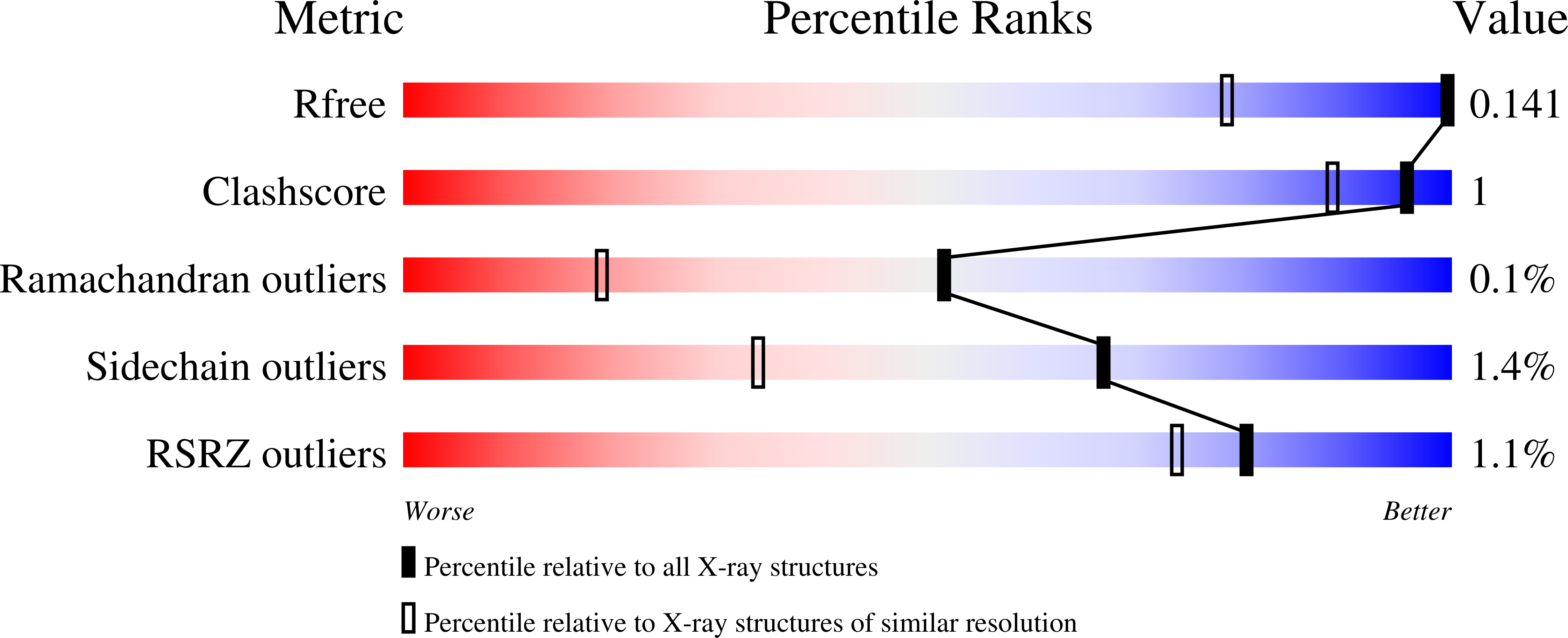
0.99 Å
R-Value Free:
0.12
R-Value Work:
0.11
R-Value Observed:
0.11
Space Group:
P 1 21 1
Macromolecular Entities
Structures with similar UniProt ID
Protein Blast
Polymer Type:polypeptide(L)
Molecule:Ethyl-Coenzyme M reductase alpha subunit
Chain IDs:A, D
Chain Length:595
Number of Molecules:2
Biological Source:Candidatus Ethanoperedens thermophilum
Structures with similar UniProt ID
Protein Blast
Polymer Type:polypeptide(L)
Molecule:Ethyl-Coenzyme M reductase beta subunit
Chain IDs:B, E
Chain Length:467
Number of Molecules:2
Biological Source:Candidatus Ethanoperedens thermophilum
Structures with similar UniProt ID
Protein Blast
Polymer Type:polypeptide(L)
Molecule:Ethyl-Coenzyme M reductase gamma subunit
Chain IDs:C, F
Chain Length:266
Number of Molecules:2
Biological Source:Candidatus Ethanoperedens thermophilum
Primary Citation
Crystal structure of a key enzyme for anaerobic ethane activation.
Science 373 118 121 (2021)
PMID: 34210888 DOI: 10.1126/science.abg1765

Abstact

Ethane, the second most abundant hydrocarbon gas in the seafloor, is efficiently oxidized by anaerobic archaea in syntrophy with sulfate-reducing bacteria. Here, we report the 0.99-angstrom-resolution structure of the proposed ethane-activating enzyme and describe the specific traits that distinguish it from methane-generating and -consuming methyl-coenzyme M reductases. The widened catalytic chamber, harboring a dimethylated nickel-containing F430 cofactor, would adapt the chemistry of methyl-coenzyme M reductases for a two-carbon substrate. A sulfur from methionine replaces the oxygen from a canonical glutamine as the nickel lower-axial ligand, a feature conserved in thermophilic ethanotrophs. Specific loop extensions, a four-helix bundle dilatation, and posttranslational methylations result in the formation of a 33-angstrom-long hydrophobic tunnel, which guides the ethane to the buried active site as confirmed with xenon pressurization experiments.

Legend

Protein

Chemical

Disease

Primary Citation of related structures
Feedback Form
Name
Email
Institute
Feedback