6cn8 image
Deposition Date 2018-03-07
Release Date 2019-06-05
Last Version Date 2023-11-15
Entry Detail
PDB ID:
6CN8
Title:
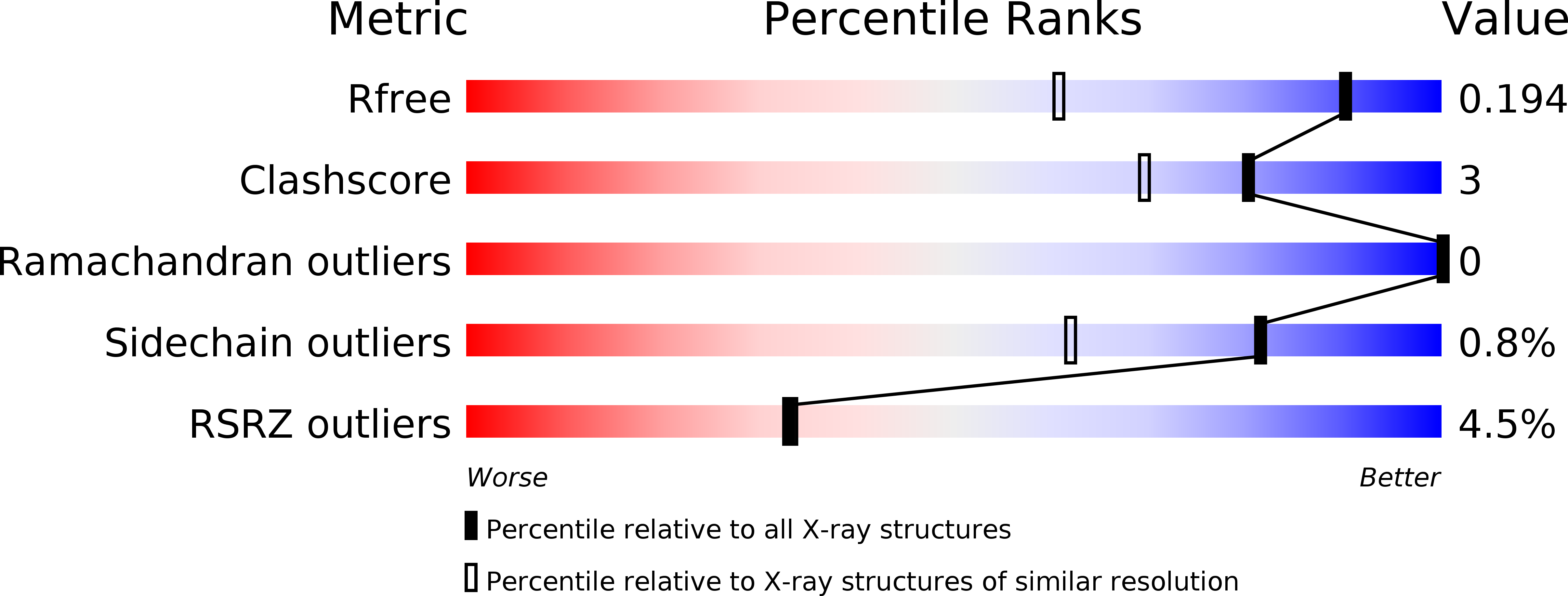
High-resolution structure of ClpC1-NTD binding to Rufomycin-I
Biological Source:
Source Organism:
Host Organism:
Method Details:
Experimental Method:
Resolution:
1.40 Å
R-Value Free:
0.18
R-Value Work:
0.15
R-Value Observed:
0.16
Space Group:
P 41 3 2
Macromolecular Entities
Structures with similar UniProt ID
Protein Blast
Polymer Type:polypeptide(L)
Molecule:ATP-dependent Clp protease ATP-binding subunit ClpC1
Gene (Uniprot):clpC1
Chain IDs:A
Chain Length:158
Number of Molecules:1
Biological Source:Mycobacterium tuberculosis
Polymer Type:polypeptide(L)
Molecule:Rufomycin I
Chain IDs:B
Chain Length:7
Number of Molecules:1
Biological Source:Streptomyces atratus
Peptide-like Molecules
PRD_002306
Primary Citation
High-Resolution Structure of ClpC1-Rufomycin and Ligand Binding Studies Provide a Framework to Design and Optimize Anti-Tuberculosis Leads.
Acs Infect Dis. 5 829 840 (2019)
PMID: 30990022 DOI: 10.1021/acsinfecdis.8b00276

Abstact

Addressing the urgent need to develop novel drugs against drug-resistant Mycobacterium tuberculosis (M. tb) strains, ecumicin (ECU) and rufomycin I (RUFI) are being explored as promising new leads targeting cellular proteostasis via the caseinolytic protein ClpC1. Details of the binding topology and chemical mode of (inter)action of these cyclopeptides help drive further development of novel potency-optimized entities as tuberculosis drugs. ClpC1 M. tb protein constructs with mutations driving resistance to ECU and RUFI show reduced binding affinity by surface plasmon resonance (SPR). Despite certain structural similarities, ECU and RUFI resistant mutation sites did not overlap in their SPR binding patterns. SPR competition experiments show ECU prevents RUFI binding, whereas RUFI partially inhibits ECU binding. The X-ray structure of the ClpC1-NTD-RUFI complex reveals distinct differences compared to the previously reported ClpC1-NTD-cyclomarin A structure. Surprisingly, the complex structure revealed that the epoxide moiety of RUFI opened and covalently bound to ClpC1-NTD via the sulfur atom of Met1. Furthermore, RUFI analogues indicate that the epoxy group of RUFI is critical for binding and bactericidal activity. The outcomes demonstrate the significance of ClpC1 as a novel target and the importance of SAR analysis of identified macrocyclic peptides for drug discovery.

Legend

Protein

Chemical

Disease

Primary Citation of related structures
Feedback Form
Name
Email
Institute
Feedback