6ZG8 image
Deposition Date 2020-06-18
Release Date 2020-09-09
Last Version Date 2025-04-09
Entry Detail
PDB ID:
6ZG8
Keywords:
Title:
bovine ATP synthase rotor domain state 2
Biological Source:
Source Organism(s):
Bos taurus (Taxon ID: 9913)
Method Details:
Experimental Method:
Resolution:
3.49 Å
Aggregation State:
PARTICLE
Reconstruction Method:
SINGLE PARTICLE
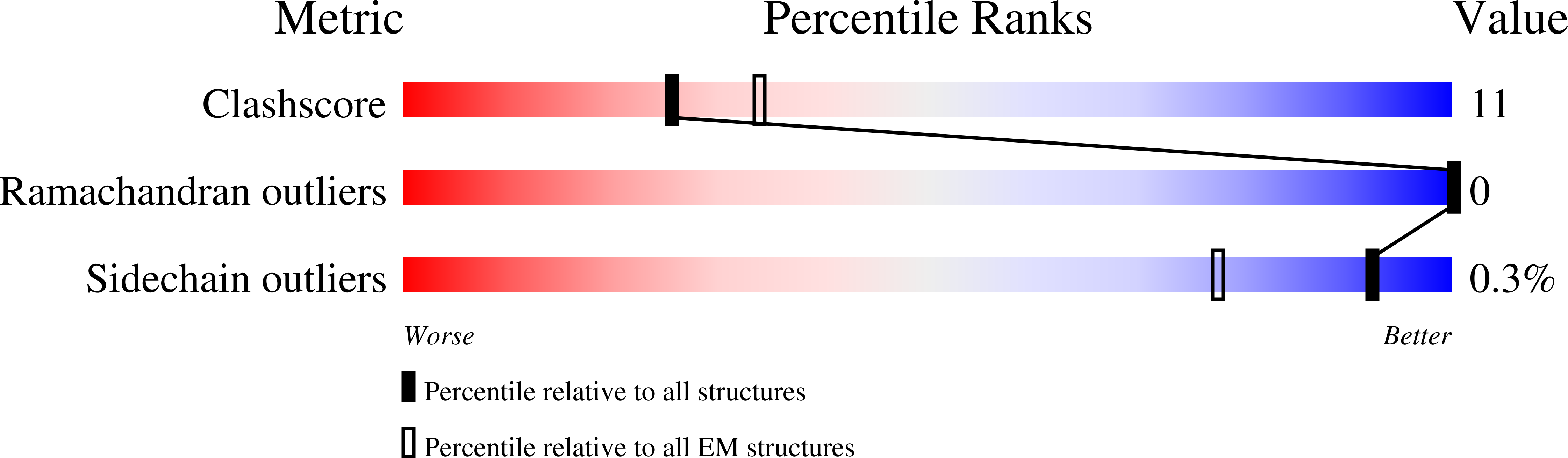
Macromolecular Entities
Structures with similar UniProt ID
Protein Blast
Polymer Type:polypeptide(L)
Molecule:ATP synthase subunit gamma, mitochondrial
Gene (Uniprot):ATP5F1C
Chain IDs:A (auth: G)
Chain Length:273
Number of Molecules:1
Biological Source:Bos taurus
Structures with similar UniProt ID
Protein Blast
Polymer Type:polypeptide(L)
Molecule:ATP synthase subunit delta, mitochondrial
Gene (Uniprot):ATP5F1D
Chain IDs:B (auth: H)
Chain Length:146
Number of Molecules:1
Biological Source:Bos taurus
Structures with similar UniProt ID
Protein Blast
Polymer Type:polypeptide(L)
Molecule:ATP synthase subunit epsilon, mitochondrial
Gene (Uniprot):ATP5F1E
Chain IDs:C (auth: I)
Chain Length:50
Number of Molecules:1
Biological Source:Bos taurus
Structures with similar UniProt ID
Protein Blast
Polymer Type:polypeptide(L)
Molecule:ATP synthase F(0) complex subunit C2, mitochondrial
Gene (Uniprot):ATP5MC2
Chain IDs:D (auth: K), E (auth: L), F (auth: M), G (auth: N), H (auth: O), I (auth: P), J (auth: Q), K (auth: R)
Chain Length:75
Number of Molecules:8
Biological Source:Bos taurus
Modified Residue
Compound ID Chain ID Parent Comp ID Details 2D Image
M3L D LYS modified residue
Ligand Molecules
Primary Citation
Structure of the dimeric ATP synthase from bovine mitochondria.
Proc.Natl.Acad.Sci.USA 117 23519 23526 (2020)
PMID: 32900941 DOI: 10.1073/pnas.2013998117

Abstact

The structure of the dimeric ATP synthase from bovine mitochondria determined in three rotational states by electron cryo-microscopy provides evidence that the proton uptake from the mitochondrial matrix via the proton inlet half channel proceeds via a Grotthus mechanism, and a similar mechanism may operate in the exit half channel. The structure has given information about the architecture and mechanical constitution and properties of the peripheral stalk, part of the membrane extrinsic region of the stator, and how the action of the peripheral stalk damps the side-to-side rocking motions that occur in the enzyme complex during the catalytic cycle. It also describes wedge structures in the membrane domains of each monomer, where the skeleton of each wedge is provided by three α-helices in the membrane domains of the b-subunit to which the supernumerary subunits e, f, and g and the membrane domain of subunit A6L are bound. Protein voids in the wedge are filled by three specifically bound cardiolipin molecules and two other phospholipids. The external surfaces of the wedges link the monomeric complexes together into the dimeric structures and provide a pivot to allow the monomer-monomer interfaces to change during catalysis and to accommodate other changes not related directly to catalysis in the monomer-monomer interface that occur in mitochondrial cristae. The structure of the bovine dimer also demonstrates that the structures of dimeric ATP synthases in a tetrameric porcine enzyme have been seriously misinterpreted in the membrane domains.

Legend

Protein

Chemical

Disease

Primary Citation of related structures
Feedback Form
Name
Email
Institute
Feedback