6ZA8 image
Deposition Date 2020-06-05
Release Date 2021-02-10
Last Version Date 2024-10-16
Entry Detail
PDB ID:
6ZA8
Title:
Crystal structure of the neurotensin receptor 1 in complex with the small-molecule partial agonist RTI-3a
Biological Source:
Source Organism:
Host Organism:
Method Details:
Experimental Method:
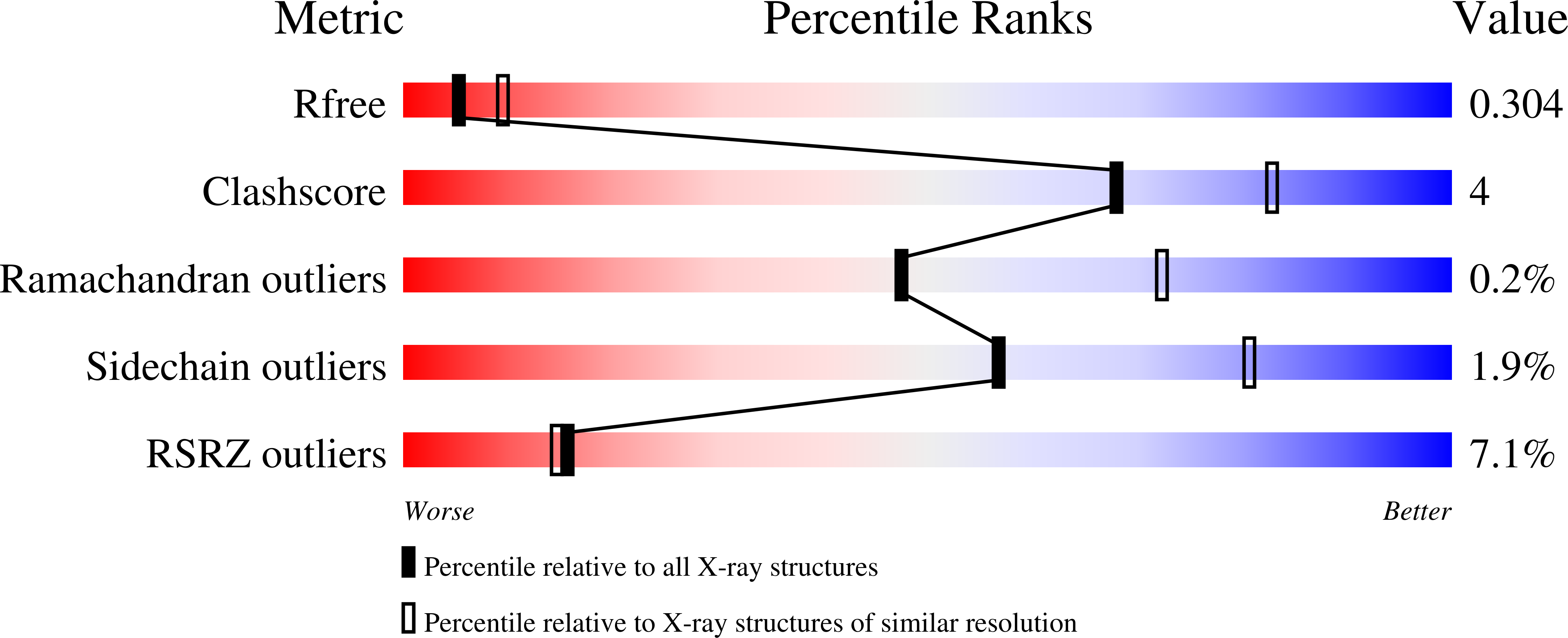
Resolution:
2.72 Å
R-Value Free:
0.30
R-Value Work:
0.28
Space Group:
C 2 2 21
Macromolecular Entities
Structures with similar UniProt ID
Protein Blast
Polymer Type:polypeptide(L)
Molecule:Neurotensin receptor type 1,Neurotensin receptor type 1,Neurotensin receptor 1 (NTSR1),Neurotensin receptor 1 (NTSR1),Neurotensin receptor type 1,Neurotensin receptor 1 (NTSR1),Neurotensin receptor 1 (NTSR1)
Gene (Uniprot):Ntsr1
Mutagens:S83G,A86L,T101R,H103D,H105Y,L119F,M121L,E124D,R143K,D150E,A161V,R167L,R213L,V234L,K235R,V240L,I253A,I260A,N262R,K263R,H305R,C332V,F342A,T354S,F358V,S362A
Chain IDs:A (auth: AAA)
Chain Length:482
Number of Molecules:1
Biological Source:Rattus norvegicus
Ligand Molecules
Primary Citation
Complexes of the neurotensin receptor 1 with small-molecule ligands reveal structural determinants of full, partial, and inverse agonism.
Sci Adv 7 ? ? (2021)
PMID: 33571132 DOI: 10.1126/sciadv.abe5504

Abstact

Neurotensin receptor 1 (NTSR1) and related G protein-coupled receptors of the ghrelin family are clinically unexploited, and several mechanistic aspects of their activation and inactivation have remained unclear. Enabled by a new crystallization design, we present five new structures: apo-state NTSR1 as well as complexes with nonpeptide inverse agonists SR48692 and SR142948A, partial agonist RTI-3a, and the novel full agonist SRI-9829, providing structural rationales on how ligands modulate NTSR1. The inverse agonists favor a large extracellular opening of helices VI and VII, undescribed so far for NTSR1, causing a constriction of the intracellular portion. In contrast, the full and partial agonists induce a binding site contraction, and their efficacy correlates with the ability to mimic the binding mode of the endogenous agonist neurotensin. Providing evidence of helical and side-chain rearrangements modulating receptor activation, our structural and functional data expand the mechanistic understanding of NTSR1 and potentially other peptidergic receptors.

Legend

Protein

Chemical

Disease

Primary Citation of related structures
Feedback Form
Name
Email
Institute
Feedback