6Z4A image
Deposition Date 2020-05-25
Release Date 2020-09-09
Last Version Date 2024-02-07
Entry Detail
PDB ID:
6Z4A
Title:
Structure of the human SAS-6 N-terminal domain, F131E mutant
Biological Source:
Source Organism:
Homo sapiens (Taxon ID: 9606)
Method Details:
Experimental Method:
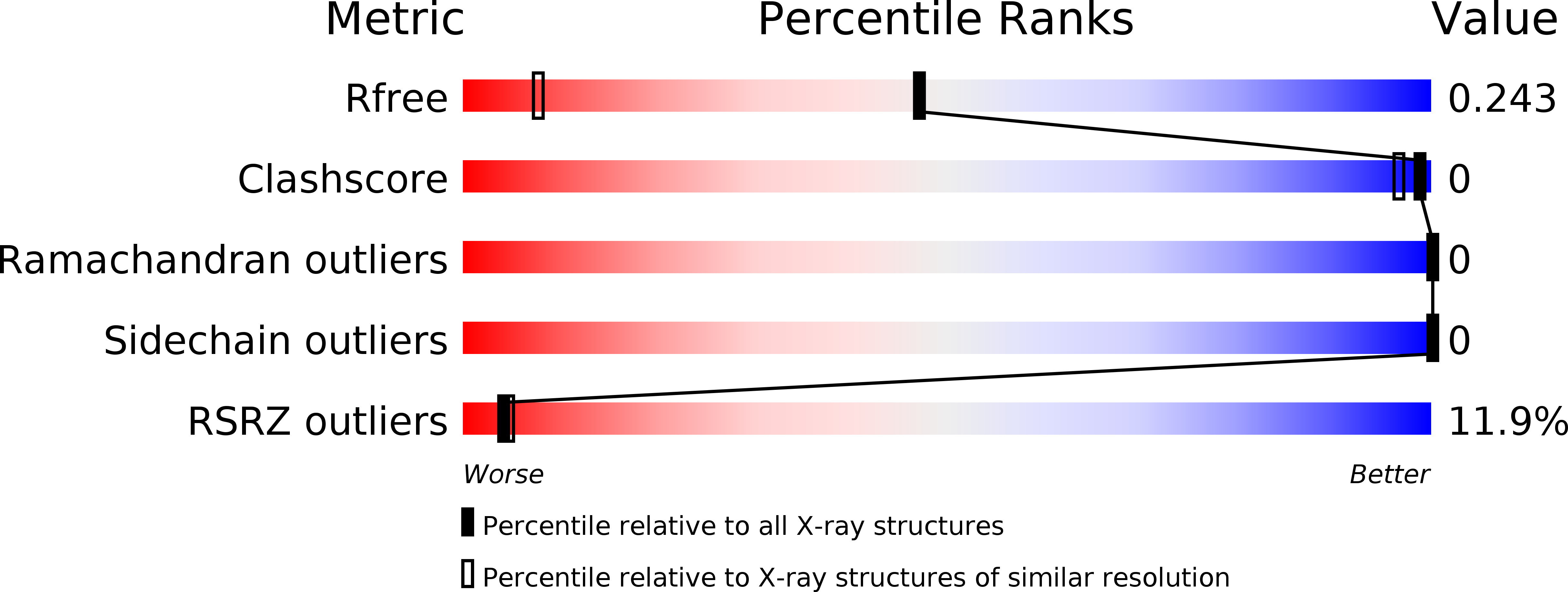
Resolution:
1.46 Å
R-Value Free:
0.23
R-Value Work:
0.19
R-Value Observed:
0.20
Space Group:
P 21 21 2
Macromolecular Entities
Structures with similar UniProt ID
Protein Blast
Polymer Type:polypeptide(L)
Molecule:Spindle assembly abnormal protein 6 homolog
Gene (Uniprot):SASS6
Chain IDs:A
Chain Length:154
Number of Molecules:1
Biological Source:Homo sapiens
Ligand Molecules
Primary Citation
Identification of compounds that bind the centriolar protein SAS-6 and inhibit its oligomerization.
J.Biol.Chem. 295 17922 17934 (2020)
PMID: 32873708 DOI: 10.1074/jbc.RA120.014780

Abstact

Centrioles are key eukaryotic organelles that are responsible for the formation of cilia and flagella, and for organizing the microtubule network and the mitotic spindle in animals. Centriole assembly requires oligomerization of the essential protein spindle assembly abnormal 6 (SAS-6), which forms a structural scaffold templating the organization of further organelle components. A dimerization interaction between SAS-6 N-terminal "head" domains was previously shown to be essential for protein oligomerization in vitro and for function in centriole assembly. Here, we developed a pharmacophore model allowing us to assemble a library of low-molecular-weight ligands predicted to bind the SAS-6 head domain and inhibit protein oligomerization. We demonstrate using NMR spectroscopy that a ligand from this family binds at the head domain dimerization site of algae, nematode, and human SAS-6 variants, but also that another ligand specifically recognizes human SAS-6. Atomistic molecular dynamics simulations starting from SAS-6 head domain crystallographic structures, including that of the human head domain which we now resolve, suggest that ligand specificity derives from favorable Van der Waals interactions with a hydrophobic cavity at the dimerization site.

Legend

Protein

Chemical

Disease

Primary Citation of related structures
Feedback Form
Name
Email
Institute
Feedback