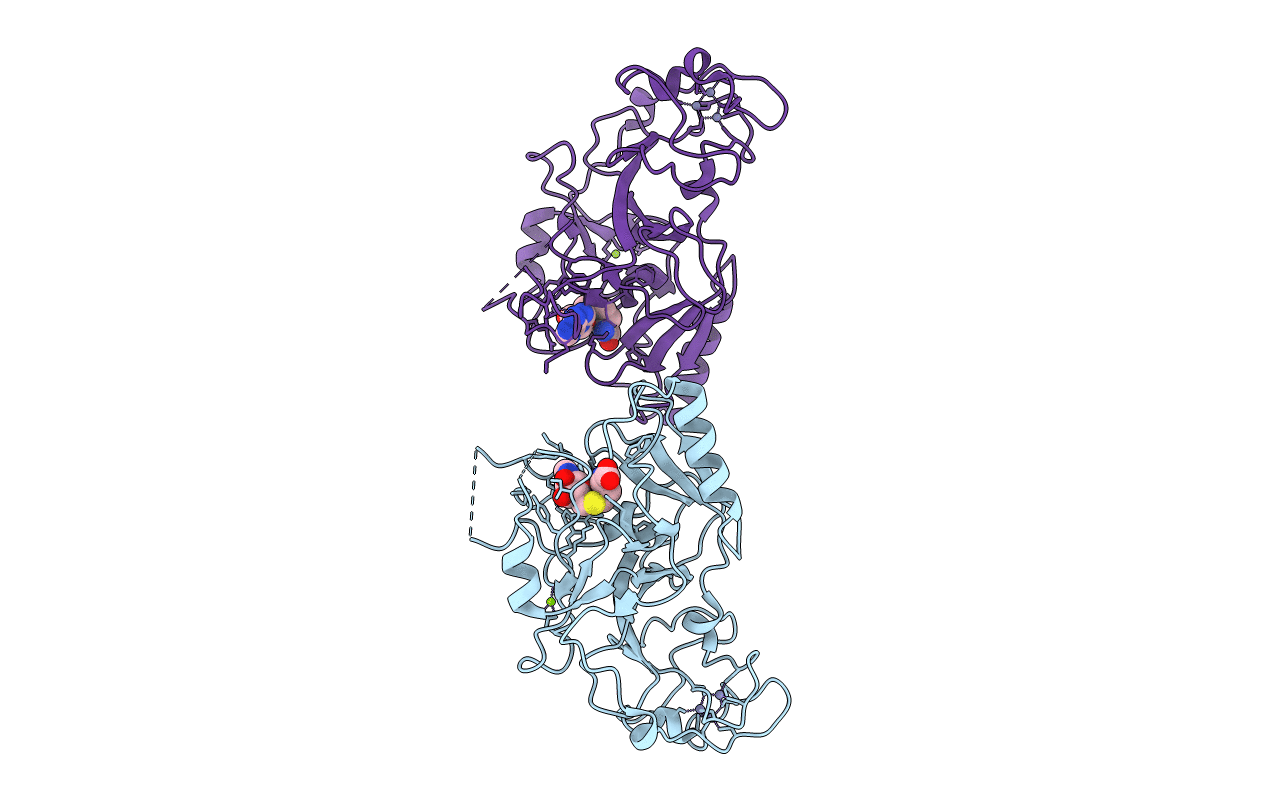
6Z2A image
Deposition Date 2020-05-15
Release Date 2021-05-26
Last Version Date 2025-12-10
Entry Detail
PDB ID:
6Z2A
Keywords:
Title:
Structure of Clr4 mutant - F256A/F310A/F427A bound to SAH
Biological Source:
Method Details:
Experimental Method:
Resolution:
2.46 Å
R-Value Free:
0.24
R-Value Work:
0.23
R-Value Observed:
0.23
Space Group:
P 21 21 2

Macromolecular Entities
Structures with similar UniProt ID
Protein Blast
Polymer Type:polypeptide(L)
Molecule:Histone-lysine N-methyltransferase, H3 lysine-9 specific
Gene (Uniprot):clr4
Mutagens:F256A, F310A, F427A
Chain IDs:A
Chain Length:296
Number of Molecules:1
Biological Source:Schizosaccharomyces pombe (strain 972 / ATCC 24843)
Structures with similar UniProt ID
Protein Blast
Polymer Type:polypeptide(L)
Molecule:Histone-lysine N-methyltransferase, H3 lysine-9 specific
Gene (Uniprot):clr4
Mutagens:F256A, F310A, F427A
Chain IDs:B
Chain Length:294
Number of Molecules:1
Biological Source:Schizosaccharomyces pombe (strain 972 / ATCC 24843)
Primary Citation
SUV39 SET domains mediate crosstalk of heterochromatic histone marks.
Elife 10 ? ? (2021)
PMID: 34524082 DOI: 10.7554/eLife.62682

Abstact

The SUV39 class of methyltransferase enzymes deposits histone H3 lysine 9 di- and trimethylation (H3K9me2/3), the hallmark of constitutive heterochromatin. How these enzymes are regulated to mark specific genomic regions as heterochromatic is poorly understood. Clr4 is the sole H3K9me2/3 methyltransferase in the fission yeast Schizosaccharomyces pombe, and recent evidence suggests that ubiquitination of lysine 14 on histone H3 (H3K14ub) plays a key role in H3K9 methylation. However, the molecular mechanism of this regulation and its role in heterochromatin formation remain to be determined. Our structure-function approach shows that the H3K14ub substrate binds specifically and tightly to the catalytic domain of Clr4, and thereby stimulates the enzyme by over 250-fold. Mutations that disrupt this mechanism lead to a loss of H3K9me2/3 and abolish heterochromatin silencing similar to clr4 deletion. Comparison with mammalian SET domain proteins suggests that the Clr4 SET domain harbors a conserved sensor for H3K14ub, which mediates licensing of heterochromatin formation.

Legend

Protein

Chemical

Disease

Primary Citation of related structures
Feedback Form
Name
Email
Institute
Feedback