6YS9 image
Deposition Date 2020-04-21
Release Date 2020-12-09
Last Version Date 2024-05-01
Entry Detail
PDB ID:
6YS9
Keywords:
Title:
T_926 truncate of ChlH from Thermosynechococcus elongatus at 1.64 A resolution
Biological Source:
Host Organism:
Method Details:
Experimental Method:
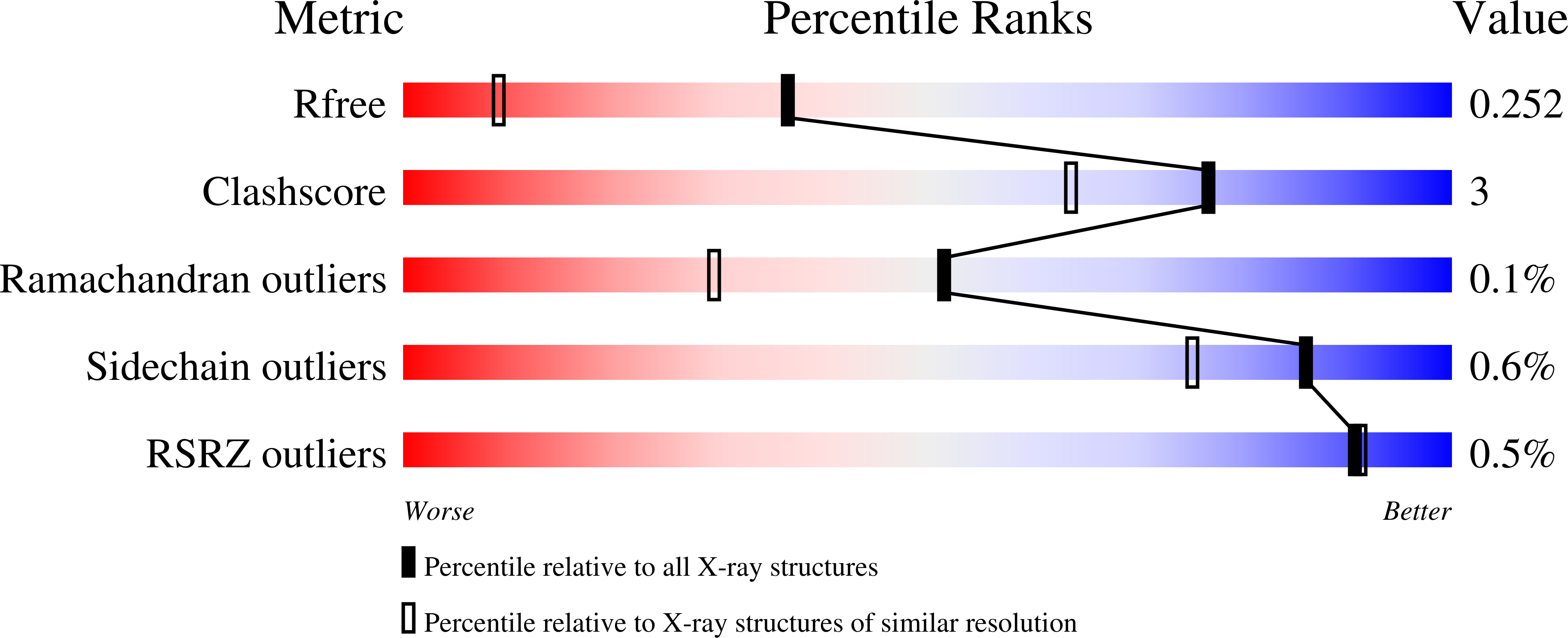
Resolution:
1.64 Å
R-Value Free:
0.24
R-Value Work:
0.20
R-Value Observed:
0.20
Space Group:
P 1 21 1
Macromolecular Entities
Structures with similar UniProt ID
Protein Blast
Polymer Type:polypeptide(L)
Molecule:Magnesium-protoporphyrin methyltransferase
Gene (Uniprot):chlH
Mutagens:Truncated at the N-terminus
Chain IDs:A, B, C, D
Chain Length:410
Number of Molecules:4
Biological Source:Thermosynechococcus elongatus (strain BP-1)
Ligand Molecules
Primary Citation
The active site of magnesium chelatase.
Nat.Plants 6 1491 1502 (2020)
PMID: 33257858 DOI: 10.1038/s41477-020-00806-9

Abstact

The insertion of magnesium into protoporphyrin initiates the biosynthesis of chlorophyll, the pigment that underpins photosynthesis. This reaction, catalysed by the magnesium chelatase complex, couples ATP hydrolysis by a ChlID motor complex to chelation within the ChlH subunit. We probed the structure and catalytic function of ChlH using a combination of X-ray crystallography, computational modelling, mutagenesis and enzymology. Two linked domains of ChlH in an initially open conformation of ChlH bind protoporphyrin IX, and the rearrangement of several loops envelops this substrate, forming an active site cavity. This induced fit brings an essential glutamate (E660), proposed to be the key catalytic residue for magnesium insertion, into proximity with the porphyrin. A buried solvent channel adjacent to E660 connects the exterior bulk solvent to the active site, forming a possible conduit for the delivery of magnesium or abstraction of protons.

Legend

Protein

Chemical

Disease

Primary Citation of related structures
Feedback Form
Name
Email
Institute
Feedback