6YP2 image
Deposition Date 2020-04-15
Release Date 2020-09-23
Last Version Date 2024-11-06
Entry Detail
PDB ID:
6YP2
Title:
14-3-3 sigma with RelA/p65 binding site pS45 and covalently bound TCF521-011
Biological Source:
Source Organism:
Homo sapiens (Taxon ID: 9606)
Host Organism:
Method Details:
Experimental Method:
Resolution:
1.80 Å
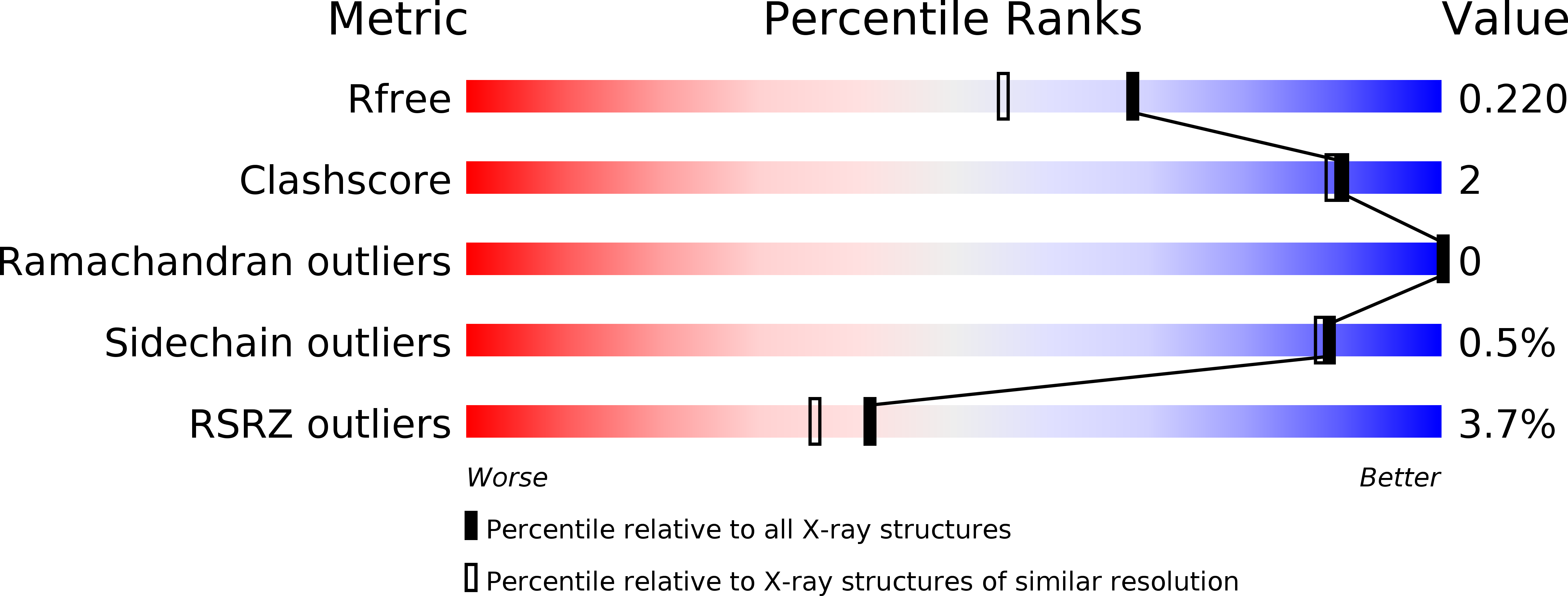
R-Value Free:
0.21
R-Value Work:
0.17
R-Value Observed:
0.17
Space Group:
C 2 2 21
Macromolecular Entities
Structures with similar UniProt ID
Protein Blast
Polymer Type:polypeptide(L)
Molecule:14-3-3 protein sigma
Gene (Uniprot):SFN
Chain IDs:A
Chain Length:236
Number of Molecules:1
Biological Source:Homo sapiens
Structures with similar UniProt ID
Protein Blast
Polymer Type:polypeptide(L)
Molecule:p65pS45
Chain IDs:B (auth: P)
Chain Length:13
Number of Molecules:1
Biological Source:Homo sapiens
Modified Residue
Compound ID Chain ID Parent Comp ID Details 2D Image
CSO A CYS modified residue
Primary Citation
Fragment-Based Stabilizers of Protein-Protein Interactions through Imine-Based Tethering.
Angew.Chem.Int.Ed.Engl. 59 21520 21524 (2020)
PMID: 32816380 DOI: 10.1002/anie.202008585

Abstact

Small-molecule stabilization of protein-protein interactions (PPIs) is a promising concept in drug discovery, however the question how to identify or design chemical starting points in a "bottom-up" approach is largely unanswered. We report a novel concept for identifying initial chemical matter for PPI stabilization based on imine-forming fragments. The imine bond offers a covalent anchor for site-directed fragment targeting, whereas its transient nature enables efficient analysis of structure-activity relationships. This bond enables fragment identification and optimisation using protein crystallography. We report novel fragments that bind specifically to a lysine at the PPI interface of the p65-subunit-derived peptide of NF-κB with the adapter protein 14-3-3. Those fragments that subsequently establish contacts with the p65-derived peptide, rather than with 14-3-3, efficiently stabilize the 14-3-3/p65 complex and offer novel starting points for molecular glues.

Legend

Protein

Chemical

Disease

Primary Citation of related structures
Feedback Form
Name
Email
Institute
Feedback