6YBT image
Deposition Date 2020-03-17
Release Date 2020-09-16
Last Version Date 2024-05-22
Entry Detail
PDB ID:
6YBT
Keywords:
Title:
Structure of a human 48S translational initiation complex - eIF3bgi
Biological Source:
Source Organism:
Homo sapiens (Taxon ID: 9606)
Method Details:
Experimental Method:
Resolution:
6.00 Å
Aggregation State:
PARTICLE
Reconstruction Method:
SINGLE PARTICLE
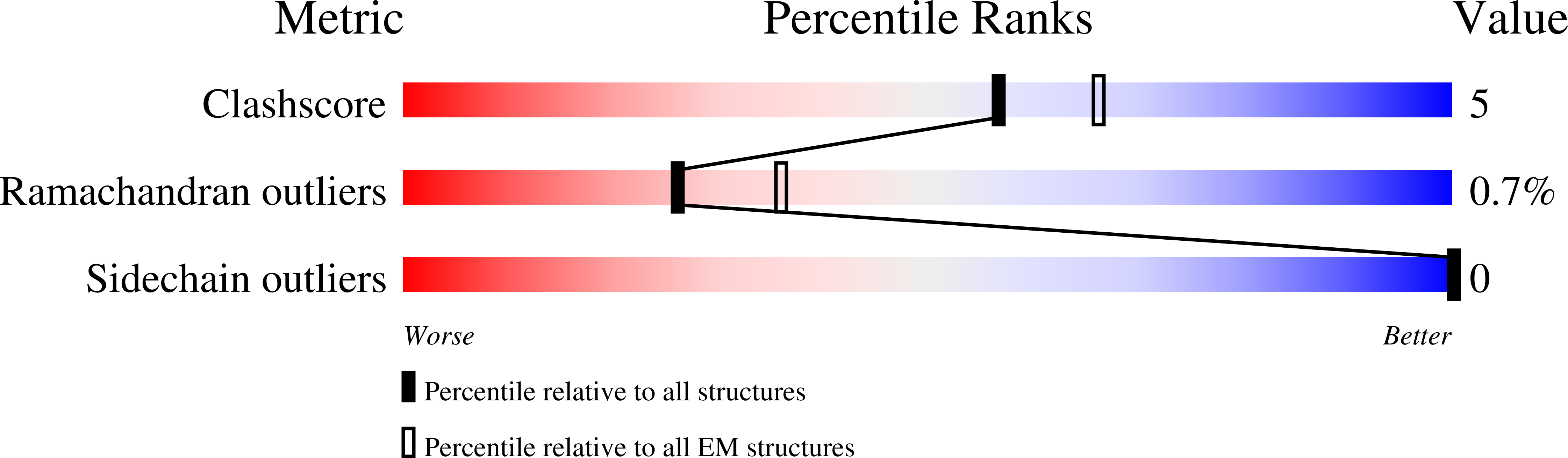
Macromolecular Entities
Structures with similar UniProt ID
Protein Blast
Polymer Type:polypeptide(L)
Molecule:Eukaryotic translation initiation factor 3 subunit B
Gene (Uniprot):EIF3B
Chain IDs:C (auth: 1)
Chain Length:814
Number of Molecules:1
Biological Source:Homo sapiens
Structures with similar UniProt ID
Protein Blast
Polymer Type:polypeptide(L)
Molecule:Eukaryotic translation initiation factor 3 subunit I
Gene (Uniprot):EIF3I
Chain IDs:B (auth: 2)
Chain Length:325
Number of Molecules:1
Biological Source:Homo sapiens
Structures with similar UniProt ID
Protein Blast
Polymer Type:polypeptide(L)
Molecule:Eukaryotic translation initiation factor 3 subunit A
Gene (Uniprot):EIF3A
Chain IDs:A (auth: u)
Chain Length:1350
Number of Molecules:1
Biological Source:Homo sapiens
Ligand Molecules
Primary Citation
Structure of a human 48Stranslational initiation complex.
Science 369 1220 1227 (2020)
PMID: 32883864 DOI: 10.1126/science.aba4904

Abstact

A key step in translational initiation is the recruitment of the 43S preinitiation complex by the cap-binding complex [eukaryotic initiation factor 4F (eIF4F)] at the 5' end of messenger RNA (mRNA) to form the 48S initiation complex (i.e., the 48S). The 48S then scans along the mRNA to locate a start codon. To understand the mechanisms involved, we used cryo-electron microscopy to determine the structure of a reconstituted human 48S The structure reveals insights into early events of translation initiation complex assembly, as well as how eIF4F interacts with subunits of eIF3 near the mRNA exit channel in the 43S The location of eIF4F is consistent with a slotting model of mRNA recruitment and suggests that downstream mRNA is unwound at least in part by being "pulled" through the 40S subunit during scanning.

Legend

Protein

Chemical

Disease

Primary Citation of related structures
Feedback Form
Name
Email
Institute
Feedback