6XRR image
Deposition Date 2020-07-13
Release Date 2020-12-30
Last Version Date 2024-04-03
Entry Detail
PDB ID:
6XRR
Keywords:
Title:
Structure of SciW bound to the Rhs1 Transmembrane Domain from Salmonella typhimurium
Biological Source:
Method Details:
Experimental Method:
Resolution:
1.90 Å
R-Value Free:
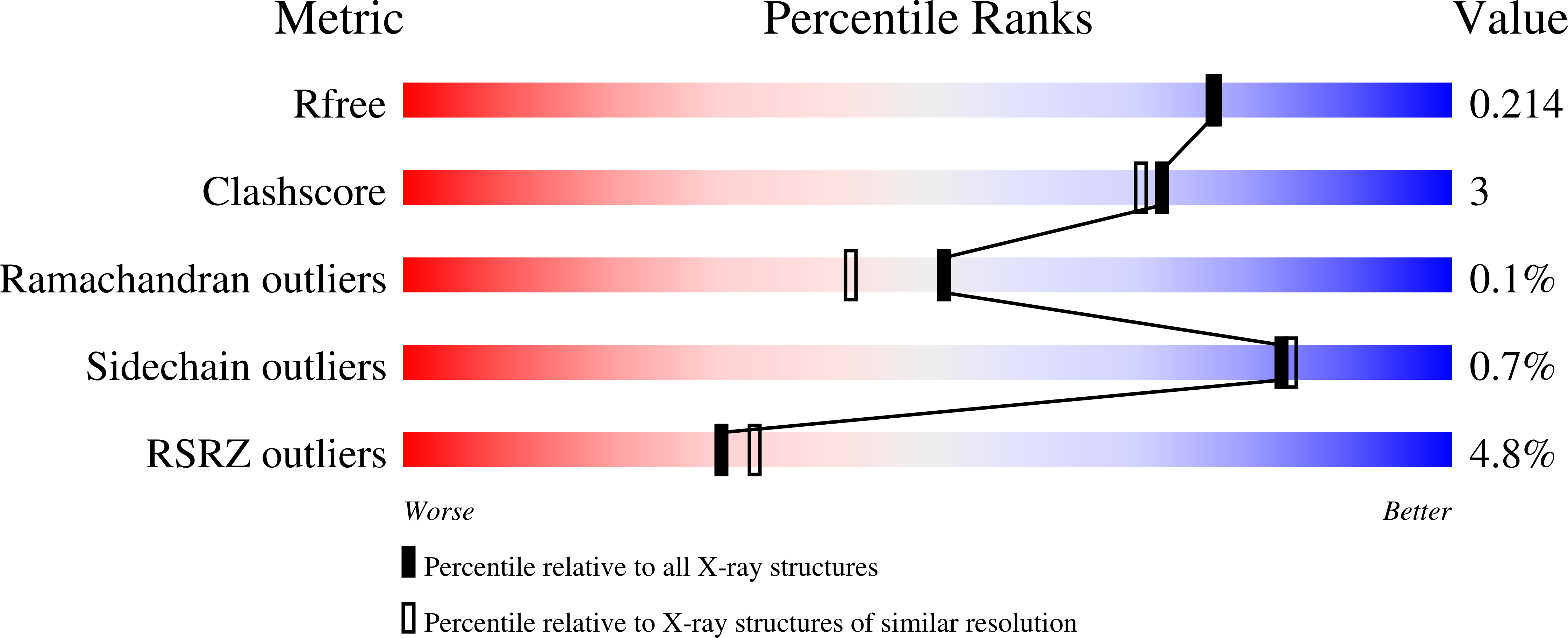
0.21
R-Value Work:
0.18
R-Value Observed:
0.18
Space Group:
P 31 2 1
Macromolecular Entities
Structures with similar UniProt ID
Protein Blast
Polymer Type:polypeptide(L)
Molecule:Putative cytoplasmic protein
Gene (Uniprot):STM0290
Chain IDs:A (auth: E), B (auth: I), D (auth: A), E (auth: B), G (auth: D), H (auth: F), J (auth: H), K
Chain Length:148
Number of Molecules:8
Biological Source:Salmonella typhimurium (strain LT2 / SGSC1412 / ATCC 700720)
Structures with similar UniProt ID
Protein Blast
Polymer Type:polypeptide(L)
Molecule:RHS repeat protein
Chain IDs:C (auth: J), F (auth: C), I (auth: G), L
Chain Length:66
Number of Molecules:4
Biological Source:Salmonella typhimurium
Ligand Molecules
Primary Citation
Structural basis for effector transmembrane domain recognition by type VI secretion system chaperones.
Elife 9 ? ? (2020)
PMID: 33320089 DOI: 10.7554/eLife.62816

Abstact

Type VI secretion systems (T6SSs) deliver antibacterial effector proteins between neighboring bacteria. Many effectors harbor N-terminal transmembrane domains (TMDs) implicated in effector translocation across target cell membranes. However, the distribution of these TMD-containing effectors remains unknown. Here, we discover prePAAR, a conserved motif found in over 6000 putative TMD-containing effectors encoded predominantly by 15 genera of Proteobacteria. Based on differing numbers of TMDs, effectors group into two distinct classes that both require a member of the Eag family of T6SS chaperones for export. Co-crystal structures of class I and class II effector TMD-chaperone complexes from Salmonella Typhimurium and Pseudomonas aeruginosa, respectively, reveals that Eag chaperones mimic transmembrane helical packing to stabilize effector TMDs. In addition to participating in the chaperone-TMD interface, we find that prePAAR residues mediate effector-VgrG spike interactions. Taken together, our findings reveal mechanisms of chaperone-mediated stabilization and secretion of two distinct families of T6SS membrane protein effectors.

Legend

Protein

Chemical

Disease

Primary Citation of related structures
Feedback Form
Name
Email
Institute
Feedback